


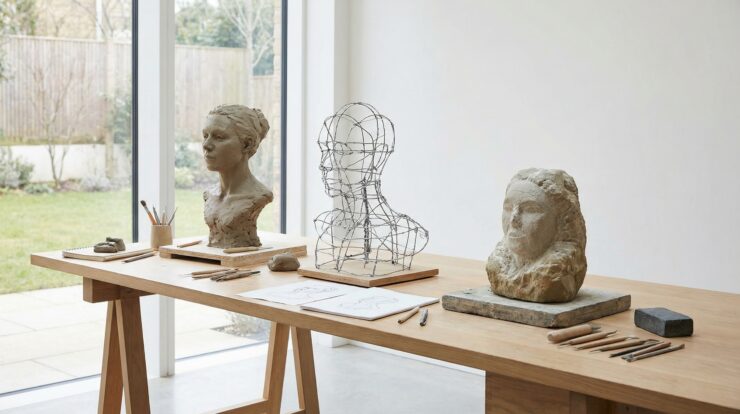
You stare at the half-finished piece on your workbench. The initial burst of inspiration has completely evaporated, replaced by a stubborn, unyielding block. Your entire studio output is suddenly held hostage by this single, difficult artwork.
The solution isn’t to force your way through the frustration or abandon the studio for the day. The secret to continuous momentum is stepping away and letting multiple projects share the burden of your creative energy. While we will focus primarily on the sculptor’s workflow here, this strategy applies just as effectively to painters, photographers, and other artists.
1. The Psychology of the Single-Piece Trap
Working on a single artwork from start to finish creates a high-pressure environment. When you hit a structural or aesthetic wall, the anxiety spikes. Your inner monologue quickly spirals: “Why isn’t this texture working? Am I losing my touch?”
This tunnel vision paralyzes you. Instead of problem-solving, you end up overworking the piece, forcing solutions that lack spontaneity. The psychology here is simple: when your entire studio’s productivity hinges on one stubborn project, the mental weight becomes too heavy to sustain.
2. The 3-to-5 Project Framework
During a recent discussion with an experienced wood sculptor, a brilliant operational strategy emerged. He noted that starting with a piece of character wood always brings great initial ideas, but inevitably, he gets stuck. His solution? He maintains an inventory of three to five active projects at all times.
If you implement this in your own studio, you create an environment of constant workflow. Whether you’re chiseling stone, painting a canvas, or editing a series of photographs, when one piece presents a challenge you aren’t ready to solve, you don’t stop working. You simply pivot.
-
Active Incubation: While your hands are busy on a secondary project, your subconscious is quietly untangling the compositional issues of the first piece.
-
Zero Downtime: Frustration no longer equals a halted studio. You maintain momentum by shifting your focus to an artwork that is currently flowing smoothly.
-
Reduced Attachment: Rotating your attention prevents you from hyper-fixating on minor details, allowing you to return to a difficult piece later with objective, fresh eyes.
3. How to Implement the Pivot
Keeping multiple pieces in play requires discipline. It is not an excuse to leave dozens of artworks half-finished and abandoned in the dark corners of your workspace.
Limit your active rotation strictly to three to five pieces. When you hit a wall, physically set the frustrating piece aside. Place it out of direct sight if necessary. Pick up the next project and immediately begin working. Treat this rotation not as a distraction, but as a deliberate studio mechanism to protect your creative energy.
One Final Takeaway
Your studio time is too valuable to waste staring down a project that refuses to cooperate. By managing a controlled rotation of active pieces, you eliminate artist’s block and ensure that your creative business is always moving forward.
What’s Your Ratio?
How many active projects do you currently have rotating in your studio, and how do you decide when it’s time to switch between them?

This is a great article Jason. I feel like I very well could have written this piece because that is exactly the strategy I employ in my painting studio, for all the reasons you mentioned. And 3 to 5 pieces is the perfect range for me too.
Being able to pivot away from a problematic, difficult, or massive project to work on something easier has saved my artistic confidence many times. Regaining momentum keeps me feeling like I am winning and having fun.
Having a variety of projects in progress also means I can pick the appropriate one to work on, to match my mood, energy level, or schedule on a given day.
Quite often an hour spent working happily on the ‘fun’ finishing phase of a successful piece gives me the confidence to return to tackling the more difficult one.
over time i have occumulated a fair number of works that might fall within such a catagroy, which i have recently been getting back into to finally finish them. all the while revisiting a variety of sculptures inspires revisioning and thoughts of new ideas and directions.
I remember reading about Joshua Reynolds (I think it was, he went to my school) who would work for half an hour on each piece, at the same time each day, so the daylight was consistent.
This doesn’t really work for me, I prefer to finish one piece at a time, but blocks are something I very rarely experience. I find working on several pieces dilutes my energy. We’re all different.
I encountered the magical luxury of the multiple project workflow when I left my art educator career.
It was not the same as the “sketchbook” which was more a repository of thoughts and [ossibilities.
The floodgates of creative energy seemed tto open, and my work really seemed to improve. What I was doing in the second piece triggered what I should try in the others. “Cross-pollination” which had been a mental exercise also became a physical one.
I like the idea of limiting the number of active works. The sketchbook takes care of the fleeting possibilities. The upper limit allows for what I’ve always needed which is contemplation time before finally giving in to pronouncing “Done.”
So much goes on subconsciously and rabbit holes abound. I’ve gotten to the point where I trust that part to do what itv does. The results have been amazing.
In the ABA course the question is “How many pieces do you feel you can produce?” WIth this process in place, I’m shattering my estimate. I process hasn’t changed but the linear sequential nature of one worl at a time means no downtime and sleepless worry.
Quick corrections. Should have finished the morning coffee first! Apologies.
3rd par. “tto” should be “to”.
5th par. “itv” should be “it”. It refers to the subconscious activity.
6th par. “I” should be “My”.
6th par. “worl” should be “work”.
Such a great article! Putting into words what I’ve been feeling. Yes to 3 or more pieces in various stages really helps with the flow. Not just from a creative perspective but also from a work flow. Final touches on a pieces finish doesn’t mesh with cutting and grinding on new work. I’ve found staggering the work flow allows more production. Now, if someone can help me price my work!
Jason, I arrived at a very similar strategy after reading a comment you made about how artists often get blocked when they’re trying to make something “perfect,” rather than trusting their instincts—which frequently leads to stronger work. I believe the phrase you used was to work “as fast as you can.”
I decided to try this approach first with smaller sculptures, and I was amazed at how quickly I was able to complete them—and how much I liked the results. Collectors seemed to respond to them as well, since those pieces sold very well.
I’ve since applied the same concept to my larger works. At the moment, I have four works in progress in my studio, and I routinely rotate between them. When I reach a creative block on one piece, moving instinctively to another keeps the momentum going and often helps the original problem resolve itself.
There has also been an unexpected practical benefit to working this way. I leave my sculptures completed, but not yet “finished.” As a wood sculptor, the final oil finish is applied after completion. Once I finish three to five pieces, I can apply the oil finish to all of them in a single session. This simplifies the process considerably, since I only need to set up the finishing workspace once for multiple sculptures.