


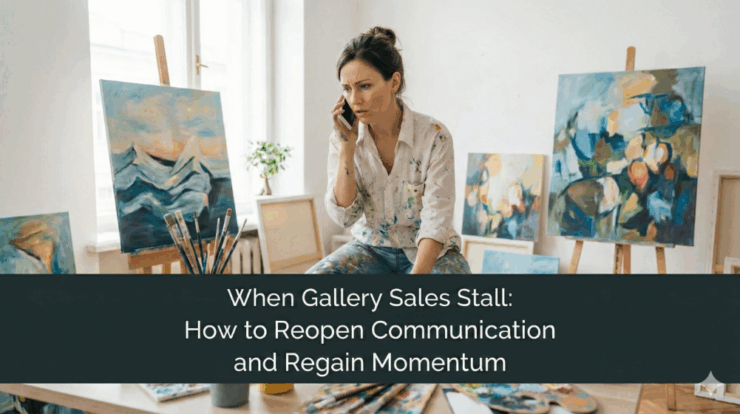
Not long ago, an artist reached out with a familiar dilemma: their work had been in a gallery for over a year without a single sale. They weren’t sure how prominently the pieces were being displayed, whether the gallery staff understood the work, or even whether the relationship was still active in any meaningful way. The question beneath the question was simple: What should you do when a gallery relationship goes quiet?
It happens more often than artists realize. Even in solid gallery partnerships, seasons ebb and flow, staff turns over, and inventory rotates. The worst thing an artist can do is go silent and assume everything is fine—or assume the gallery is the problem. When communication stalls, so do sales.
Here’s how to reopen the conversation and re-energize the relationship in a healthy, productive way.
Start With Communication, Not Suspicion
When a year passes with no sales, it’s tempting to imagine the worst: maybe the gallery isn’t showing the work, or they’ve lost enthusiasm, or they’ve tucked everything in the back room. Those scenarios can happen, but jumping to conclusions puts you in the wrong mindset from the start.
A simple conversation is almost always the better path. Reach out and say something like:
-
“I’ve been thinking about how things are going and wanted to check in.”
-
“Is there anything you need from me that would support sales?”
-
“Would a fresh set of pieces help?”
-
“What are you seeing from your collectors right now?”
These questions open the door without creating tension. They signal partnership. They also give the gallery a chance to say things you wouldn’t otherwise know: maybe they’ve had staff changes… maybe their foot traffic has shifted… maybe they need updated inventory… or maybe they’ve actually had interest but haven’t been in touch.
You won’t know until you ask.
A Quiet Check-In Can Help—But Don’t Turn It into a Spy Mission
Artists sometimes send a friend to the gallery to see how the work is displayed. There’s nothing inherently wrong with that. A discreet visit can give you a general sense of the presentation, pricing, and enthusiasm level.
But the mindset matters.
If you think of it as a covert operation, it shifts you into an adversarial posture. That emotional shift can bleed into every interaction afterward. A friend’s visit is simply a way to gather context, not evidence for a courtroom drama.
The most important information still comes from talking directly to the gallery.
Why Time Matters: Don’t Let Months Turn Into Years
Quiet periods happen. But letting long stretches pass without communication is one of the fastest ways to watch a gallery relationship quietly fade.
Here’s what often happens behind the scenes:
-
When work isn’t selling, a gallery may rotate newer or more active pieces into prime spots.
-
If communication with an artist has gone cold, the gallery may assume the artist is disengaged.
-
Valuable wall and floor space is constantly in demand; if work hasn’t moved in a while and no conversation is happening, it tends to migrate to the storage racks.
-
Once artwork is in the back room, the odds of a sale drop dramatically simply because fewer collectors ever see it.
None of this is malicious. It’s just the natural flow of a busy gallery. The antidote is consistent, constructive conversation.
A quarterly check-in is usually enough. It keeps the relationship fresh and ensures the gallery is thinking about your work—and knows you’re thinking about them.
Approach the Conversation as a Partner, Not a Critic
A good question to ask yourself before contacting a gallery is: What outcome do I want?
If the goal is to restart momentum, the approach needs to be collaborative. Instead of questioning what the gallery hasn’t done, position yourself as someone who wants to help create success. For example:
-
“I’m about to start a new series—would you like to see some previews?”
-
“Would a mix of sizes help you appeal to more buyers?”
-
“Are there trends you’re noticing that I could respond to in my work?”
-
“Is there anything your collectors have been asking for that I might be able to create?”
These questions show initiative and interest. They also give the gallery a chance to re-engage with your work in a fresh way.
Be Ready for Any Outcome
A stalled period may lead to one of several outcomes:
1. The gallery may say, “Let’s refresh your inventory.”
Great. Momentum often returns as soon as new work arrives.
2. They may reassure you that cycles ebb and flow.
Also great. Sometimes the next sale comes right after the conversation.
3. They may admit they haven’t found the right collector base.
This is valuable information. You can decide together whether it makes sense to keep trying.
4. They may acknowledge that things aren’t working.
Disappointing, yes—but far better than letting another year slip by unnoticed. Ending a stagnant relationship frees you to seek better opportunities.
The Bottom Line
Gallery relationships thrive on communication, transparency, and shared effort. When sales stall, your best move isn’t to worry, assume the worst, or wait for something to magically change. It’s to re-open the conversation with curiosity and care.
A gallery partnership is most successful when both sides are engaged, proactive, and invested in the next sale. The moment you take that first step to reconnect, you set the stage for momentum to return.
