


I often hear a specific phrase from artists, usually delivered with a heavy sigh of resignation: “I am not a natural salesperson.”
It is a feeling that plagues the creative community. We look at those individuals who seem born ready to sell—the ones who made fortunes at their childhood lemonade stands or were entrepreneurial wizards in high school—and we feel a sense of inadequacy. Because we have to work so hard at it, we assume we are just not cut out for the commercial side of art.
But I want to challenge that assumption. In my experience running a gallery, I have found that “natural salespeople” are rare. The vast majority of successful sales are not the result of a genetic gift, but rather the result of a learned skill set.
If you can learn to paint, sculpt, or draw, you can learn to sell.
Sales as a Technical Skill
Consider the technical proficiency required to create your work. You likely weren’t born knowing how to perfectly blend oil paints, how to execute complex perspective, or how to weld bronze. You had a vision, and you cultivated the technical skills required to express that vision. You studied, you practiced, and you failed until you succeeded.
Selling is no different. It is a technical process comprised of specific, learnable components:
-
Building Relationships: Learning how to greet someone warmly.
-
Engendering Trust: Establishing credibility.
-
Education: Teaching the client about the work.
-
Closing: Knowing how to ask for the sale.
-
Resolving Concerns: Navigating hesitation.
These are not mysteries; they are mechanics. Just as you learned the mechanics of your medium to serve your creative vision, you can learn the mechanics of sales to serve your commercial vision.
If you are looking for a roadmap to navigate this territory, I actually wrote the manual on it a few years back. In my book, How to Sell Art: A Systematic Approach to Creating Relationships with Collectors and Closing the Sale, I break down these mechanics into concrete steps. I wrote it because I saw so many artists struggling to find a consistent process. Just like a textbook on color theory helps you mix paints, having a systematic approach to sales helps you mix the right ingredients to connect with a collector.
The “Split Personality” Technique
One of the biggest hurdles artists face is their own humility. As an artist, you are likely hyper-critical of your own work. You see the flaws; you see where there is room for improvement.
However, to sell effectively, you almost need the polar opposite mindset. In the moment of the sale, the piece of art on the wall needs to be treated as the greatest object in the known universe.
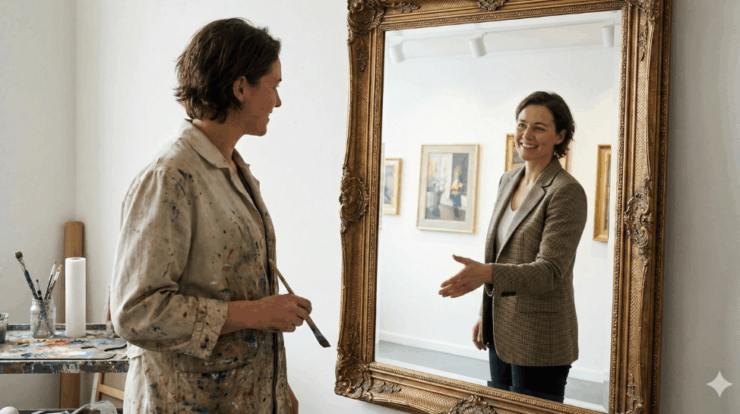
How do you reconcile these two opposing views? I suggest adopting a “Split Personality” approach. You must separate The Creator from The Advocate.
-
The Creator is introspective, humble, and critical.
-
The Advocate is objective, enthusiastic, and bold.
When you are at an art festival or a gallery opening, leave The Creator in the studio. Step into the role of The Advocate. It can even be helpful to speak about yourself and your work in the third person or from a detached perspective. This allows you to brag about the technique, the composition, and the emotion of the piece without triggering your personal modesty.
Dress for Success: The Non-Verbal Sale
Before you ever speak a word about your art, you have already begun the sales conversation. Trust is the currency of the art world, and trust is often established visually.
It may seem superficial, but hygiene and attire matter. People want to be around people who are put-together. If you are well-groomed and dressed appropriately for the venue, you signal that you are a professional. You remove the subconscious barriers that make buyers hesitate. You want to present a welcoming, non-threatening, and attractive persona. If you look the part, the client is more likely to listen to the part.
The Narrative Approach: Ditch the Script
A common request I get from artists is for “scripts”—specific lines to say when a client asks a certain question. While it is good to be prepared, rigid scripts are often a trap. We are not actors. If we memorize a script, we get nervous about “flubbing our lines,” and that anxiety kills the connection.
Instead of a script, focus on the Narrative. Focus on your “Why.”
-
Why do you use that specific fan brush?
-
Why did you choose that subject matter?
-
Why does this lighting fascinate you?
Passion covers a multitude of sales sins. You might not be the smoothest closer in the world, but if you are genuinely enthusiastic about the story behind the work, that excitement is contagious. If you can get the client to connect with the reason the art exists, they are far more likely to want to live with it.
A Practical Exercise
The prospect of learning an entire new profession (sales) can be overwhelming. So, don’t try to master it all at once.
For your next open studio, art fair, or gallery attendance, pick one specific skill to focus on.
-
Maybe you just focus on your Introduction: How you greet people when they walk in.
-
Maybe you focus on The Story: Sharing the “why” behind one specific piece.
-
Maybe you focus on the Close: Simply asking, “Would you like to wrap this up?”
Don’t let the pressure to be perfect stop you from improving. I have hired many young staff members over the years who I didn’t initially view as “natural salespeople,” yet I watched them become tremendous assets simply by practicing these fundamentals one by one.
Which part of the sales process causes you the most anxiety, and what is one step you could take to objectify that fear? Leave a comment below.

Most anxiety- closing. I’ve worked as a salesperson. I understand building relationship and trust. My downfall is closing.
I somewhat freeze when someone says I love that painting! They next ask the price and often say I can’t spend that amount on a painting. I just recently thought this through and it is what I do when I want a painting from an artist and it is above $1000. I ask if I can make payments and ask how much would you allow the payments to be?I have bought three beautiful paintings this way. I can’t get the painting until I pay the full amount but it is worth the wait. So the next time someone says this to me I will offer them a payment plan.
I engage people and introduce myself as the artist and this is my art hanging here. i have found over the years that people who are interested in adding to there art inventory actually look over all the pieces and say i will take that one. I have noticed they don’t look at the price first. This is my experience so far have been doing this for 7 years. I am sure there are areas that i can improve. Jason thank you for the piece very interesting and well written.
Thanks,
Rick Hamilton Artist.