


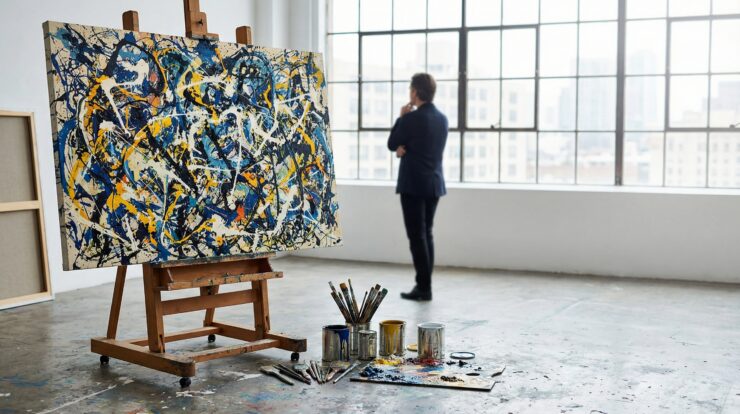
Picture a gallery visitor standing in front of a stunning, complex abstract painting. They tilt their head, squint, and mutter those four dreaded words: “I could do that.”
As a gallery owner, I observe this kind of skepticism regularly. It is a natural reflex for viewers encountering non-representational work or mixed-media pieces where the technical effort isn’t immediately obvious to the untrained eye.
But I have also watched that exact skepticism evaporate in seconds when the buyer discovers the rigorous, deliberate method behind the canvas. Revealing your creative process is not just about sharing a behind-the-scenes peek—it is a highly effective sales strategy.
Lifting the veil on your artistic technique builds undeniable value, proving your mastery and transforming passive onlookers into emotionally invested collectors.
The Psychology of the Skeptical Collector
Many buyers walk into a gallery looking for a connection, but they are terrified of looking foolish. When they look at an abstract piece and cannot immediately decipher the technique, their defense mechanism kicks in.
They assume the work is just random squiggles or carelessly thrown paint. “Where is the skill in this?” they wonder.
You have to educate them. When you show a collector the steps you took to arrive at the finished piece, you provide them with a critical intellectual foothold. You give them the vocabulary to understand your work and, more importantly, the confidence to buy it.
Understanding your process makes the collector feel like an insider. It adds a rich narrative to the physical object that they can later share with friends who visit their home.
The Jackson Pollock Proof
If you worry that showing your process ruins the magic, consider a legendary story about Jackson Pollock. He once had a skeptical reporter in his studio who implied his drip paintings were just random, talentless splashing.
Pollock did not write a thesis to defend his work. Instead, he expertly flicked a glob of paint across the room, landing it precisely on the door handle as he ordered the reporter to get out.
He demonstrated absolute, deliberate control over a medium that looked chaotic to the layman. There was real forethought, rigorous skill, and hard-earned experience driving every drop of paint.
When you pull back the curtain on your own studio practice, you are executing your own version of the doorknob flick. You are proving that your abstraction is intentional, complex, and irreplicable by an amateur.
Strategic Ways to Pull Back the Curtain
You do not need to give away your deepest trade secrets to build value. You just need to show enough of the journey to prove the destination was earned.
Here are a few pragmatic ways to document your process and engage collectors:
-
Time-Lapse Progressions: Compress forty hours of painting into a thirty-second video to showcase your immense patience and the sheer volume of transparent layers involved.
-
Compositional Planning: Share the digital sketches, Photoshop mockups, or pencil thumbnails you meticulously create before ever touching a brush to the final canvas.
-
Scale and Tools: Post photos of your workspace showing the massive, specialized brushes you use, or the unique way you mix your pigments.
-
The Backstory: Share a brief anecdote about the specific inspiration or even the physical hurdles you overcame to complete the piece.
Final Takeaway
Never assume a buyer intuitively understands the difficulty of what you do. The creative process you take for granted is absolutely fascinating to a non-artist.
By treating your artistic process as a marketing asset rather than a closely guarded secret, you strip away collector hesitation. You replace their skepticism with awe, making it infinitely easier to justify your price point and close the sale.
Question for Readers
Have you ever had a piece sell specifically because you shared the story or a video of how it was made? What parts of your process do your followers respond to the most?

Hey Jason,
So trying to apply this to my photography work. Shots of me in the field? Sitting at my computer? Watching the print roll off the printer? Seems a bit lightweight and photography is ubiquitous, what makes it special is technical knowledge and an understanding of light quality. Thoughts?
Hi Michael,
Nicki French here . . . I am a photographer too . . . Here are some thoughts of what you can share . . .
1) A time lapse video from the start to finish of one photo . . . If you’re shooting early morning, show getting your gear, clothing, etc, the night before . . . Getting up in the morning getting ready, grabbing a coffee, juice, etc . . . Getting in the car and traveling to the location . . . Once at the location, show yourself looking around at the conditions, location to set up, etc . . . Show getting your gear from the vehicle . . . Show setting up for the shot . . . show if your shutter speed is too slow, too fast, etc . . . show taking the shoot . . . and do this with every step you take . . . not all the time just on a shoot you truly want to show these details
2) Sometimes, when I am shooting in the field, I have one idea of what I have wanted to capture, but the wind may blow in a different direction, and change the cloud cover, so now, I need to look at the shoot differently. I think that’s important to share with your viewers.
3) What have been your failures and your successes on a particular shoot and why?
4) If I am shooting still life, I sometimes sketch out my ideas (I have yet to share them).
5) If you’re shooting landscape, maybe choose something within the scene and zoom in on the object you’ve chosen, and share how the object fits into the scene, but may be missed, if you only concentrate on the whole view in front of you and not the various objects.
6) Why do you use the photography tools you use, and how do they assist you in creating the shot you’ve chosen.
I can think of all these ideas, it’s just getting over the next hurtle of actually sharing this with my viewers.
I wish you the best.
Take care,
Nicki
Thank you Jason. Trully very helpful advice.
You are awesome!
I am a surrealist oil painter. I used to define my myself as a surreal cartoonist but the self imposed title diminished my work. I used it to excuse the unfinished or under developed vision that I did not fully develop.
Then I I found Theobot to describe my work back to me. It remarkably pointed out areas of my work where I should focus to improve.
Example “ while the sketch-like lines and unfinished areas add a sense of spontaneity and rawness. The background employs gentle gradients of color, subtly separating the figures from the environment without distracting from the central narrative.
This piece effectively captures motion and emotional intensity through gesture and form, inviting viewers to explore the relationships amongst the figures. The blending of defined and less defined elements creates a tension that encourages engagement and interpretation. To build on these strengths, consider experimenting with contrasts in texture or sharper focal points to guide the viewer’s eye more decisively through the composition. Greater variation in light and shadow could enhance the three-dimensionality of the forms and deepen the emotional impact. The sense of intimacy and fluid connection among the figures is compelling; further exploring these human interactions through color and detail would enrich the storytelling. Overall, this artwork is a thoughtfully executed piece that thrives on its expressive gestures and emotive ”
I find it useful.
Holly BURGUIÈRES
Yes, and it still surprises me every time. I shared multiple short videos, on Instagram and FB, of an alla prima portrait I was working on, just a loose, in-the-moment study. A new client saw it, connected with the energy of the process, and ended up commissioning a large portrait of her granddaughters on horseback.
It’s a great reminder that people don’t just fall in love with the finished piece; they fall in love with how it comes to life. The brushstrokes, the decisions, the little moments in between… that’s what really draws them in.
You truly never know who’s watching, or what opportunity might come from simply sharing the work as it unfolds.