


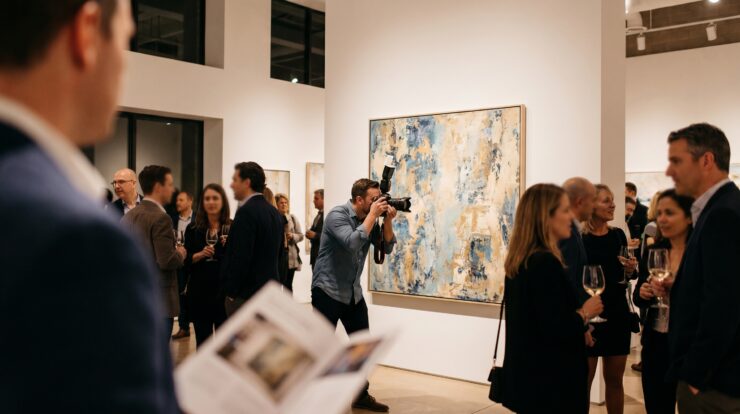
Opening night. The adrenaline is rushing, the wine is flowing, and your artwork is finally up on the walls. You have spent months preparing for this exact moment.
When the doors lock and the last patron leaves, many artists realize they made a critical error. They spent the entire evening bouncing between conversations and soaking in the praise, but they walk away with exactly zero usable photos of the event.
The immediate sales from an exhibition are fantastic, but the long-term value of a gallery opening lies in the marketing collateral you walk away with. Visual social proof is the engine that will drive your future sales, and your opening night is the absolute best time to capture it.
1. The Psychology of the Crowd
Buyers are inherently influenced by the actions of others. When a prospective collector sees your artwork hanging in a pristine gallery space surrounded by a bustling crowd, it triggers immediate psychological validation.
They inevitably look at the image and think, “This artist is in demand. People are actively collecting this work.”
Seeing your pieces in a physical space provides essential context that a tightly cropped image on your website simply cannot achieve. It proves that your work commands attention in the real world.
2. Delegate the Documentation
You cannot be the gracious host, the closing salesperson, and the event photographer simultaneously. If you try to juggle all three, you will fail at least two of them.
You need someone else holding the camera while you work the room. Here is how you execute this:
-
Assign a dedicated photographer: Hire a local professional, or ask a trusted friend with a high-quality smartphone to act as your official documentarian for the night.
-
Stay in the moment: Your primary job is to engage with collectors and close sales. Let your designated photographer worry about the lighting and angles.
-
Step into the frame: Make sure you are actually present in the photos. Buyers want to see the creator standing proudly next to their creations and interacting with the public.
3. The Essential Shot List
Do not leave the photography to chance. Provide your photographer with a specific shot list before the gallery doors open.
-
The Wide Shot: Capture the scale of the room, the layout of the installation, and the sheer volume of attendees.
-
The Engagement: Snap candid photos of visitors pointing at, discussing, or closely examining a specific piece.
-
The Handshake: Photograph yourself interacting with a happy collector, ideally standing next to the piece they just acquired.
-
The Red Dots: Zoom in on the title cards that proudly display a sold sticker. Nothing screams success quite like a cluster of red dots on opening night.
4. Fueling Your Future Marketing
This raw visual data is the exact collateral you need to sustain your marketing efforts for the next six to twelve months.
Writing a newsletter that says, “I just had a highly successful solo show” is fine. Showing an image of a packed gallery with red dots stationed next to your canvases is undeniable proof.
When you approach a new gallery in a different city, these photos prove you have a track record. They demonstrate that you are a serious professional who can draw a crowd, engage an audience, and move inventory.
The Final Takeaway
Your exhibition is a temporary installation, but the documentation of that event will pay dividends for years. Treat the photography of your opening night as a critical business operation, not a casual afterthought.
Who Holds the Camera?
How do you currently handle photography at your gallery openings or art festivals? Do you hire a professional, rely on a friend, or constantly forget to take photos until the event is over? Share your experiences in the comments below.

Brilliant!
Great article. Could you expand on this with a blog on what type of marketing to do with the images over the next 6-12 months?
I’m archiving this blog. It will be part of my show prep folder in an “After party” section. Thank you Jason for taking the time to analyse and organize whar we need to do and why. This pro-actively extends the effect of the show beyond that opening rush.
Thank you for this article Jason, it comes at the right time before my upcoming exhibition. I had already asked a friend, who happens to be a collector and artist herself, to take some photos at my opening with my excellent Samsung. I now forwarded this article to her so she would have a better idea what types of shots to take.
Yes, very timely as I plan a solo show this summer in my own space. I would have completely forgotten to do this! Thanks!
Yes, this is great advice. I’ve always photographed shows. The only thing I would quibble with is photographing specific artworks with red dots. Maybe angle shots that capture portions of paintings with red dots, but that’s all. And here’s why. Most people have such difficulty making that final purchase decision. The money comes from the precious “disposable income” that has so many demands on it. And one of the frequent stalling – or no-purchase excuses is: “Gosh, I’d really love to buy one of your works, but the one I really wanted is sold.” That’s why I NEVER keep sold works on my website – and red dots on wholly visible works do the same thing. They become excuses not to purchase. But getting a good photographer to do crowd shots and shots of handshaking and enthusiasm at your show? Great – and keep those on the website under your “shows” category. It’s terrific pr.