


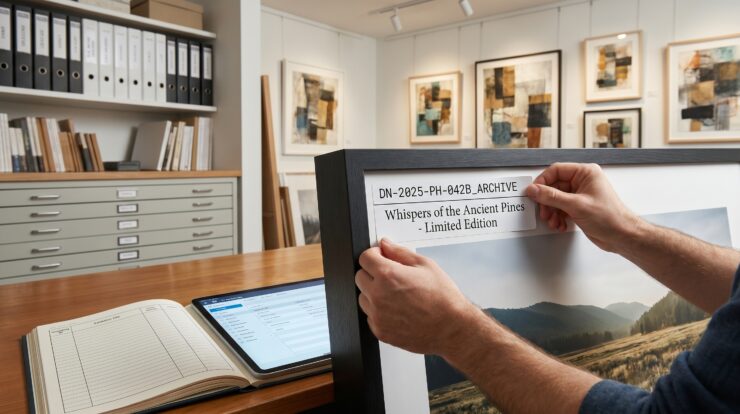
I recently received an email from a prolific photographer trying to manage an archive of over 700 pieces. His problem is one I see repeatedly with high-volume producers, from photographers to mixed-media artists. He had organized his entire inventory using file numbers and broad descriptive categories.
It made tracking his work incredibly efficient for his database and copyright registrations. However, it left him presenting titles like Warm 367R to the public.
As a gallery owner, I can tell you that a title like that is an immediate romance killer for a potential buyer. You need a system that satisfies both the cold logic of your database and the emotional needs of your collectors.
The Psychology of the Numbered Title
We have spoken here many times about the opportunity a title provides. A title is your first chance to convey context, share your inspiration, and begin telling a story. It provides a hook for the viewer to grab onto when they are standing in a gallery experiencing your artwork.
When a collector looks at a label and sees Image #3,741, it does the exact opposite of telling a story. It actively diminishes the perceived value of the piece.
The collector’s internal monologue instantly shifts. “If this is just one of four thousand images, how could there be anything truly special about it?” You never want your buyer to feel like they are purchasing a mere unit from a manufacturing line. We want the artwork to feel singular and special to the person falling in love with it.
A Real-World Example
Even traditional painters and mixed-media artists grapple with this as their inventory builds over a career. I represent an incredibly talented and prolific mixed-media artist. Because he produces at such a high volume, some of his pieces naturally fall into serialized themes.
He has a wonderful series of works featuring vintage matchbooks. Understandably, he does not want to agonizingly invent a completely unique title for every single iteration. For a while, we were receiving inventory logged simply as Matchbook #60 or Matchbook #61.
I eventually had to reach out and ask him to add a subtitle to these pieces. Even if it was something relatively simple like Spirit of the Plains, we needed to do a little bit more for that collector walking into the gallery. That subtle addition transforms the piece from an inventory unit into an experience.
The Two-Tiered Naming Strategy
If you are struggling to balance organization with collector appeal, I highly suggest adopting a two-tiered naming convention. This allows you to scale your production without sacrificing the emotional resonance of your work.
-
The Operational Tier: Maintain your strict keycodes, file numbers, or Library of Congress registration tags on the back end. This is your personal business logic. It ensures you can instantly locate a piece across your databases, shipping logs, and website archives.
-
The Experiential Tier: When a piece is printed, framed, and sent out into the world, it receives its public subtitle. Whether it is heading to a gallery wall or being featured on your website’s primary portfolio, this is where you assign the narrative hook.
-
The Curated Approach: You do not need to publicly title and feature every single image in your 700-piece archive. Treat your website like a curated gallery show. Select the best work, assign those specific pieces evocative subtitles, and leave the raw inventory numbers strictly in your private database.
One Final Takeaway
Inventory management is a crucial part of treating your art as a serious professional business. You absolutely need a systematic approach that makes logistical sense to you. However, you must never let the sterile mechanics of your tracking system leak out onto the gallery floor. Keep your data in your spreadsheet, and give your collectors the romance they came looking for.
What is Your Titling Strategy?
Have you struggled to balance your internal tracking codes with buyer-friendly titles? How do you manage naming your work as your inventory grows? Share your systems and experiences in the comments below.

Great advice Jason! I think this is why AI art will never replace the human artist. We all have an emotional story that goes into our work, from both physical and emotional experience. The experience of being alive. AI will never have that. At least not for a while.
I use my start date code with the title, for example a work I began February 15, 2026 is titled: 021526-“title”. The date code is my inventory code , making a work easy to file chronologically across formats including writings, the artwork, jpg images, etc. since I generally don’t make multiples.
Something you might consider is whether you want a date tied to a piece of art. Could someone looking at it five years later wonder “why didn’t it sell before?”
Interesting point!
I’ve encoded the year in my inventory number, but what I use for work completed in 2026 is 1A so people generally don’t know when a work was completed.
There are many times I have a title before I’ve even started the work. Sometimes months ahead. I find myself imagining the scene and title long before putting a model together. My inventory is numbered but not out in the public eye so much. My latest work on my website is an example of a title that I’ve had for months before starting to paint.
As a landscape painter I am torn between choosing titles that will appeal locally vs titles that will have broader appeal. To date I’ve chosen the former—I’ve noticed people really connect with the specific places in upstate ny where I live and paint. But then I feel I’m limiting myself to local buyers. Do you have any advice about that? Maybe I could think about subtitles that would evoke mood??
I definitely don’t intermix my inventory number with my Title. Even when I only used a spreadsheet to track my art I always had a separate Title to share a bit of my inspiration. When I switched to a formal inventory system it allowed me to record the Title, Inventory number ( which I continued from my prior spreadsheet approach) and a self defined Category. I use the category to identify themes which can help if a customer is interested in a particular theme.
Titling is one of my favorite things. It’s the moment I really sit and look and see what the painting is “about”, the moment I start to understand what it’s saying. It doesn’t happen often but occasionally I’ll retitle something if I haven’t waited long enough to have the proper title revealed. It makes it easy for me as well to remember which painting is which to have a meaningful title. And of course it helps the viewers.
I have been recording my artworks by hand in a notebook. Images are stored on my computer in picture folders. After 2+ years, I need a digital portfolio or archive. Please advise. Suggestions for a simple archive.
Regarding titling. I immediately have a descriptive title, however these tend to be personal, for instance, a real pet’s name used. For my website, I change the name to be more generic to an objective viewer. Example, “Meet Archer” becomes “Playful Pet”
I built a database in which I track my inventory. Each piece gets a unique inventory ID number, which is for my use only. Each piece also gets a title, some of which are more evocative than others.
I don’t need to put my inventory ID on the back of my paintings, since my system allows me to search by title. I also track the year completed, again for my own records, but don’t put that on the painting. If someone asks, I’m happy to tell them when it was painted, but if they don’t care, I see no need to provide the date.
Thanks for another helpful article!
Thanks for this article – it was really useful. Some of my work are in series’ but I’d never thought to subtitle the names. I’m gonna steal that idea!
I quite like naming paintings but am hopeless at inventory. If you have advice on a simple, straightforward system I’d love to hear it. Thanks!
As I am working on a piece, the name emerges as my husband and I talk about it. The names usually reflect the meaning of the piece or the effect it has on the viewer, but not always.
This has backfired only once, so far: I paint landscapes and skyscapes. One of the skyscapes became Godzilla and The Bunny (from Monty Python and the Holy Grail”). Luckily, we both love that piece and it lives on a wall because that title would destroy whatever another viewer sees in it.