


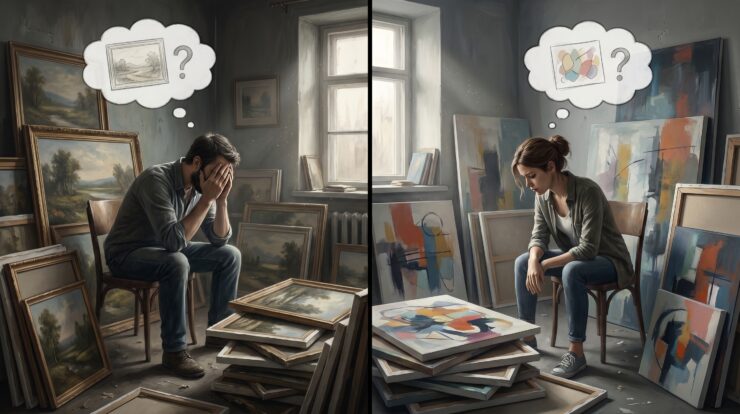
I regularly review artist portfolios, and I watch incredibly talented creators twist themselves into knots over an imagined problem. They bring me bodies of work that are bold, cohesive, and visually striking, yet they are paralyzed by doubt. They look at a few unsold pieces and immediately ask, “Is my style too inconsistent? Is this too interpretive? Do buyers only want traditional work?”
It is a heavy, creative burden to carry. You convince yourself that the market is rejecting your vision. You start wondering if you need to scrap your current direction entirely and paint whatever feels safe.
Let me stop you right there. As a gallery owner, I can tell you that the problem is almost never the art itself. The real reason your work isn’t selling is a mathematical reality that most artists simply refuse to acknowledge.
Stop blaming your aesthetic choices. Your lack of sales is an exposure problem, and it can only be solved by getting your work in front of a higher volume of the right eyeballs.
1. The Invisible Sales Ratio
When I look at my gallery’s annual performance, I see a highly predictable pattern. Over a five or ten-year period, our sales volume is directly driven by our foot traffic.
There is a concrete number that exists for your work: the sales ratio.
Not everyone who sees your portfolio will be interested. Of those who are interested, only a specific percentage will convert into paying collectors.
-
The Total Audience: The raw number of people who physically or digitally view your art on a regular basis.
-
The Attracted Viewers: The subset of that audience whose personal tastes naturally align with your chosen subject matter and medium.
-
The Converted Buyers: The tiny fraction of those interested viewers who are ready, willing, and able to purchase today.
You do not have direct control over this conversion percentage. Your only job is to aggressively feed the top of that funnel.
2. The Trap of Studio Tinkering
When the sales ratio works against us, our natural instinct is to retreat. We go back into the studio and start overthinking the canvas.
We tell ourselves, “If I just make this landscape more realistic, or if I switch from gouache to oil, it will finally sell.”
This is a comfortable lie. Tinkering with your style is emotionally safer than facing the friction of marketing and gallery outreach. It feels like productive work, but it is actually avoidance.
By changing your artistic vision to chase a hypothetical buyer, you dilute the very strength that makes your work compelling in the first place.
3. Optimizing for Eyeballs
If your work is not selling, you are either not in enough venues, or you are in the wrong venues entirely. Fixing this requires a massive shift in your daily energy.
Instead of guessing what a buyer might want, rely on data. Put the work into the world and see where it actually sticks.
-
Audit Your Venues: Are you showing in spaces that naturally attract your target demographic, or are you settling for spaces with low commercial foot traffic?
-
Increase Outreach Volume: Submit your portfolio to more galleries, juried shows, and online platforms. You must push past the initial friction of rejection.
-
Stop Asking Peers for Validation: Other artists are not your buyers. Stop worrying about whether your fellow creatives approve of your specific techniques.
There is a financial and energetic cost to getting this exposure. You have to be willing to pay it if you want to see movement.
One Final Takeaway
There is a market out there for your work exactly as it is right now. You just haven’t found them yet.
Stop constantly evaluating your style and start evaluating your reach. Commit to the aesthetic choices you make, and then relentlessly pursue the audience that will resonate with them.
What’s Your Ratio?
How many non-starters do you typically see before a piece finds its permanent home? Have you noticed a shift in your sales when you actively increase your marketing output rather than changing your art?

This blog could not have come at a more opportune time. I was tempted to raise my hand while reading to convey. “Guilty!” I am at the crossroads. It’s not that I haven’t entered shows, it that shows are the only path I have traveled so far. I hear what you are saying and will expand on my efforts rather than pout and whine about poor sales. Thank you.
I had an art painting student, who did an oil painting scene from Venice. Reflected water, iron railings covered in rose bushes. She sold it, and went on to create another 75 works based on the same theme. Never sold one of the new ones….my advice, paint what is in your heart. Schmidt’s works were off the charts unique, and they all sold at top dollar. Don’t get trapped into the I paint the “whatever theme because it sells”. Great art will always find a home.
Í am with you on this view
Can you share what your ratio is for your gallery? Foot traffic & sales?
I switched to a new medium after years in another, and am back to square one of figuring out who “they” are. It sounds easy but is such a chicken or egg scenario when you’re new. You need to know your target audience is to get in front of them, but if you haven’t sold very much then you don’t know who your audience is to target them. Too bad Theobot hasn’t advanced to the point of answering this mystery. Lol
I would love to take an online course designed by you on how to figure out who my customers would be.