


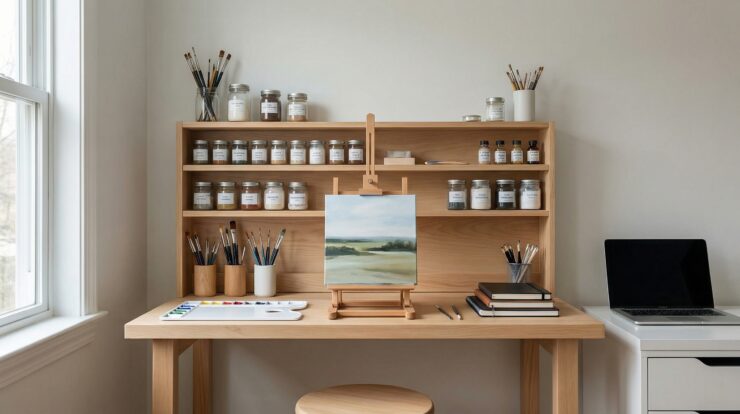
Every year, I speak with talented artists who share the exact same fantasy.
They dream of a sprawling, 5,000-square-foot industrial warehouse flooded with natural light, convinced that limitless physical space is the missing key to their creative breakthrough. They imagine themselves pacing in front of massive canvases, untethered by the constraints of a spare bedroom or a retrofitted garage.
But after visiting hundreds of studios throughout my career as a gallery owner, I’ve noticed a very different reality. When you give an artist unlimited physical space, it rarely unlocks unbridled genius. Instead, that boundless square footage almost always breeds chaotic habits, unchecked hoarding, and massive dumping zones for unresolved work.
Here is the uncomfortable truth about your creative workspace. Intentionally downsizing to a compact, hyper-organized footprint streamlines your material flow, eliminates decision fatigue, and will actually lead to your most productive years.
1. The Myth of the Warehouse Studio
It is easy to equate the size of your studio with the scale of your professional success. You tell yourself, “If I just had more room, I could finally paint without feeling claustrophobic.”
Yet, massive studios offer a dangerous luxury: the ability to ignore messes. When you have a vast warehouse, you don’t have to clean your brushes immediately or put away your reference materials. You simply move your easel to another empty corner.
Recently, an incredibly talented artist shared how he transitioned from a massive, leaky commercial warehouse to the smallest studio of his life. In the large space, materials were scattered everywhere, paralyzing his workflow. It wasn’t until he was forced into a tight, highly efficient room that he experienced his most prolific and profitable year ever.
2. How Constraint Breeds Intentionality
When you downsize your footprint, you can no longer afford to be a passive occupant of your studio. Every single square foot of real estate must be rigorously negotiated.
This spatial constraint acts as a forcing function for your art business. You are forced to look at every dried-up tube of acrylic or broken frame and ask, “Does this tool actively serve my current body of work, or is it just stealing my real estate?”
A smaller studio forces you to design a highly intentional space. You stop accumulating junk and start prioritizing a seamless workflow, keeping only the essential tools perfectly within arm’s reach.
3. Designing Your Hyper-Organized Footprint
Thriving in a smaller space requires strict operational rules. If you want to leverage a compact studio for maximum productivity, you must build systems that prevent chaos from taking root.
Implement these strategic boundaries to master your downsized workspace:
-
Establish strict zones: Never mix your messy creative work with your clean administrative tasks. Even in a tiny room, divide your drafting table so one side is strictly for your laptop and gallery correspondence, while the other is dedicated to paint.
-
Utilize vertical storage: When floor space disappears, you must build up. Use pegboards, heavy-duty clips, and wall-mounted easels to keep your active colors visible and your floor entirely clear.
-
Adopt rolling modularity: Put your supply shelves and secondary tables on heavy-duty casters. A small studio must be adaptable, allowing you to instantly reconfigure the room when you transition from shipping artwork to varnishing a canvas.
-
Enforce the clean-slate rule: A compact space cannot absorb yesterday’s mess. You must clean your brushes, scrape your palettes, and reset your easel at the end of every single session.
One Final Takeaway
Your creative potential is not dictated by the square footage of your real estate. Endless space gives you permission to be sloppy, while a constrained, highly organized studio demands professional discipline.
By downsizing your footprint, you strip away the distractions, force a streamlined material flow, and create an environment built solely for serious, uninterrupted production.
Question for Readers
Have you ever found that having too much space actually hurt your workflow, and what specific organizational trick saves you the most time in your current studio? Leave a comment below and share your experience.

Your article is timely — I’ve been bugging my husband to buy us a bigger house so I can have more than just a corner of the dining room. Instead we should stay put and I utilize the space I have more efficiently. Thanks for good ideas!
Hi Jason- I enjoy your articles. About biggy sizing sculpture. For me, that is over 20′ high. You know are over the DOT limit, need a crane on the loading and delivery ends, so long as you don’t go wider than 8.5′ you are good to go without a pilot car. I do not do this unless I have it sold.
And yes, I do usually have 3-5 projects going at the same time. It does allow time for reflection and changes, so long as all projects don’t go south at once, this is a great idea. I gave up my warehouse years ago- too much of a drain on the wallet, and as my business answers calls 24/7, I needed two computers updated with info to be useful when I fielded a call at home or warehouse. Best for an artist to be lean, work on table wheels, organized, and inspired.
It helps when the tubes of color paints are organised in a wall-rack during the painting process. But it is usually difficult to find a proper one: stable, for enough of colours and takes less space on a table. The same is with the brush organisers. Often they take too much space in a little studio, and you collect more and more garbage trying to organize the space of the studio, and it is difficult to relocate with all of this amount of organizers.
Also I like an fashioned custom-made palettes for oil, not flat, made in fabric but like a wave on the surface. It helps to see the colours on the pallet under different angles and different lightings helping to match with the colour arrangement that is already on the canvas or a board. In this way my artwork becomes not the “second palette”, and the palette becomes a “uning instrument”, and I should not change the place again and again to find what is better lightening for working on my paintings.
I work in a small studio space and I love it! There are a few downsides, but overall it’s great. I like not having a lot of clutter. I keep my collection of brushes and pallette knives to a minimum so I don’t clutter my work area with things I don’t need
I found this article encouraging because we retired to a 2 bedroom 1100 sq ft home and my studio is along a wall in the master bedroom. The 2nd bedroom belongs to my husband’s books and other stuff. In the early 2000s, I had a 2000 sq ft studio in a historical mill building in Manchester NH. Jason, you’re absolutely right about having too much space. I did use that space to teach and enjoyed networking with other artists in the building. In 2012, I joined a shared studio in a mill building in Nashua NH. We had a gallery space at the entrance and 5 to 7 of us shared the rear space for working. It was delightful and each of us had just enough space to get work done. Having others there who were working hard and selling their work was a great situation to motivate me to go every weekday just like it was a job. That situation was the most productive years of my painting life.
Jason,
How timely. I did most of the list. My New Art Studio is in my backyard. It is a 12 x 16 Portable building made by StorMore buildings. It is efficient, cozy or tight – depending on your perspective and mind set. Lots of Casters, most of the components move.
Read the article on the description of this video. See my new space. https://www.youtube.com/shorts/iAO-WVu0ZO0
Anyone is welcome to reach out.
I’ve always functioned like this
All bins are under tables, or stacked neatly in the closets.Every plastic bin has labeled.drawers
Vertical metal sheving holds tools , within arms reach.
All tools, palettes are cleaned daily.
And because I work in several mediums ( painting, printmaking.and papermaking, the space and materials are sthen set up for the next day.
Thank you for the article. I have had no issues as you relate in your writing. For many years I had a studio outside my house and since Covid, my studio is at home. In both studio situations I kept and keep my studio clean & orderly avoiding having to search for materials I need.
I was an art teacher for 30 years…. Organization is everything! Most days, I had the cleanest room even after 750 little artists came through my room each week. I do wish for a bigger space, but mainly because I want to paint larger! Storage of my paintings is my challenge right now. I have so much work because I paint every day and now I am painting bigger pieces consistently… suggestions for organizing the artwork would be welcomed! Thanks!