


A topic that inevitably comes up in my conversations with artists—whether they are brand new to the industry or veterans with five decades of experience—is the question of “standing out.”
In a world populated by thousands of artists, how do you ensure your work is the work that gets noticed, engaged with, and purchased?
I was recently speaking with an artist who has been painting successfully for forty years. He produces nearly a hundred major paintings a year and has very little inventory sitting around his studio. By all metrics, he is a success. And yet, even he admitted to me that he is constantly looking for that one adjustment to his style—that one shift in subject matter—that will make his work “irresistible” and cause it to sell instantly.
It is a universal concern. However, I often notice that when artists ask, “How can I make my work stand out?” they are actually asking two different questions.
The first is a marketing question: How can I find pathways to buyers for the work I am already creating? The second is a creative question: Is the art I am creating capable of standing out, or do I need to fundamentally change it?
While the reality is usually a hybrid of these two, it is helpful to look at the Art Market as two distinct paths. Depending on the art you create, you likely fall into one of two camps: the Innovator or the Traditionalist.
Understanding which camp you occupy is vital because the strategy for selling your work differs dramatically depending on where you sit.
The Path of the Innovator: “I’ve Never Seen That Before”
The first path is creating work that is radically unique. This is work that is inventive, unexpected, and perhaps uses materials or techniques that the average buyer has never encountered.
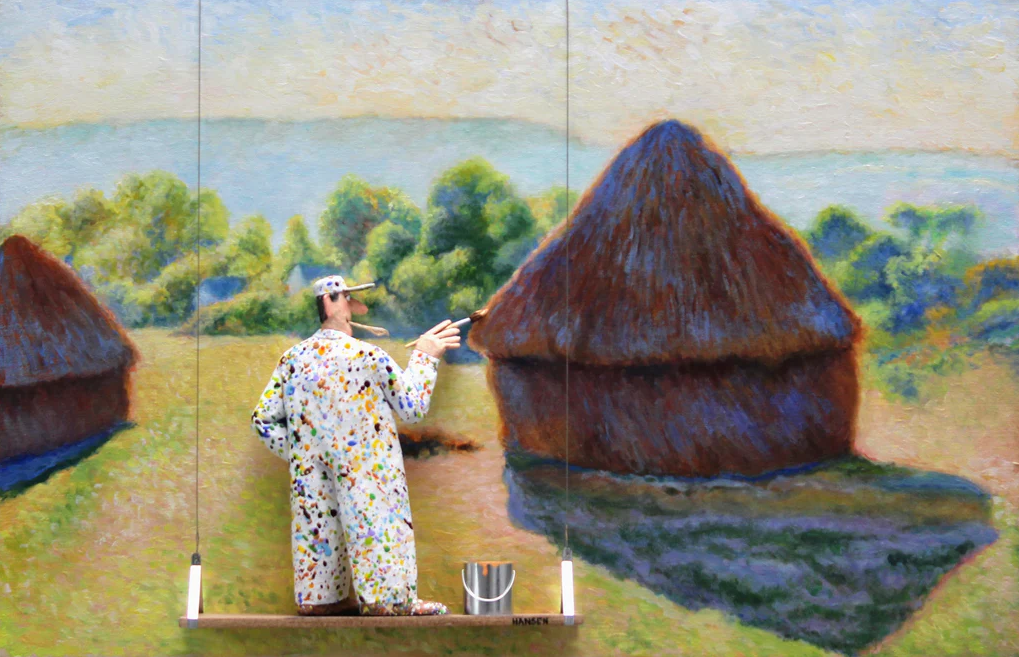
I work with several artists who fit this description. One paints on multiple layers of glass to create a 3D sculptural effect. Another recreates historical masterpieces but inserts humorous papier-mâché figures into the scene.

The Advantage: The primary benefit here is instant attention. When a collector walks into a gallery and sees something completely novel, the immediate reaction is, “Wow, I’ve never seen anything like this before.” It sparks curiosity. It stops the scroll.
The Challenge: The downside of innovation is that you are often sailing into uncharted waters. If no one has ever done what you are doing, you have no proof that a market exists for it. You don’t know if there is a single buyer out there who wants it. Furthermore, innovative work can be polarizing—people tend to either love it or hate it.
The Strategy: If you are an Innovator, your “superpower” is your story. Because the work is unfamiliar, collectors need a bridge to understand it. They will ask, “How did you come up with this?” or “How is this physically made?”
Your biography and your personal history become the most critical marketing tools you have. You must articulate the “why” behind the innovation. You cannot just rely on the aesthetic; you have to sell the invention and the vision.
The Path of the Traditionalist: The Comfort of the Familiar
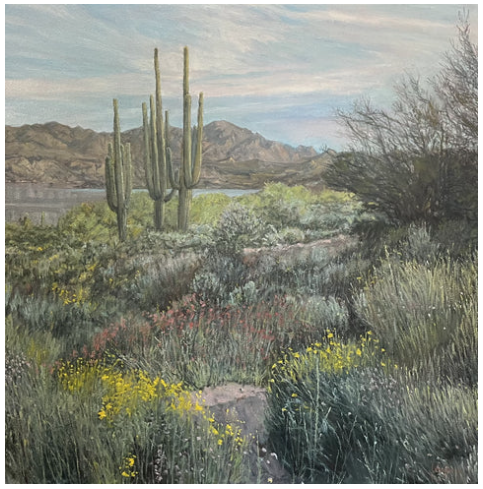
The second path is creating work that is expected, familiar, and understood. This includes landscapes, still lifes, figurative bronze sculpture, and traditional oil painting.
The Advantage: You are entering a proven market. You don’t have to wonder if people buy landscapes; we know they do. There is a massive, existing audience that already understands the language you are speaking. They find comfort and beauty in the familiarity of the medium.
The Challenge: The flip side of a massive market is massive competition. You are not just competing for attention against other artists in your gallery; you are competing against the entire history of that medium.
The Strategy: If you are a Traditionalist, you cannot rely on novelty. You cannot rely on a gimmick. Instead, you must compete on Excellence.
The conversation about your work won’t be “How did he do that?” It will be about composition, balance, color harmony, and mood. Your goal is not to be different; your goal is to be undeniable. You must execute your craft so well that even though the viewer has seen a thousand landscapes before, they pause at yours because of the quality of the light or the emotion in the brushwork.
The Spectrum of Success
Of course, these two paths are not mutually exclusive. Most artists exist somewhere on a spectrum between the two.
You might be a landscape painter (Traditional) who uses a very distinct, loose palette knife technique (Innovative). Or, you might be an abstract artist. Interestingly, abstract art is a perfect example of how the market shifts. Decades ago, abstract expressionism was the “Innovative” path—shocking and unseen. Today, abstract art is a staple of the art world. What was once a revolution has become a tradition.
As a gallery owner, I curate a collection that reflects my own eclectic tastes. I am just as captivated by a sculpture that defies the laws of physics as I am by a landscape that perfectly captures the light of a setting sun. By bringing both into the gallery, we create a space that feels alive and varied—offering opportunities for collectors who crave the thrill of the unexpected, as well as those who seek the deep satisfaction of a timeless classic. Both have a vital place on our walls, and both find dedicated buyers.
Quality, Consistency, and Quantity
Regardless of which path you are on, the fundamentals of a professional career remain the same.
If you are unique, you cannot rely solely on the novelty; the work must still be high quality. If you are traditional, you cannot rely solely on the subject matter; you must develop a consistent, recognizable voice. And for both, you must produce enough quantity to maintain a presence in the market.
Don’t feel pressured to force your art into a “unique” box if that isn’t who you are. There is a massive market for traditional work executed with excellence. Conversely, don’t be afraid to push boundaries if your spirit demands it, even if the market feels unproven.
Identify where you fit, and then optimize your story—or your skills—to match that path.
What’s Your Perspective?
I’m curious to hear where you feel your work lands. Do you find it easier to market work that is completely unique, or do you find comfort in working within a tradition that buyers already understand? Leave a comment below and let me know.

I enjoyed your comparison piece. I have taken the experimental path with my work with my “Crop Series.” After doing Plein Air work for several years, I had an itch to do something with more depth. Plus, even though my sales have always been acceptable, I found it hard to compete.
I still question my decision, but with every new idea, I get excited about the outcome and wonder what kind of response it will deliver. They are not all winners, but sometimes I get a gem that is difficult to part with.
I would be curious about your take on my work.
Thanks for your article.
Terry
Dear Jason;
I always benefit from learning something entirely new or a nuance or three through your newsletters. The nudes the nudes within an interior were a proven market especially at Orlando Gallery back in the day. My grad school Mentor Donald Lagerberg exhibited there and he was a Master Anatomist & Draughtsman creating beautiful classical nudes. Then I jumped into unchartered waters with paintings that I still have HAHAHA — many liked them but few purchsed – I think revisiting that subject with a fresher POV is worthwhile – and then the POLITICAL stuff that I currently am bleeding over. Do I even want to dive into that pool of troublesome topics that hurt many of us so much. The answer is return to the familiar – familiar for viewers but new for me. (a Grape fruit tree in my neighbors yard) Lastly, I kicked out some black white and grey abstracts — didnt have the courage to send them to you as these took me 1/2 hour to create —- too easy. Have gessoed up three wood panels to begin work on the grapefruit with leaves and shadows — Thank you Jason I always take valuable stuff from your postings. Respectfully Carlos
What if you’re crazy like me and have two completely different styles? On one hand I create fine art landscape and nature photography and on the other, abstract macro photography of rusted, scratched and dilapidated metals and painted objects, I still don’t know where I fit exactly.
First let me say that I started painting when I was 74 I believe and I’m now 80. My work is abstract mostly and eclectic. I want something different I don’t want to look like everybody else’s and I don’t want to do pretty cookie cutter looking scenes. I’m not doing badly but I don’t definitely don’t sell enough to make a mark. I keep looking for that magic spot where I will shine
I just need to be me. If I’m trying something because it’s a trend I don’t feel authentic. I’m not interested in being cutting edge but I’m always open to a new idea. I don’t always know what approach I’m going to use, I just paint the way I feel at the moment, reacting to what I see and feel. I’m always painting with the intention to discover something, so if it doesn’t turn out well I know where I went wrong and chalk it up to a lesson. But no matter how I choose to apply paint- thick and knifey, dry and scrubby, big flat shapes or impressionist daubs – the composition, values, drawing, color and edges are always the highest quality I’m capable of at the time.
A bit of both. My work looks like traditional landscape, but people often comment that they’ve never seen a whole exhibition in oil pastel before.
I have branched out in the past and was quite successful with a series I called “Shattered Reality”. They were eye-catching and people always had questions and comments. Frankly, I got burnt out on this series. I now paint traditional paintings and am trying to reach a level of making them stand out in the vast sea of traditional art. I hope I get there before the end of my life (I am and old lady).
Thank you for a though provoking post, Jason.
Great article! Lots of good stuff here.
thanks