


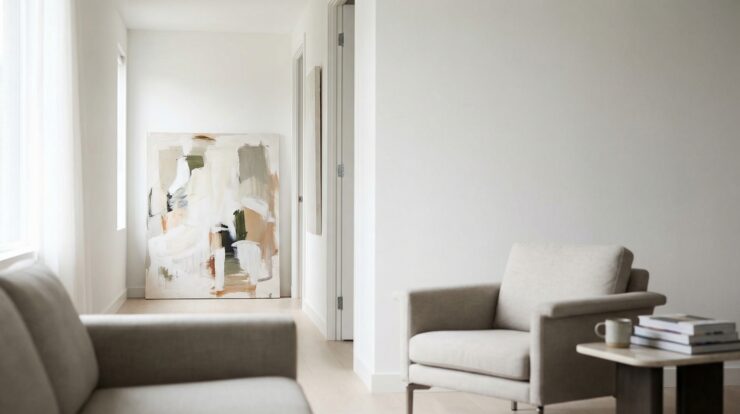
You spend weeks staring at the same canvas under the exact same perfectly calibrated studio lights. Your easel is dialed in, your track lighting hits the surface just right, and your brain has completely adapted to the environment. You think the painting is finished. Then, a collector takes it home, hangs it in their living room, and suddenly a glaring compositional flaw jumps out at you.
The environment where you create your art is rarely the environment where it will be consumed. If you want to accurately evaluate an unfinished painting, you need to pull it out of the studio and hang it in a transitional domestic space like a hallway to view it with fresh eyes.
1. The Trap of the Studio Environment
In the studio, your primary mode is intense focus. You are actively painting, mixing, and scrutinizing every brushstroke. This hyper-focus creates a psychological blind spot.
-
Lighting adaptation: Your dedicated LEDs or vast north-facing windows bathe the canvas in an idealized light that few collectors possess in their homes.
-
Proximity fatigue: You are standing mere inches from the surface, losing sight of how the piece reads from ten feet away.
-
Contextual bias: Your brain associates the painting with the tools, the mess, and the effort of the studio, preventing you from seeing the artwork as an isolated object.
2. The Power of the Transitional Space
To break this bias, you must physically remove the artwork from the space where it was born. A long hallway outside your studio or a wall near your living room is the perfect testing ground.
This is not a space for active critique. It is a space for passive observation. When you hang a piece in a hallway, you view it exactly as a buyer will in passing.
You will catch yourself thinking, ‘Does that shadow look too heavy when I walk to the kitchen?’ or ‘Is the focal point reading clearly from the other end of the hall?’
3. Creating Your Own Viewing Gallery
Setting up a transitional viewing area requires zero financial investment, but it will dramatically improve your quality control. Treat this mechanism as a functional tool in your daily routine.
-
Choose a high-traffic area: Pick a wall you walk past multiple times a day on your way to watch TV or do the laundry.
-
Simulate domestic lighting: Avoid setting up gallery-level track lighting in this space. Let the ambient, everyday lighting of your home reveal how the piece will actually look in a typical interior.
-
Observe without engaging: Do not bring your brushes into the hallway. If you spot an area that needs more work, mentally note it and take the piece back to the studio.
4. The Golden Rule of Finalization
Treat this transitional gallery as the final gatekeeper before a painting leaves your hands. If an artwork only looks good under your 5000K studio LEDs, it is not ready for the market.
It must hold its own in the casual, imperfect environments where collectors actually live and appreciate art.
What Is Your Hallway Test?
Where do you hang your work to get a fresh perspective before declaring it finished? Share your process and preferred viewing spots in the comments below.

Yet another piece of great advice! I appreciate your blog so much! I do try this with my paintings, plus standing back as far as possible. I also find using an in situ room app helps me see my paintings with fresh eyes. It doesn’t help with the lighting issue but at least gives me perspective on how the painting might look in various environments.
Fantastic idea! Thank you!
Great advice!! Will definitely do this!
Oooh…. I love this idea! I usually let my work marinate for a few days but now that it is so big I don’t move from my studio. Never thought about how the light would affect it! But I will definitely move my work to a neutral space now! Thank you! ☺️
As always, your suggestions and ideas are most appreciated. I have one in the hallway now!
Barbara
I do this all the time. I purchase my mats in bulk and I keep 6 or so empty gallery frames at all times. Before I sign any work, I’ll mat it and pop it in the frame and hang it in my home. I usually have 3 or 4 hanging at one time and I move them from room to room to see how well they present, is there something off, etc.. then I’ll take them out, do want needs to be done, if anything, sign them, then store them with an acid free backing board and acetate envelope, in a flat file. I’ll also place my sticker on the back of the painting with its name, serial number, mediums used, size, and my logo. My serial numbers incorporate the creation date. I used to just place them on easels throughout the house but why not use them as art and, the cats can’t knock them over.
Rule 4 is really important. I find my work looks great in my studio and even in my home, as I have a lot of natural light. But, take it into the office, and the life gets sucked out of the color. I am still trying to figure out exactly what to do to correct that. It leads me to wonder if sold work should go to the new home with a note about the ideal viewing light for the work?
I leave mine on an easel in my studio but use only the natural light from the window. It’s positioned so that I see it every time I walk past the doorway or when I go down or come up the stairs from the family room. I get little glimpses with each step and it’s surprising what I see as the painting is revealed.
All good suggestions but I will also hold them up to a mirror to get a totally different perspective