


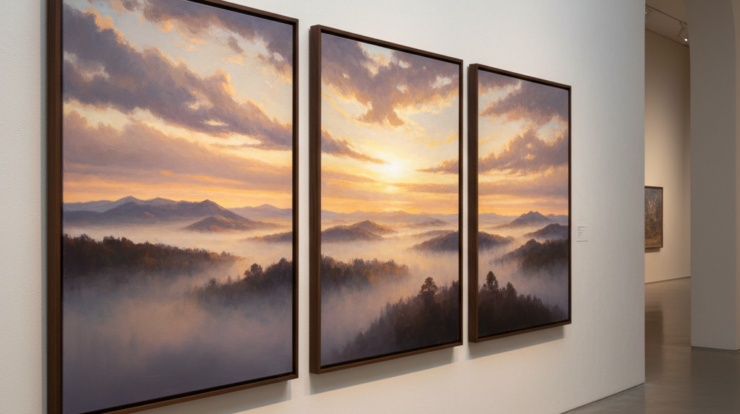
In the gallery, I see a recurring scene: a collector stops in front of a landscape, mesmerized by the light or the mood of the piece. They study it for a long time, and then they turn to me and ask the most common question in the art world:
“Where is this, exactly?”
Whenever I’m asked that, I usually have a bit of a standard joke: “Where do you want it to be?” While it usually gets a laugh, there’s a deep truth behind it. As a gallery owner, I’ve spent years watching how people interact with art, and I’ve noticed a consistent trend. While geography gives a painting a name, it’s the atmosphere that gives it a soul. Most buyers aren’t looking for a map; they are looking for a feeling.
The Geography Trap
Many of the artists I work with are deeply tied to the specific places they paint—the exact bend in a river, the specific anatomy of a mountain range, or a local reservoir. There is a natural instinct to want the viewer to “see” what they saw.
But for the collector, the “subject” is often just the doorway. The real hook is the atmosphere—the mist in the air, the way light hits a breaking wave, or the biting chill of a winter sky. When a painting moves away from literal representation and leans into mood, it creates an emotional connection that is far more universal.
Leaving Room for the Viewer
When we talk about art to collectors, we aren’t usually trying to sell them on a specific set of GPS coordinates. In fact, giving too much “factual” information can sometimes break the spell.
If I tell a collector that a painting is a specific marsh in a specific county, I’ve anchored that painting to a spot they may have never visited. But if I let them bring their own interpretation, that marsh might become the lake behind their childhood home, or a place they visited on a favorite vacation.
By prioritizing the atmosphere over the landmarks, the artist allows the work to breathe. It becomes a vessel for the collector’s own memories of light and air.
The Power of Luminous Space
In my experience, what truly catches a collector’s eye from across the gallery floor isn’t the “what,” it’s the “glow.” They are drawn to work that feels alive—pieces where the light seems to move through the paint rather than just sitting on top of it.
They may not know the technical reasons why a certain horizon line feels so expansive or why a certain sky feels so heavy with coming rain; they just know they want to live with that feeling every day. They aren’t buying a record of where the artist was standing; they are buying a window into a world that feels “true” to them.
The Ultimate Goal
As a gallery owner, my goal is to facilitate that “click”—that moment when a person realizes a piece of art belongs in their home.
That click rarely happens because of a location. It happens because of a connection. When we stop worrying about the map and start focusing on the mood, the work stops being a description of a place and starts being an invitation to an emotion.
So, the next time you find yourself wondering if a painting is “accurate” enough, remember: the person who eventually buys it isn’t looking for a destination. They are looking for a way to feel.
Question for Readers
When you’re working from a reference photo, do you find it hard to ‘break the rules’ and change a sky or a landmark to better suit the mood of the piece? How do you decide when to stop being literal and start being atmospheric?

Thank.you, Jason. This is really helpful!
Thank you for the article!
Atmosphere is all my art is about. I’m working for feeling, not just place. Especially when I’m working in the studio. Rarely I just follow the reference, almost never.
It is different when I do plein air and when I am following what’s there – usually the mood of the day/place. I’ve also noticed collectors who buy plein air work are very specific about location, often sharing memories about particular place.
Anyway, it was good read!
I’ve learned to use a photo only as a reference for exploring possibilities. I do a simple line drawing of what’s in the photo and put it away. Then I do more line drawings (small, tiny even) from my initial drawing to explore composition, then value studies to explore feeling, atmosphere. Then I do some color studies from the favorite value study. At some point I do get the photo back out for anything that’s particularly important to me.
thanks for this
Perfect, Jason! It’s in the feeling,
Thank you for articulating the essence of what the real draw a painting will have to a collector. I like that applied to landscape, Location specific is good but atmosphere provides the reason you painted it.
RedDot keep on keeping on!
I have a specific suggestion for all landscape painters: add an object to your landscape, and you will suddenly find that it transforms your painting and makes it unique. Just consider, for instance, how many similar paintings with reddish skies were painted? They are all alike in most of the cases. But with just a single small object, it will be unique; it will not be for wall decoration, but will have a special meaning.
Similar argument goes to people in landscapes. I’ve encountered a few who claim “landscapes shouldn’t have people (or sometimes even human constructs) in them,” but I’ve also read painters who advocate using the human figure to give a sense of scale to a painting. (Specifically that came from John C. Pellew’s discussion of a painting he made of a few seaside stones that he turned into massive rocks simply by adding a few people.)
yes good one. when adding people, i feel that making then ‘indistinct’ maybe a side or back view allows someone to see themselves or someone they know.
That is really good advice.
Thank you Jason!
location is relavent to most collectors of wildlife art, especially those images that are detailed renderings. the more impressionistic the form is the more questions focus upon the atmosphere. Once again it comes down to finding how your art speaks to people which changes over time and generations. early in my carrear i worked on large scale historical dramas for museums where specifics were everything. technical proficiency was valued over creativity.
was it art? or rendering? the greatest challenge was to impart atmosphere and mystery into a static defined form. great practice but brutal in terms of accepting critical reviews from museum curatorial staff.
Its opposite is complete abstract forms that deal only with feeling, color, motion and atmosphere.
somewhere inbetween lies art.
As a landscape painter, I found this so usesful. Thank you.
Good article. Thanks, CHC
Thanks Jason this is a great topic for those of us who work with nature. My paintings are oceans and landscapes, locations I’ve hiked, surfed, photographed and “researched.” All are places where I’ve had an awe moment and my goal as a painter is to share that moment. With visitors to my shows and open studios there is often a hush or whisper as they take in my work. Pretty soon though the questions come. “Where is this?” Or even though many of my canvases are rather large, “Did you paint this on site?” In our deeply technical world I think awe makes us just a bit uncomfortable. The challenge is helping visitors and potential clients stay in the moment but still respond to their curiosity in a way that feels authentic. Interestingly though, no one has ever bought or not bought one of my painting solely because of the location!
I am a landscape artist. My landscapes are usually a combination of multiple scenes
put together to create my composition. Also, I add my imagination to the subject.
I stop aiming for hyper-realistic when I realize some dimension/angle isn’t quite right and it’s going to be obvious if I go into greater detail. Or I get tired of wrestling with it. Which is why I may omit smaller details, or things that could have moved “out of frame” from when I observed/photographed them.
Skies have always been fair game for alteration, because clouds never hung around long enough for anyone to compare them to the painting. Even the advent of cameras hasn’t changed that.
As to location, it’s a bit of a contradiction for me. On the one hand, I have a strong urge to render scenes/portraits that either have no visual record or have only poor-quality images. On the other hand, I do make entirely fictitious scenes (and portraits), and worry that such work might impair the legitimacy of my historical painting.
As a landscape artist, what catches my attention is always the mood. If I try to be accurate to the location, I lose the mood; the accuracy somehow destroys the mood. So, I empathize with and encourage the buyer who wants the mood.
I still do, sometimes, title a work with the location. One can’t be poetic or witty all the time.
Thanks for this Jason! I have found this to be true too, but wasn’t sure if that was because those are the people who are drawn to my art. Very interesting to hear that this is universal in your years of experience.
I think that’s true of abstracts and figurative work also. The viewer connects with the mood, the feeling it stirs inside them.