


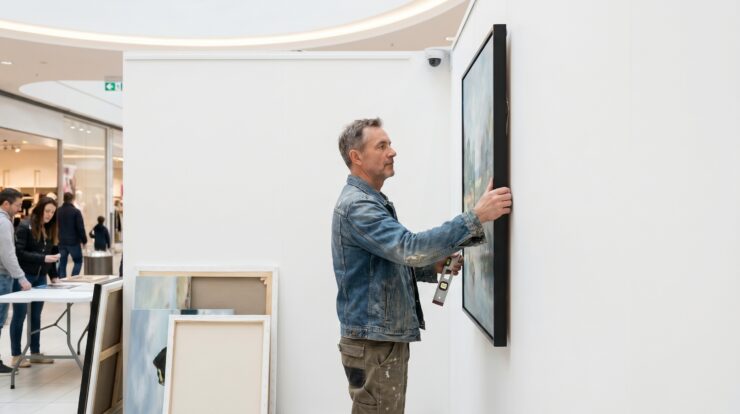
Imagine walking into a pristine, empty retail space. The keys to your new three-month pop-up gallery are in your hand. Your mind immediately races through a checklist of lighting logistics, display aesthetics, and marketing plans. But before long, a darker thought creeps in: “What if someone walks out with my art?”
When an artist suddenly steps into the role of a gallerist, loss prevention is often the first instinct that kicks in. You are solely responsible for the inventory, and the vulnerability of a temporary space can feel overwhelming. But here is the hard truth of gallery operations: the threat of theft is infinitesimally small compared to the threat of obscurity.
Your primary focus must be on preventing artwork from overstaying, not keeping it bolted to the walls.
The Myth of the Art Heist
We have all seen Hollywood movies where cat burglars meticulously steal high-value paintings. This pop-culture programming creates a disproportionate fear for independent artists setting up shop in a mall or vacant retail unit.
The reality is far less glamorous. Of all the things a petty thief can steal, artwork is arguably the hardest to turn into cold, hard cash. It is bulky, recognizable, and highly difficult to fence on the street.
While theft does occasionally happen, it is such an exception that it proves the rule. I recall a staggering story of a $45,000 sculpture going missing from a gallery, only to be discovered years later sitting on the shelf of a wealthy collector who had taken it merely for the psychological thrill. These anomalies are memorable precisely because they are incredibly rare.
The Hierarchy of Pop-Up Priorities
If I am organizing a show and looking at my hierarchy of worries, theft is near the absolute bottom. I am infinitely more concerned that artwork will never walk out of the space because no one is buying it.
When you fixate on loss prevention, you risk compromising the buyer’s experience. You might hesitate to display smaller, easily accessible works that often serve as perfect gateway purchases. You might also create an environment that feels fortified and unwelcoming.
To run a successful pop-up, you have to accept an asymmetrical risk. The tremendous opportunity to engage with new collectors, understand buyer psychology face-to-face, and generate sales far outweighs the marginal risk of a stolen canvas.
3 Rules for Practical Pop-Up Security
You do not need to turn your temporary exhibition into a fortress. Instead, deploy these three practical, low-friction security measures:
-
Attentive Hosting: An engaged host is your best alarm system. Greet every visitor the moment they walk in, make eye contact, and be present in the room. Thieves thrive on anonymity; attentive customer service eliminates it.
-
Visible Surveillance: You do not need a complex, hardwired security network. Inexpensive, web-connected cameras placed visibly in the corners of your space provide profound social proof of security. Simply knowing a record exists is a massive deterrent.
-
Standard Hardware: Skip the complicated wall locks. In my gallery, we hang artwork—even easily pocketable pieces—on standard hooks. Security hardware creates installation nightmares and is rarely foolproof anyway.
One Final Takeaway
Hosting a pop-up show is a monumental undertaking that offers invaluable real-world gallery experience. You will inevitably make a few mistakes, and that is simply part of the professional learning curve. Keep your focus directed outward on your marketing, your display presentation, and your customer interactions. Secure your sales first, and trust that the security of the artwork will largely take care of itself.
Question for Readers
Have you ever hosted a pop-up exhibition or a temporary show? What practical steps did you take to manage the space, and did you ever experience an issue with theft?

No, never been in a pop up. However I did have a 27 inch piece of bronze stolen from an established gallery. As it happened while the gallery was open, the insurance didn’t cover the theft and I was reimbursed the casting cost by the gallery. It was a limited edition so I lost a number in the edition and the time to cast again.
Apparently the guy put it under his jacket and just walked out.
Aha, I feel this might have come from my question about security as we opened our popup for 3 months, a month ago now! Of course we are mainly raising awareness, though we have had a lot of sales of glassware, and a few pictures. We are being attentive as we invigilate, and some of us are concerned that people are taking photographs. I know you have covered that in previous blogs, and the lighting is not good enough for those photographs to be used for making prints, so I feel that it is good publicity. My main lesson is in the number of qualified buyers for artwork coming through. I think there have been about 5 in a month, and we have had about 600 visitors. So it turns out for me at this point, that a shopping centre isn’t as good for art sales as an obscure gallery in the library/theatre complex just outside it.
While I’ve never hosted a pop-up show and I don’t mean to offend. But I’ve been doing the other kind of pop-up show (indoor/outdoor art festivals) for over a decade now and in the beginning, I did have some concerns, those quickly got pushed to the bottom of the list and have stayed there as I have never had any work stolen.
I’d be somewhat flattered if someone stole my art. As a different question, when art is displayed in a more casual setting like a cafe or a bar where it’s unattended, is that of more concern for theft? Do artists insure their work when it’s out in the world on display and out of their control?