


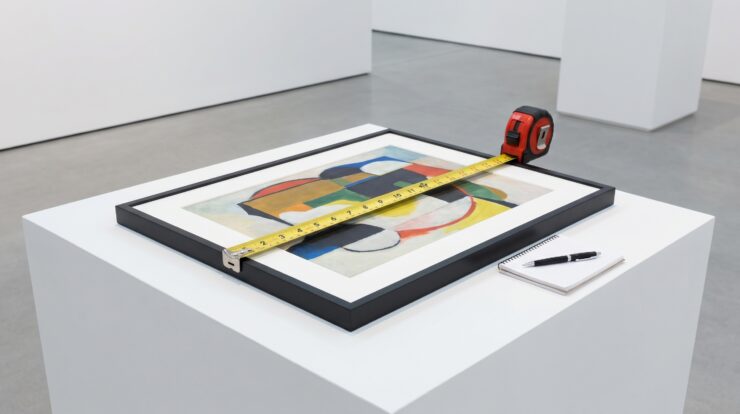
You have finally finished a new collection of paintings and secured a gallery showing. Now you face a pile of consignment agreements and inventory sheets demanding your artwork dimensions.
For many artists, this feels like an afterthought. You quickly jot down the numbers, hand over the spreadsheet, and wait for the show to hang.
But a few days later, the gallery’s website goes live, and every single vertical painting is listed as a horizontal landscape. Your 24-inch tall by 18-inch wide portrait is suddenly being marketed as a short, wide rectangle.
The golden rule of gallery inventory is entirely non-negotiable: Height always precedes Width. If you want to be treated like a professional, you must submit your dimensions using the strict H x W x D industry standard.
1. Overcoming the Graphic Design Habit
If you come from an advertising, graphic design, or photography background, this standard is going to feel entirely backward. Photographers are trained to say “8 by 10” or “5 by 7” regardless of orientation.
Graphic designers are taught to list width before height. The fine art gallery business plays by different rules.
When gallery staff receive a consignment sheet, their database software expects the height first. If you flip those numbers, the gallery associate will blindly enter your data exactly as written.
They won’t pause to ask, “Did she mean this is a vertical piece?” They will simply enter 18 x 24, and your inventory records will be permanently compromised. By conforming to the height-first convention, you remove a major point of friction for the gallery staff.
2. The Rules of Measurement and Precision
Beyond the order of the numbers, there is a distinct gallery preference for how those numbers are formatted. We are running a retail business, not a scientific laboratory.
Here are the core rules for formatting your sizes:
-
Stick to inches: If you are selling in the United States, use inches. Metric measurements do not translate cleanly to an American buyer’s spatial awareness.
-
Use decimals instead of fractions: Gallery websites and inventory software prefer decimals. List your piece as 24.5 rather than 24 ½.
-
Round to the nearest half-inch: Your buyer is not going to refuse a painting because it is listed at 16.5 inches when it is technically 16.375 inches. Keep the math clean.
3. Handling Frames, Depth, and Sculpture
Once you have the basics down, you will inevitably run into corner cases. “What if my frame is massive? What if I paint on a deep panel? What about the base of my sculpture?”
When a collector is evaluating a piece, they are trying to visualize its scale in their living room. You must provide dimensions that best serve that psychological need.
-
Framed wall art: Always list the unframed image size. Frames can be swapped or removed, so the canvas size is the true anchor point. If a buyer asks, the gallery will measure the outside frame dimension for them.
-
Deep canvas panels: Galleries usually ignore the third dimension (depth) for standard wall art. However, if you paint on a chunky, 2-inch gallery-wrapped panel, include the depth so the collector isn’t surprised by how far it protrudes from the wall.
-
Sculpture bases: For three-dimensional work, height remains the most critical metric. Always measure from the bottom of the base to the highest point of the piece to establish the true scale.
One Final Takeaway
Every interaction you have with a gallery is an opportunity to prove you are a seasoned professional. Consistently listing your dimensions as Height x Width x Depth tells a gallery owner that you understand the business.
It shows you respect their systems and want to make their job as effortless as possible. You are proving that you are an artist they can easily partner with.
What Is Your Sizing Standard?
Have you been listing your artwork dimensions backward, or have you naturally followed the height-first rule? Share your experiences with gallery inventory sheets in the comments below.

THANK YOU! I can’t count the number of times I have seen this done wrong, or even worse, some work H x W and others W x H in the same show!
As a graphic designer, I used to work for Macmillan Publishing, where we produced many art books. We always listed painting dimensions as Height × Width (H × W), and that’s the convention I’ve continued to use ever since. I’ve tried explaining this to people countless times, but they never seem to believe me! So whenever I submit the dimensions of my paintings, I always list them as H × W.
I’ve always used the international convention of height, then width, especially on my website. But I clarify this by declaring: Size (h x w).
This is necessary because in Australia, submission forms often list it the other way around.
Thank you for posting this information. Too many artists fail to use this size description protocol when submitting art images to galleries and juried exhibitions. It’s time consuming and frustrating when H x W is misrepresented.
The two galleries that represent my work want the dimensions of the frame, not the size of the actual artwork. I’m afraid it took me longer than it should have to get used to that. So, now, on the consignments sheets, I state:
16×20 – size on wall 24×28 (horizontal)
20×16 – size on wall 25.5×21.5 (vertical)
“Size on wall” is clunky wording! Is there standard wording for this?
Thanks! JGP
Julie – could you use “with frame” or “including frame”?
Thank you for this valuable insight & reminding of ways to improve oneself
Z
I’m a 3D person and the depth question confuses me. If I create a vessel like a vase, do they want to know how deep it is inside, which is sometimes but not always different than the height. Do they want to know it’s front-to-back dimension, which is usually but not always the same as the side-to-side dimension?
What if it’s a sculptural form? What’s my depth then? I think it’s more likely the front-to-back dimension but I’m not really clear on it.
Thanks!
Oh that’s very interesting. I did come from a design background, where width came first. I might need to re-do the measurements on my website – they’re totally the wrong way round!! Thank you!
Hi Jason, this is interesting, because in my gallery, we have a standard of length x height x depth, which is based on the XYZ plane coordinates. Either way, is important that the artist submits this correctly to the gallery based on the fields they request so that these don’t get mixed up and cause issues down the line for the catalog and hanging. Thank you for bringing this forward so artists are aware.
When describing the measurements of an object, it is usually “length x width x height.” There are some exceptions to this rule, however. A different order and alternate terms are used when measuring certain objects or the dimensions of a room. (Found online)
This is the standard way of measuring, so here in lies the problem of understanding how should one measure their artwork. A piece that measures
18”x24;” however the painting was created to be in landscape form, the measurements here would indicate 18”x24.” Signifying the height being the shorter of the two planes and the horizontal being the larger. If the painting was in portrait the reverse would indicate, 24”x18.” Finally, the total paint on surface is what should be showing to collector and or galleries from my understanding. So if the height paint measured 23.5” and 17.5” width the measurements would be 23.5”x17.5” correct?
I list my work in the format of height in inches, then width. Thank you for posting.
Thank you for this info. What is the standard for framed, matted work? What is the standard mat size and should you include the entire framed dimension or just the image size?
Thank you Jason
Thank you for sharing your experience with us.
I knew the height always comes first, it good to hear how frustrating it can get when this simple requirement is missed.
Jason, coming from a graphic design background, I ran head on into this issue. I imagine that I fumbled around for a couple of years before getting things straight. That said, it was finally jumping in full tilt with FASO that did it. Even then, I wasn’t sure why the dimensions are listed differently, and still do think it’s crazy to not use the same standards. GD is long enough in my past to know now, but this topic is very pertinent because so many come from this background. Thanks for addressing!
Thank you for clarifying this. Much appreciated.
What about artwork that needs to be matted, such as a watercolor painting? There are various sizes involved: the actual painted area, the unframed mat size, and the outer frame dimensions. The image could potentially be re-matted in a different size mat, in addition to a different size frame. What do galleries want for the size in this case? Thank you.
SO VALUABLE! I have indeed been doing in backwards (probably taught in graphic design class, or by layout software!) but seen others do HxW and wondered.
Now I have a whole website to update. Drat!
I really appreciate this post, describing how to list sizes on art. Coming from a construction background I learned to list sizes width first then height, as a window opening would be 48 x 50, just as an example. So that was the way I would list the sizes of my art pieces. this has helped me greatly to understand and to start listing my pieces correctly for a Gallery.
Thanks for the clarification. I’m a designer who opened a gallery and have been using X,Y,Z coordinate logic for listing art. I’ll endeavor to become even more professional with your good information.
I’ve been a Graphic Designer/Illustrator for decades and only recently started painting for “myself” with the intent of seeking gallery representation in the near future. As such, I was taught to ALWAYS list dimensions as Width x Height x Depth. I was also taught to actually include the letters W, L, H and D (representing width, length, height and depth) in the listed dimensions so there were no misunderstandings. It wasn’t until your above article that I realized the gallery standard was the opposite.
It amazes me how often I see work posted with no reference to size whatsoever. HxWxD to the nearest half inch is how I’ve been listing my work all along. It just seems the most pragmatic. I’m glad to see it’s the gallery standard.