


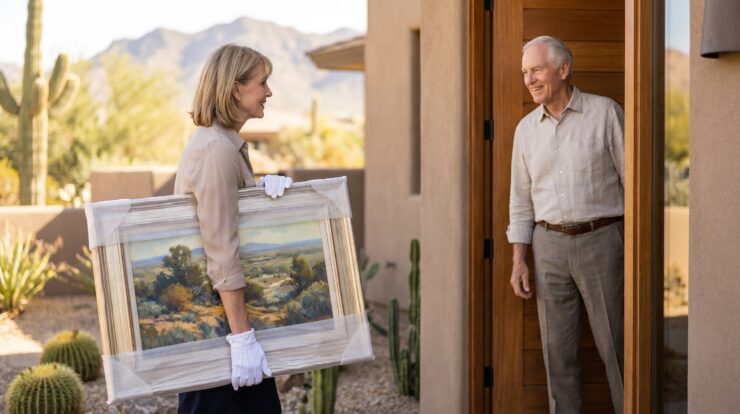
Recently, I loaded a 60-by-60-inch painting into my vehicle and drove an hour and a half to the far west end of the Phoenix valley. The client lived so far out that you couldn’t quite see Los Angeles, but they were arguably in the same zip code. I spent a good portion of my Friday navigating traffic to install the work personally.
You might ask: “If you had known the distance beforehand, would you have thought twice about offering free delivery?”
The answer is an absolute, unambiguous no. I will always take an opportunity to get inside a collector’s home. The time and gas required to hand-deliver your artwork are not operational annoyances—they are strategic investments in lifetime client relationships.
The Psychology of the In-Home Installation
When you step into a collector’s living room, you transition from being just a vendor to becoming a trusted advisor. You get to see exactly where your artwork is living, but more importantly, you learn about the buyers themselves.
In this recent delivery, the clients immediately wanted to show me another painting they had purchased from us almost two years prior. We talked about their family and their second home in Colorado. This level of connection simply cannot happen over a quick credit card swipe at a studio tour or a crowded art walk.
Sometimes, delivery is about overcoming a collector’s hidden anxieties. Just a few days prior, I drove 45 minutes to deliver two small 12-by-12 pieces. The client could have easily picked them up, but I knew she had a literal phobia of hammers. The sheer thought of installing the art was an impediment to her enjoyment. By offering white-glove service, I eliminated her buyer’s friction entirely.
3 Rules for White-Glove Deliveries
If you are going to offer hand-delivery and installation, you need to approach it like a professional operator. Here is the framework I use when stepping into a client’s home:
-
Play the long game on expenses: As I was finishing the installation for the $8,000 painting, the husband pulled out his wallet to hand me a cash tip for the long drive. I politely declined. When a client makes a major investment in your work, do not let them think you are sweating the cost of gas. Reassure them that the service is entirely your pleasure.
-
Leave a memorable artifact: I always try to leave a small thank-you gift. During this visit, I gave the couple a small Spiritile from the gallery. They absolutely loved it. It is a low-cost gesture that leaves a lasting psychological imprint of goodwill long after the check clears.
-
Read the room on gratuities: While I declined the tip on the major sale, I gladly accepted a small tip from the client with the hammer phobia who bought the two small pieces. Refusing her tip for a modest sale would have dismissed her thoughtfulness. You have to gauge the relationship and the scale of the transaction in the moment.
The True ROI of Showing Up
We can easily become hyper-focused on the immediate revenue from a sale. The money comes in, pays the bills, and is often forgotten in a matter of days.
But the artwork you install in a collector’s home will be enjoyed for decades, perhaps even generations. By physically placing the work on their wall, you tie yourself to that legacy.
You also position yourself perfectly for the next sale. When a collector realizes that buying from you means total service, zero installation anxiety, and a warm, professional interaction, they will inevitably come back.
One Final Takeaway
Any time you have the logistical ability to deliver and install a piece of art yourself, take it. The insights you gain into your collector’s tastes and the trust you build in their living room will pay dividends that far exceed the time spent behind the wheel.
What is Your Delivery Policy?
Do you currently offer hand-delivery and installation for local or regional collectors? Share your most memorable in-home delivery experiences in the comments below.

I do hand-deliver larger paintings. I’ve never been asked to install and frankly I’m a little nervous about putting a hole in someone’s wall. Perhaps I need to make it a priority to master different ways to install.
For the really small ones, I offer to deliver to their home or meet at a local bakery/coffee shop and always treat them to a cup of jo. That visibility sometimes leads to a sale from the shop owner who notices.
Make sure to bring the necessary tools for installation. Make sure they that will not leave unintentional marks on the walls. Clean tape measure. Aluminum levels can leave black marks.