


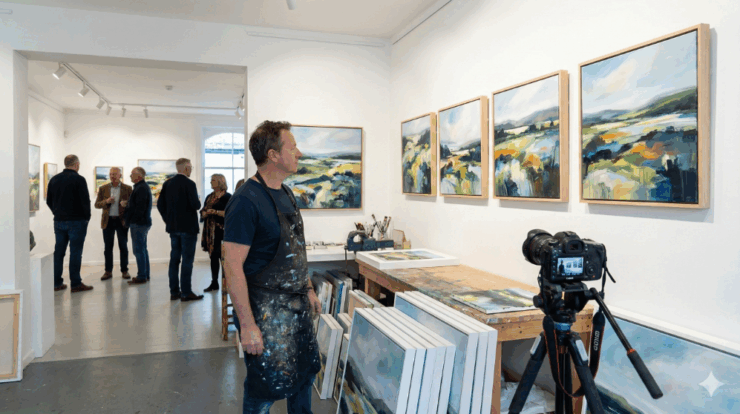
When an artist steps into the studio, the possibilities feel infinite. With a blank canvas or a lump of clay, you could theoretically go in any direction. You could experiment with a new medium, try a wildly different style, or change your subject matter entirely.
Early in a career, this experimentation is vital. It helps you find your voice. But for artists who are looking to move from “passionate hobbyist” to “professional career,” there comes a moment where that scope must narrow.
Building a sustainable art career isn’t just about having talent. Talent is the starting line, not the finish line. Over years of working with artists and selling their work to collectors, I have found that success almost always rests on four specific cornerstones.
If you are struggling to gain traction in the market, it is likely that one of these four pillars needs attention.
1. Quality: The Price of Entry
When we talk about quality, it is easy to assume we are only talking about the aesthetic success of the art itself—the brushwork, the composition, or the emotional resonance. While those are obviously critical, “Quality” in the professional art market extends much further.
Quality is total professionalism in presentation. It is the framing. It is the wiring on the back of the canvas. It is the base of the sculpture. It is how the work is lit and photographed for online viewing.
Collectors are savvy. When they are considering investing in a piece, they look for signals that the artist takes their work seriously. If a painting is beautiful but housed in a cheap, ill-fitting frame, it signals a lack of confidence or professionalism. To build a career, your work must meet a minimum standard of excellence in every aspect of its physical existence.
2. Consistency: The Power of Recognition
There is a myth that artists must constantly reinvent themselves to stay interesting. The reality of the market is quite the opposite. Most artists find success when they narrow their focus and create a body of work that is recognizably theirs.
Consistency allows a collector to walk into a gallery, spot a piece from across the room, and say, “That’s a [Your Name].”
This doesn’t mean you become a robot painting the exact same image over and over. It means developing a cohesive visual language—a signature style. This is crucial for building a collector base. When a buyer falls in love with your style, they often want to buy a second or third piece. If your next series looks like it was painted by a completely different person, you break that chain of trust and continuity.
3. Quantity: You Can’t Sell Empty Walls
This is often the hardest pill to swallow for artists who prefer to work slowly or sporadically. The reality of the art business is that you need inventory to generate sales.
You need a breadth of work and a depth of inventory. Why? Because sales are a numbers game. To sustain a career, you need to capture enough attention to find the specific buyers who resonate with your work. If you only produce three paintings a year, you simply don’t have enough “product” to capture the necessary market share.
Furthermore, galleries need to know that if they sell your work, you can replace it. A gallery cannot effectively promote an artist who creates one great painting and then disappears for six months. We need to see a flow of work that proves you are active, engaged, and capable of meeting demand.
4. Exposure: The Engine of Sales
You can have the highest quality, the most consistent style, and a studio full of inventory—but if no one sees it, you don’t have a business.
This is the “if a tree falls in the forest” scenario of the art world. I often see artists pouring 100% of their energy into creation and 0% into exposure. A prudent artist understands that they must divide their time.
You must get “eyeballs on the work.” This happens through art fairs, festivals, gallery representation, email newsletters, and social media. It can feel daunting to switch hats from “creative” to “marketer,” but exposure is the catalyst that activates the other three pillars. The market is saturated, and buyers are not going to hunt you down in a hidden studio. You have to go to them.
Finding Your Balance
It is rare for an artist to be perfect in all four areas immediately. You might have the quality and quantity, but lack the exposure. You might have great exposure, but lack the consistency to close the sale.
The goal is to assess where you stand today. Are you producing enough? Is your presentation professional? Is your voice consistent? And are you doing the work to be seen? By shoring up these four cornerstones, you move away from relying on luck and toward building a career that is built to last.
Which Cornerstone is Your Stumbling Block?
I’d love to hear from you. As you look at these four areas—Quality, Consistency, Quantity, and Exposure—which one do you find most difficult to maintain, and why? Share your thoughts in the comments below.

Good info share, Jason. As always, very helpful!
You ask, which cornerstones need shoring up? For me, it’s exposure.
I am in a constant upheaval with media, mail lists, etc. Through many less than stellar attempts, the residual knot in the stomach and the thought in the neural pathways “Here we go again…” results in a creeping attitude of fear. And more often than not, the show drops.
And still, I proceed. I will say that I try to do something toward exposure every day. It’s dawning on me that like showing up fpr studio work every day. I need to show up for nusiness work too. It’s still frought with doubt and fear many times but now there is this reality that there is tomorrow and the next step awaiting.
As if there isn’t enough to do in the studio! But yes, these 4 feel true. I definitely produce enough. I strive for high quality and professional presentation. My style is emerging and within my community I would say my work is recognizable.
But exposure! Oy. So much energy goes into this. It feels imbalanced compared to the results so far.
Thanks for the reminders to keep showing up.
Thanks, Jason for sharing. Very helpful!
For me, consistency is the hardest to maintain.
Between deep studio work, research, and life responsibilities, my rhythm isn’t always linear. Some periods demand slow, immersive making, and others pull me outward. I’m learning to honor those cycles while still showing up—because consistency doesn’t always mean constant output, sometimes it means staying committed even in quieter phases.
Definitely exposure! I am no marketer and I know I need to be. It’s such a struggle. Don’t know exactly what to do beside posting on social media.
Jason, Thank you for your consistent and helpful support.
Always marketing, exposure. Artists are rarely challenged to create, if anything the opposite. For me its focus, ADD is a double edged sword. What drives me in many like me to explore create innovate it can also be a nail in the coffin of profitability and recognition for a style or a type or a medium. I consider myself fairly accomplished and a dozen crafts modalities and mediums but which helps my students learn and explore more but it doesn’t build my brand. And harder still, as a marketing consultant I should know better!
I thought my retirement years were going to be full of art shows and sharing my love of color and Light… yet physical limitations, budget and unpredicatable weather conditions have put up massive roadblocks. I don’t get me started on technology and AI stepping on our toes.
Yes Jason, these four points are important but many more times is who you know and the buzz behind a name ….
TRUTH!
Spot on, Jason, These four pillars of an art career are essential to success. Thank you for sharing your wisdom.
Exposure, definitely. I’ve achieved the other 3, and I am working at building my exposure. Last year I did many different types of event. This year I am focussing closer to home, but just as much effort to be out there and get my work seen. I am currently into the second week of a three-week show in my local theatre centre. I am there at least part of the day every day it’s open. I just know I have to keep on going.
Thank you, again, Jason,
For me, consistency of product is the most difficult to attain. I am productive, but my work varies- sometimes I create figure compositions from imagination, sometimes, I paint landscape from direct observation. The common thread is the way I handle paint.
I so enjoy your newsletters. I read each one. This one resonates with me as I’m in a ‘learning’ stage. I am in transition so everything needs work but I’m trying to just step back and spend a big chunk of time learning more. I have new oils that are calling me. I will embrace the four when I come out the other end. I do see an end point. Thanks for sharing your thoughts. Very valuable.
Jason. This is such excellent and clear advice. The area I need to focus on is inventory. I’m the opposite of many artists… being an extravert, I enjoy marketing. It’s difficult for me to spend many hours alone in the studio.
That said, I’m working hard to be there a few hours a day, which add up.
Extremely helpful. Your advice is always concrete and straight forward and I appreciate that so much. I feel confident on quality and consistency. I am working hard on building a base of inventory with the goal of maintaining 20-30 pieces in inventory at any given time. In the process, I am also paying attention to building a range of pieces from affordable to signature works. I will reach a sustainable point within 3-4 months at the rate I am currently working. Exposure is the real challenge for me. I have lots of work to do there. On that front, I am doing my research so that when the inventory is ready, I am ready to finally pull up my socks and face my fear of marketing.
Exposure is a struggle for me. Marketing is not my strong suit.
I would say consistency is a challenge because I am heavily reliant on the animals of the sea providing the treasures that I try to capture. I’m working hard on exposure but it is a challenge that does take time in order to emerge from the shadows.
Thank you for all of the information that you provide. I’m looking for ways to get more exposure. I just purchased your book and look forward to learning more from you.
One area I’m actively refining right now is Consistency — particularly in subject matter and identity.
I’m deeply committed to figurative painting and dreamscape imagery rooted in archetype and psychological narrative. While I’ve explored contemporary equine portraiture and other themes over the years, I’m recognizing that my strongest work emerges when I lean fully into mythic, symbolic storytelling.
As I move from passionate hobbyist into long-term professional strategy, I’m asking harder questions:
– Does one body of work dilute the other?
– Should distinct subject matter live under separate branding?
– How much evolution is healthy before it disrupts collector trust?
For me, this isn’t about quality or production — it’s about refining authorship and building a body of work that collectors can recognize immediately.
This discussion is timely. Thank you.💛
This year I am focusing more on quality and less exposure so I think it can shift as we cycle through.