


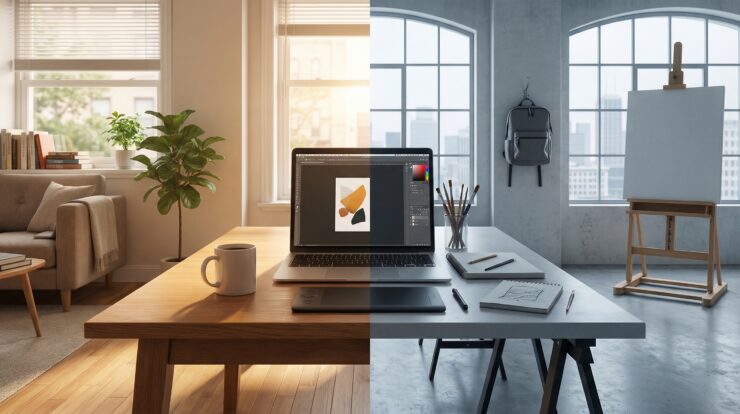
An artist recently asked me if they should sign a lease on an external studio or simply renovate their garage. They were entirely torn on the decision.
On one hand, they loved the idea of walking down the hall at midnight to capture a sudden burst of inspiration. On the other, they were exhausted by the constant bleed of domestic life into their creative time. “If I paint at home, the fridge and the television are just a room away,” they told me. “But if I rent a space, what if I don’t go?”
The space you choose dictates the boundaries you set. Your studio location isn’t just an architectural choice; it’s a strategic business decision that fundamentally alters your creative routine and professional output.
1. The Allure of the Home Studio
There is an undeniable magic to living directly alongside your work. You wake up, grab a cup of coffee, and instantly evaluate a piece that was drying overnight.
The primary advantage of a home studio is raw accessibility. You can walk into your workspace in your pajamas at 1:00 AM and execute a brilliant idea without a second thought. Your creative impulses are never bottlenecked by a commute.
But a home setup requires fierce psychological boundaries. Without a physical separation, your workspace and your living space constantly blur. You might find yourself doing laundry when you should be painting, or obsessively staring at a canvas when you should be resting.
2. The Focus of the Remote Space
Renting a dedicated workspace outside the home forces a profound professional separation. When you commute to a studio, you are signaling to your brain—and your family—that it is officially time to work.
One artist I know noted how an external studio essentially saved her productivity. At home, visiting grandchildren and a newly retired spouse meant constant, well-meaning interruptions. Renting a space blocks out that domestic noise.
In a rented space, you can close the door on the chaos. You leave the mess, the half-finished work, and the creative frustration behind when you drive home, establishing a vital division between your professional practice and your personal life.
3. Evaluating Your Creative Boundaries
To determine which setup serves your career best, you have to ruthlessly audit your own daily habits. Ask yourself where your operational weaknesses currently lie.
-
Analyze your discipline: If you struggle to start working, a home studio removes the friction of a commute. If you struggle to stay focused, a remote space removes the temptation of the living room television.
-
Audit your domestic traffic: Look closely at your household dynamics. “Can I realistically lock my studio door for four hours without someone knocking?” If the answer is no, you desperately need an external sanctuary.
-
Calculate the overhead: A remote studio adds fixed monthly expenses. Ensure your current sales volume justifies the lease without putting desperate, downward pressure on your pricing strategy.
The Final Takeaway
Your studio must actively serve your workflow, not hinder it. Whether you carve out a corner of your basement or sign a commercial lease, the goal is to design an environment where the work happens predictably and professionally.
Home or Away?
What is your current studio setup, and how does it directly impact your daily productivity? Let me know in the comments below if you prefer the convenience of home or the intense focus of a separate space.

I don’t think there is much difference being an artist or an employee for someone when it comes down to the discipline range of working at home or an office, rented studio. The Home Depot parking lot is full in the middle of the day with people “working from home.” As a consultant I’ve had office space and have also worked at home. In both environments, I believe you need to dress for success. In other words, you don’t do either in your bathrobe. I have always had my art studio in my home. My wife and I are both retired, artists and work at home. Her studio is upstairs, mine is down. We meet for lunch or snacks during the day. No matter what your space, you are going to have distractions, it’s up to your personality how you handle them.
I love my in-home studio for the accessibility reasons you mentioned. But a one-month artist residency in France last year showed me the value of a dedicated space separate from living quarters. I’m not giving up my home practice, but if my art earnings ramp up I will consider a *solo* studio space.
I’m gun shy because my previous (before France) experiences with paid studio spaces were nightmares. Costly shared spaces with people who moved more of their production into my area. My studio earnings were low. Other costs included co-op wall fees, required retail & public teaching in the gallery, insurance costs, and travel (it was eight miles away). I’ve seen co-op galleries go out of business so unexpectedly that artists’ supplies and unfinished work were seized by gallery creditors.
I prefere home as I have my own space. If any idea comes 1AM or 5 AM I am already there.
I have been a full time professional artist for 25 years making my living at it. I have always had a home studio and wouldn’t have it any other way. I don’t have grandchildren, my only child lives far away and my husband works long hours, so I don’t have many distractions. My family room is my studio so I’m close to the kitchen and laundry room. I can put on a pot of soup or wash clothes within a few steps. I also have a 4×8 for table in my garage for shipping the art and all the supplies that go with that out there. I can sit outside on my deck for a break, watch a sunset, get the mail, etc. All of these things wouldn’t happen if I had an off site studio and would have to be done when I got home, so I save a lot of time. I feel happier creating my work from home – which helps me create better art!
I started renting a space a few months back because I’v grown out of my home studio and frankly, I needed some solace. It took a while to get everything just the way I like it, but then I had very few opportunities to get there and work, and when I did, I would get pressure to return home to help with the dogs, or switch cars. Very inconvenient. Then my husband had a medical issue and I found I had to move my studio back. I had to do some serious bargaining to get the space I need at the house, and moving out of my studio was a real pain – but now I’m here, and able to paint every day!
Once I retired from my “day job”, my production really ramped up. I had a studio space on one side of the living room divided by the sofa and a rack for finished painting. As the first year progressed the sofa kept getting pushed closer to the opposite wall where the TV was.. By the end of the year I gave up trying to pretend it was 2 rooms and treated the whole space as a studio. It worked well till I had to move. I struggled with deciding whether to get a studio or get a 2 bedroom apartment using one bedroom as a studio. Most of the studios available were remodeled old factories or a communal space with limited privacy and noisey. Since I like solitude and calmness, that wasn’t for me. The other alternative was to rent a solo place that is in the downtown section that could also be used as a gallery. However that would be much more expensive than renting a larger apartment and doing my work at home. I am a plein air painter so much of my painting is outside with and without other people. So a home office works best for me.
I tried a paid studio when I was in another city. It was 10
miles from my house and had rules that included leaving at a certain time or being locked in until the am.
I have had a home studio for over 25 years. I like the idea of working when I want. Both houses that I built had plans for a studio within the house. I really think it depends on your discipline. When I work at a serious project, I don’t answer phones
Or look at TV- or allow distractions.
I feel so lucky to have a perfect studio set up. My studio is attached to my home, but is not accessible from inside the house. It was originally a mother-in-law set up, so has a separate entrances from either the garage or patio. This limits the inside-the-house distractions, yet allows me the opportunity grab a cup of coffee at 5a.m. and go check on the kilns or get a peek at a new piece as soon as it’s cool. The majority of my work is in the kiln for more than 24 hours; I can’t imagine renting a studio space and not knowing if the power went out in the midst of a firing, or even finding a place that would allow unattended overnight firings. My husband is a car guy and has a big shop in the back yard which allows us to pop in on one another for a visit, or a helping hand, an opinion, or lunch. My dog works for me full time, occupying a cushy bed next to my work bench, so it really is the perfect arrangement.
My studio space is in my home and I prefer it that way. I’m older, my children and grandchildren live in different states and my husband respects my door. He knows when that door is closed, I am not to be disturbed except for an emergency and it had better be a real one. My friends and neighbors accept the fact that if pop over without notice or during certain times of the day, they may end up visiting my husband rather than me. However, I’ve outgrown my current studio space and it has crept into the dining room, the office and any spare space available. It’s neat as a pin, and I now use my entire home as a pseudo gallery.
We are moving.. to a more metro area, a centralized location in the middle of my markets and into a much larger home. I will have a giant walk out basement larger than of our current home. Room to paint, room for storage of materials (supplies, shipping materials, art festival equipment) and room for my clients and gallerist to come over and see what’s on the easel (s), perhaps have a cup of coffee. I have tried having a space away from home and living in a fairly rural area, I just hated the commute to and from, dealing with the traffic, etc.. wondering if my husband was okay (he’s older and not in the best health). Not pleasant at all and I need to feel good about every aspect of my art. The last time I didn’t, it took me eight years to get over it. I don’t have eight years to throw away anymore.
I have a home studio and love it. However, to make ends meet I have a day job and it wouldn’t make sense for me to have a remote space not being fulltime. I think there are more customer/ collector opportunities with open studios, studio events, etc. Living in a gated community, these types of things aren’t as easy to do. Even if my art career was full time I’d probably have a home studio, but its hard to say. Currently, the set up works great for my situation although space is starting to be a limitation.
It’s an interesting choice and I love hearing all the personal experiences. I work in the garage squeezed in with the home gym and tools. since my kids are homeschooled, my door is open and I can hear them. They don’t interrupt as much as they used to- where I would have to sneak away and hope they wouldn’t notice. So it’s a lesson in perseverance. I do rent a space but I can’t work there.i do think working alongside my kids has inspired them to pursue their own creativity more, and showing them the time it takes it to do this is worth it to me while they are young.
I used to have a studio in downtown Boston which was one room out of four. The other rooms were each used by an artist, and we had a shared room for coffee, crits etc. Sounds great, right?
The downside of that was the interruptions by the other artists! If their work was going slowly, they wanted to chit-chat.
Now I have a studio wing which we built onto the house. I treat my art like a job; start work after breakfast and work until two pm. If I have my blue work shirt on, my husband knows not to interrupt me.
The biggest problem is the phone, and that would be a problem no matter where I work unless I turn it off.
I’ve always worked at my kitchen/dining room table. I’m not messy so that’s OK. My children were used to a mother who was dovetailing all tasks, and they did their own thing too. I work better in short bursts, so working at home is best for me. And I love being surrounded by my work. This year I am taking part in the 2-week-long Warwickshire Open Studios from my studio, for the first time I’m looking forward to being able to stay where I am.
I love this topic. Several years ago I began a lease in an arts centre which is an old converted mill. It separates my home and professional life and most importantly, my particular building gives me an opportunity to connect with buyers as well as other artists. I treat my studio as a gallery/work space as this arts centre allows public access and I can choose whether my door is open to them. One of the best moves I have made as an artist to further my career.
I had the luxury of a remote studio for two summers when I first started my art educator career. I was too young to appreciate that luxury but I got a lot worked out post art school. Changing where I taught erased the studio possibility.
After that, I have always worked within the confines of a residence and not always in a dedicated space within the residence.
At this point, with a fairly long arc, I have the upstairs as my studio space and this works fairly well. My other “studio” is my laptop and I spend that time in close physical proximity to my soulmate of 56 years. My first exhibited painting after art school hangs where we see it every day.
Both spaces feel like a good fit and production seems to flow well. Missing is a “stuio space” peospective gallery owners and collectors can visit. I think more than once, this was a deeal breaker though I can’t ne entirely sure.
Before retirement I worked remotely for my job so was quite adept and happy to be focused on work in the home environment. When COVID hit the work stopped and I immediately pivoted to painting in my covered patio in the back, with the same work hours. Post pandemic: I balanced both painting and work but always with an eye to return to full time painting. Now I’m happily there, and the consistency of art hours is apparent in my work. I’m very protective of my peace and quiet and don’t think a studio in a shared space would work for me. No problem to throw in laundry while I’m reviewing the past days’ work in my pajamas and making my plans for the next phase. Wouldn’t change this for anything.