


You sit down to write your artist statement, and you face a terrifying blank page.
You know your latest body of work was born out of a deeply painful personal chapter. You want to be authentic, but you are terrified of scaring away a potential buyer.
The golden rule of sharing personal hardship in your art marketing is simple: Your struggle should act as the creative catalyst, not the emotional focal point.
The Trap of the Heavy Narrative
When a collector walks into my gallery, they are looking for a connection. They want to understand the human being behind the brush or the lens. But there is a very fine line between sharing your humanity and burdening your buyer.
If you dump unprocessed trauma into your portfolio context, you inadvertently change the collector’s internal monologue.
Instead of thinking, “This piece speaks to me,” they start thinking, “Oh wow, this is incredibly heavy. Am I supposed to feel sorry for them?”
Pity does not sell fine art. It makes people uncomfortable, and uncomfortable people walk out of galleries.
The X-Ray Approach: A Real-World Example
Recently, an artist shared his photography portfolio with me. He had spent decades battling a chronic, deteriorating medical condition.
Early in his career, he admitted to throwing his illness in people’s faces out of anger. He realized it quickly became a chain around his neck. Collectors saw him coming and thought, “Here comes that guy to tell us how sad his life is.”
So, he changed his approach entirely.
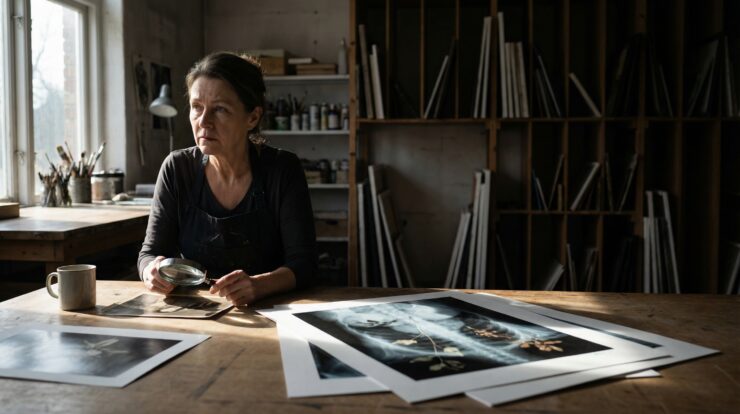
He began scanning his actual medical x-rays and MRIs, using them to explore broader visual themes of decay, physical structure, and deterioration.
He stopped complaining about his illness and started letting it inform his creative process. When he presents his work now, the medical history is simply the context. It explains where the work grew from, giving it profound depth without demanding the viewer’s emotional labor.
3 Rules for Professional Vulnerability
How do you strike this balance in your own artist story? Follow these practical steps:
-
Keep it in the rearview mirror: Frame your struggle as something that sparked the work, not an ongoing crisis you are asking the collector to navigate.
-
Focus on the universal: Translate your specific pain into a broader theme. Your medical struggle becomes an exploration of “fragility,” while your heartbreak becomes a study of “resilience.”
-
Let the art do the heavy lifting: Give just enough backstory to intrigue the buyer. Let the visual impact of the work carry the rest of the emotional weight.
Final Takeaway
Vulnerability is a powerful marketing tool when handled like a professional.
When you share your struggles constructively, you stop being a victim in the eyes of the collector. You become an authority over your own narrative.
You transform your personal hardship from a warning sign into a compelling bridge that draws the buyer closer to your art.
Question for Readers
Have you ever struggled to write about a painful inspiration behind your work? How do you balance being authentic with maintaining a professional boundary? Share your experiences in the comments below.

I’m not an artist in the traditional sense.
I’m not selling anything or building a collection. I’m just someone going through grief and trying to process it.
These started as simple scribbles. But when I draw, I begin to see things—memories, emotions, pieces of what I’m carrying.
Art has become a therapy tool for me. It helps me get things out that I can’t always put into words.
I’ve only shared a little so far. It feels vulnerable. But I’m starting to understand what people mean when they say you never know who your work might reach.
I’m not trying to be perfect.
I’m just trying to be real.
This is something I’ve been navigating recently. I’m working on a piece inspired by a deeply personal moment involving my mother near the end of her life. It’s a subject that carries a lot of emotion, and it’s not easy to put into words.
What I’ve realized is that I don’t need to share the entire story to honor it. I can express the feeling [the peace, the transition, the love] through the painting itself, allowing viewers to experience it in their own way.
That feels like the right balance for me.
Exactly this.
This is a thoughtful article and one that speaks to me as an artist. I would be interested in your feedback about my series As Pure As Fresh Snow. I reproduced one of the drawings and donated the framed prints and cards to organizations in Southern California and in Portugal that support sexual violence survivors.
I really like this as a practical consideration which isn’t discussed much. Very good!
I have spinal stenosis, which comes with aging and is progressive. Because of that, standing or sitting for long periods in the studio aren’t an option any more. I’ve changed my art practice to do much more work with quicker completions – gel prints that go into collages and smaller substrates so reaching and lifting isn’t an issue.
How to address this with collectors is a question.
My work revolves around nature since I’m a retired landscape architect. I’ve done a series of small very abstract works about visual patterns I see when hearing bird songs and about how the imagination can soar when asking yourself what a bird might see when sitting on a nest in a variety of locations. These are all about increased awareness of nature that can come from the stillness of sitting and moving more slowly, deliberately, gently.
I’m hoping that taking this intent with the work will feel authentic and make sense to collectors.
It’s my experience that artists by and large are optimists. It’s how we convert ideas, materials, energy, into physical tangible expressions.
And yet, so many artists famous or not so shoulder burdens that would crush one flat if it weren’t for that overarching sunny side of the street perspective.
It seems when I’m working, everything is in the rear view mirror– time, food, sleep, the struggle to contend with channelng the ideas and energies into physical expressions. There’s very little space left for self-pity. I can’t help a moment or two now and then, but it is not the central focus.
I must quickly add that I have struggled on this journey and there were times when I had to ne unpleasant to be around. My path is mine in the same way anyome’s path is theirs. How you might cope will be different, but the worl of your calling to be an artist awaits. Have at it.
I am wondering why art has to be because of circumstances in one’s life or of the world. Why is it that the drama of life is supposed to be our inspiration. I do my art for the sheer beauty of it, and am in awe of the splendors that are right in front of us and on display for all to see from the heavens to the earth. The things that are revealed to us in color and light, even out of the darkness of space, inspire and strike me with awe with the glory and the splendor of the power of God and all that He created.
I do my artart because I can and because I was given this gift from my creator. This my prayer, my Thanksgiving and my returning of His blessings back to Him.
I have triumph and tragedy in my life but I do my art out of gratitude and thanksgiving.
deal with the reality of whatever the challenge is and move beyond it. the way forward is to allow it to transform both your art and your circumstances. Clients can readily understand the process but rarely relate to the details of the particular event/condition. Hanging onto the past is to become the victim.
Look at the stories of artists throughout recorded history , most will have been transformed by their challenges. The resultant art speaks in a way the comfortable easy life does not. Take the leap because rarely is there another path.
for myself it has been relearning several times how to read, write, walk and communicate after major surgeries. The art has deepened each time. take it as an opportunity to create your life anew.
Robert, the challenge IS the message. It is part of you forever, and your art embodies that. It isn’t about moving on, that signifies a loss of lessons, a loss of embodying those lessons. It is about embracing both things, the broken self and the hopeful self. Or the broken self and the healed self. Even the healed self has scars. Both can be held at the same time, and both can be seen in the artwork. Acknowledging the past is not the same thing as hanging onto the past. Both are very different, and being a victim is real and should be acknowledged. We don’t have to live in a victim mentality, however. I agree. But moving on is not the same thing as acknowledgement and healing, or acknowledgement by story, to educate and edify.
I am sure that your art has deepened, how could it not with such a history? The “moving on” jargon connotes dismissal in my mind. Embodiment is a different story. Good luck with your healing journey.
I have sometimes debillitating struggles in my life that interfere with my ability to create sometimes. I never once thought about mentioning these struggles to collectors. I never reflect them in the art I create, hoever I do know artists that do.
This is an interesting post. Thanks for sharing.