


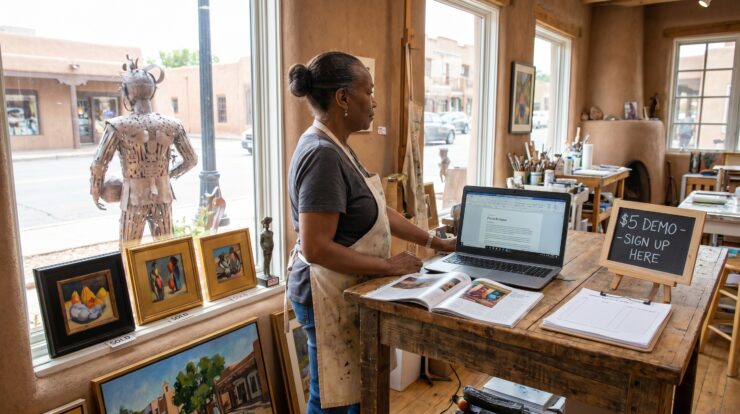
Most artists view a busy street outside their studio as a nuisance. The noise interrupts your flow, the traffic complicates parking, and you often find yourself thinking, “I just want to be left alone to paint.” But as a gallery owner, I see busy streets differently. I see them as a free, built-in billboard. If you are producing work in a space with high foot or vehicle traffic, you possess an asset that most businesses would pay thousands of dollars in advertising to replicate.
In this post, I am speaking primarily to artists who have studios in public or highly visible locations. However, many artists have studios in their homes or other spaces that are not as accessible. If that sounds like you, do not worry—whenever you participate in open studio events, art walks, or local pop-ups, much of what we are discussing will still apply to you.
To illustrate how powerful public visibility can be, consider artist Anna Jewel Gove, who has been building her studio practice in Santa Fe, New Mexico, in a highly visible location near the city’s Railyard neighborhood. Her space is unconventional, but that visibility has become part of the opportunity. As neighbors and passersby see her working outside on large papier-mâché sculptures, curiosity builds long before an open studio event begins.
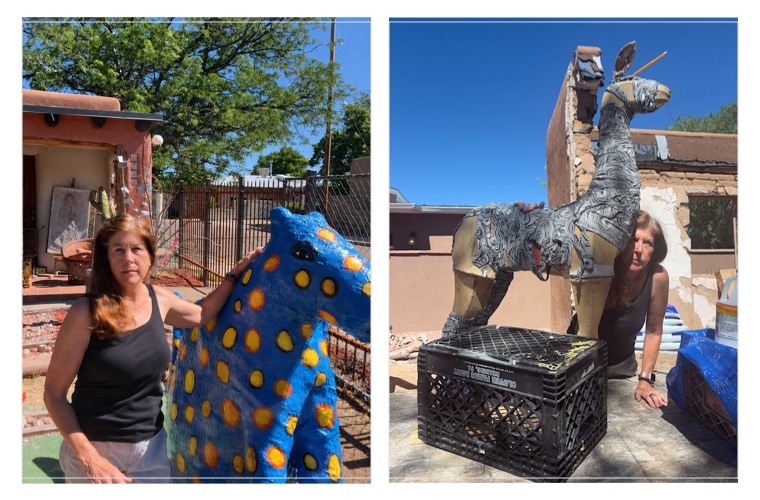
Anna Jewel Gove in her Santa Fe studio with examples of her papier-mâché sculpture practice. See more of Anna’s work at AnnaJewel.com and AnnaJulie.com.
The golden rule of local marketing is simple: passive street visibility means nothing unless you actively convert that traffic into earned media, captured emails, and tangible sales.
1. The Psychology of the Drive-By Collector
When you work outside or in a highly visible space, you are passively building anticipation. For months, local residents might drive past your workspace, watching your process and thinking, “What exactly are they making out there?” This consistency creates a powerful sense of familiarity and social proof. By the time you announce an open studio, the local audience is already primed. They don’t need to be convinced to look at your art; they simply need an invitation to finally step behind the fence or through the door.
2. Leverage Local Media with a Simple Pitch
Foot traffic alone won’t maximize your sales, so it pays to pitch your unique process to the local press. Anna wrote a basic press release, used AI to polish the formatting, and emailed it to the two main local publications. The result was a full-page feature article in the Sunday weekly magazine the day before her event. When pitching local media, follow these guidelines:
- Target local interest: Newspapers want stories about their community, not just generic artist profiles. Focus on what makes your process or location unique to the city.
- Use AI for formatting: If you are intimidated by writing a press release, draft the raw facts and use AI to clean up the structure.
- Provide high-quality images: Make the journalist’s job easy by attaching clear, compelling photos of your work and your studio space.
3. The Low-Friction Demo and Email Capture
Once an article or street presence drives traffic to your studio, you need a way to capture visitors’ contact information. Offering a simple demo of your process is highly effective. If an event allows, you can charge a small fee, which serves a brilliant psychological purpose.
- Charge a micro-fee: By charging just five dollars for a demonstration, you weed out the uninvested looky-loos while keeping the event highly accessible.
- Incentivize the email opt-in: Don’t just pass around a blank clipboard. Hold a raffle for a small, inexpensive matted print at the end of the demo, requiring an email address to enter.
- Follow up immediately: Once you capture new email addresses, send a brief, appreciative follow-up email right away to solidify the connection.
4. Move the Inventory
The combination of year-round visibility, local press, and an engaging demo can create an absolute frenzy of traffic. During her open studio, Anna didn’t just sell her new work; she dragged decades-old prints and small drawings out of storage and priced them to move. She sold a massive sculpture to a fellow artist, along with multiple smaller pieces. Ultimately, she generated over $2,000 in sales, far exceeding the average take for the artists on the tour.
The Final Takeaway
You do not need a massive marketing budget to generate buzz in your local community. By utilizing the visibility you already have, pitching a clear story to local media, and strategically capturing contact information through a low-barrier event, you can turn passive neighbors into paying collectors.
What Is Your Local Leverage?
Have you ever used your studio’s physical location or a local event to capture emails and generate press? Share your strategies, successes, and setbacks in the comments below.

Jason,
You taught me this years ago! Drawings…. Email collection. I had a nice following in Old Mesilla. Here in San Angelo, I’ve had to start over. We moved across town, and I have an Art Studio in a shed in my backyard. And I’m restarting AGAIN. This inspires me and keeps the wheels turning.
Someone email mea link on waterproof papier- mache! There are sheep all over this town… I need something in my front yard!
Thank you,
Debra
As always Mr. Horejs – your insight and advice are most valuable. I might tweak the ‘micro-fee’ just slightly to clearly state that the 100% of the fee is being donated to Xxxxx local charity.
Brilliant.
This is inciting me to expand my thinking beyond pop-ups in my courtyard which I started because of the foot traffic. a fun demo or other intriguing lure. fun for passerbys to see what is happening i the studio where by the way they can see my art surrounding me.
THANK YOU!