


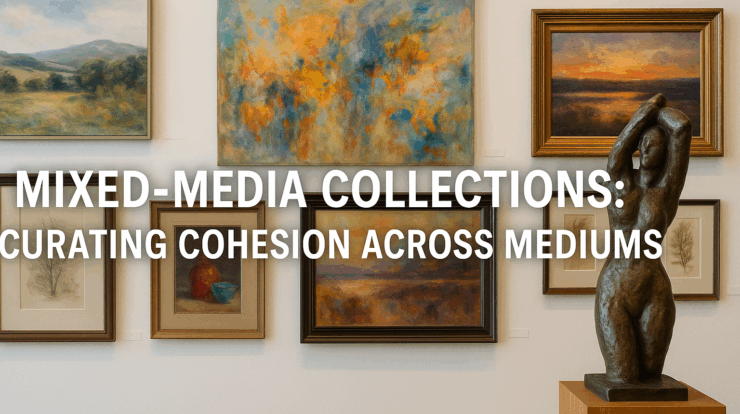
If your body of work includes more than one medium—paintings and prints, sculpture and collage, oils and encaustics—you’re not alone. Many artists today are working across disciplines, and for good reason: it keeps creativity flowing, and it opens new avenues for expression and experimentation.
But when it comes time to present that work—on a gallery wall, in a portfolio, or online—it’s easy for mixed-media collections to feel disjointed. Without care, a diverse practice can look like three artists sharing one website.
The good news: there are proven strategies for bringing cohesion to even the most varied collections.
Think Like a Curator
Galleries do this all the time. We hang abstract paintings next to representational ones. We mix ceramic, metal, and wood sculpture. We create harmony from variety.
And the trick isn’t to force sameness—it’s to find and emphasize the connections between works. Here’s how:
Use a Common Color Thread
A shared palette across mediums is one of the easiest and most effective ways to create unity. Even wildly different pieces feel cohesive if they share dominant tones. For example:
-
A warm ochre that appears in both your oil landscapes and your hand-pulled prints
-
A rich black line that threads through drawings and steel sculptures
-
A neutral ground or backdrop that links otherwise contrasting works
When shooting work for your website or a submission, consider showing a few pieces together to demonstrate this harmony.
Develop a Thematic Through-Line
Subject matter and theme can be powerful anchors. Whether you’re exploring identity, memory, ecology, or motion—highlight the common ideas across formats.
You can do this with artist statements, show descriptions, and series titles that frame your work in narrative terms. Give viewers a lens through which to understand the connections.
Even something as subtle as a recurring symbol or gesture—a circle, a slash, a motif—can act as a visual breadcrumb trail between pieces.
Use Consistent Titles and Descriptions
Your titling conventions can tie your works together. Try:
-
A series title followed by individual identifiers (e.g., Echoes I, Echoes II)
-
Consistent language or tone (poetic, minimalist, descriptive)
-
Descriptions that reference the same themes, processes, or inspiration points
Consistency here builds brand clarity, even across formats.
When Hanging, Use Rhythm and Balance
If you’re showing work in person or hanging a booth at an art fair, treat your display like a composition. Vary the scale and media, but create balance. A few pointers:
-
Group by visual weight (darker works clustered or anchored by lighter ones)
-
Place similar textures opposite each other for contrast
-
Use negative space to keep the arrangement from feeling chaotic
-
Echo shapes and forms from one piece to another
You’re not just hanging pieces—you’re choreographing how a viewer experiences your world.
Mirror the Approach Online
Your website is your gallery wall. Don’t just dump everything into one page. Curate. You might:
-
Create themed galleries that mix media around a shared concept
-
Use short headings or statements to connect what’s in each collection
-
Display thumbnails that create visual flow—similar tones or shapes adjacent
The goal: to let a visitor feel like they’re stepping into a unified body of work, not flipping through unrelated experiments.
The Power of Cohesive Variety
When mixed-media work is presented well, it doesn’t feel fragmented—it feels rich. A well-curated collection shows confidence, range, and clarity of vision.
You don’t need to make everything look the same. But you do need to help viewers understand how it all fits together.
Show them the threads—and they’ll see the tapestry.

Hi Jason,
This is a really interesting and important subject, and I’m glad you’re addressing it. I think I understand much of what you wrote. However, it’s a complex subject, and I expect that your readers (including myself) would benefit from some visual examples and more in – depth written explanation in some areas. In other words it would be great if you would write a longer article on the same subject.
Thanks,
Hal
Great suggestion Hal – I’ll work on a longer article with illustrations – stay tuned!
This topic is absolutely important to me because I try to merge different visual languages in my work, all of which have the creative act as a common denominator. I constantly try to substantiate this fusion through written essays, not only so that the viewer understands my intention, but also to solidify the meaning of my search. Thanks for sharing, and, as Hal says, it would be interesting to expand further on this topic. Thanks again, Mario.
I agree With Hal. Some suggestions are hard to visualize.
Thank you so much for your advice, as always. When I first started to paint, I was obsessed, and still am, with beautiful bright rich colors in my skies. I used a lot of orange, orange vs. purple and lavendar, orange vs. lime green, orange vs. you get the point. But not 100%. As time has gone on, sometimes I try abstracts just for fun, different color combinations, etc. However, I think it is best for me to stick to what really captures my soul, the bright colors, the beautiful sunsets and skies. Some people say my paintings are too bright or too bold for their home. I think I need to move on from what other people think of my work, and create my work. I think we all have to paint what makes us happy and what feels comfortable. I will never be famous, but I hope I will continue to be happy and love what I do.
This has been very helpful as i am an artist who works primarily in oils.. I also do pastels and encaustics..
Now I have been trying my hand at mixed media.. You have given me information that will help tie it all together.
This is super helpful. I’ve been focusing on oil landscapes for several years now, but I love doing my encaustic monotypes. So I started doing abstract landscapes with my monotypes, and they are currently my best sellers! I still have not put many of them on my website because I didn’t want to seem “all over the map” but after reading this post, I have some ideas how I can make it work.
Thanks Jason!
I found this very helpful since I’m really in this category with being a glass artist and painter.
Only one gallery that I sell through sells both, and now I’m wondering if that’s the reason why my greeting cards of my floral paintings do better there than anywhere else. Maybe customers who like my glass dragonflies make that association.
Thank you, Jason. I struggle with this as an older painter with bits and pieces left from many shows over many years – many sold and many left behind. So I am left with putting together what remains into coherent groups = sometimes along the original lines I was thinking of when I created them; sometimes putting disparate pieces together to show as a group. I look forward to images illustrating these ideas.