


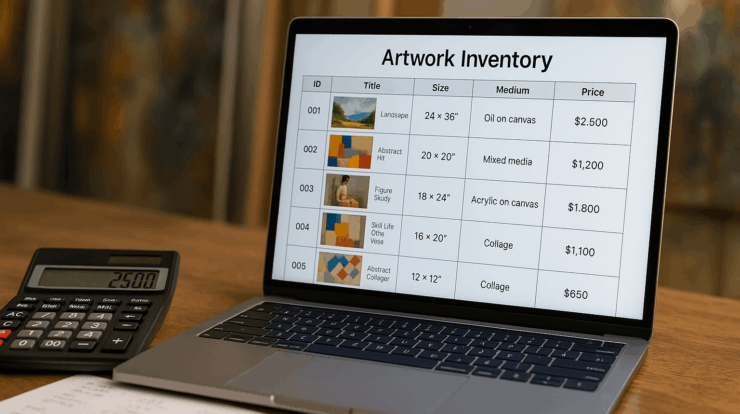
Pricing is one of those topics I return to again and again—and will continue to revisit in the future. It’s one of the most common questions artists wrestle with, and one of the trickiest aspects of the art business. No formula solves everything, but there are principles that can help you bring order to the process, even when your work doesn’t fit neatly into a standard pricing model.
Consistency Matters More Than Rigid Formulas
Many artists want the security of a single formula that dictates price—say, by square inch or linear inch. That approach can be a good starting point, but what matters more than the formula itself is consistency. Collectors and galleries need to feel confident that your pricing makes sense across your body of work. If two pieces of similar size and complexity are priced wildly differently, questions start to arise.
The goal is not perfection, but predictability. Buyers don’t need to know your formula, but they should sense an internal logic.
Hybrid Pricing for 2D Work with 3D or Mixed-Media Elements
Where formulas break down is when a painting incorporates significant three-dimensional or mixed-media components. In these cases, a square-inch calculation alone underestimates the time, skill, and cost involved. Artists in this position often find themselves adopting a hybrid approach—starting with a size-based calculation, then layering on an additional charge for complexity.
Think of it less as abandoning the formula and more as adapting it. Sculptors, for example, rarely use square-inch calculations; they price based on scale, materials, and labor. If your work straddles the line between painting and sculpture, your pricing method should, too.
Adjusting for Complexity
A few examples of how artists build this in:
-
Figurative work: A painter may start with square-inch pricing, but add a surcharge for each figure in a composition, acknowledging the additional labor involved.
-
Mixed-media attachments: For works that include ceramic, wood, or floral elements attached to the canvas, artists may create a tiered add-on system—charging a set amount for small, medium, and large additions.
-
Found-object work: Collage and assemblage artists sometimes classify studio materials into categories (common, rare, or unique) and assign values to each, then total those values into the final price.
Each of these systems reflects the same idea: complexity must be accounted for, but in a way that keeps results predictable.
Building a Repeatable, Predictable System
The best pricing systems take the guesswork and emotion out of the process. Ideally, if a studio assistant picked up your spreadsheet, measured a new piece, tallied its elements, and applied your system, they would arrive at the same price you would. That’s the mark of a solid system: it’s repeatable, scalable, and objective enough to guide you even when you’re feeling uncertain.
The longer you use a system, the more intuitive it becomes. Over time, you may even stop calculating and simply know what a piece of a certain size and complexity should be priced at—because your internal compass has been trained by the consistency of your system.
Keeping Explanations Simple with Galleries
When it comes to galleries, the details of your formula matter less than the fact that you have one. A gallery doesn’t need to hear about multipliers, add-ons, or tiered charges. They just want to know that your pricing is consistent, sustainable, and that future works will be aligned.
If asked, a simple explanation such as “I base my pricing on size, with adjustments for complexity” is enough. Over-explaining risks confusion. Galleries want reassurance, not math lessons.
Final Thought
Pricing will always involve judgment, and every artist occasionally second-guesses a number. The aim is not to eliminate doubt but to reduce it. By committing to consistency, allowing flexibility for complex variables, and simplifying how you communicate your system, you give yourself—and your collectors—confidence.
I’ve written about pricing many times before, and I know I’ll return to it many more times. The challenges won’t disappear, but with a thoughtful system, the decisions get easier, and your career becomes more sustainable.

This is really helpful to me right now, Jason. I’ve been working out my pricing for my first ever market (first time selling) on Sunday. I’m using the linear-inch calculation, but there are a few pieces where I feel I need to make adjustments, some collages in particular. This gives me the confidence that I’m on the right track.
I live in a rural area and my prices have reflected the relatively low pricing the local market can bear. Now, however, I’m striking out to other more urban areas to show my work, nation-wide, and I feel my pricing needs to be adjusted. Your advice has been to be consistent in pricing no matter where the artwork is being shown, so should I undervalue the work in markets where higher prices seem called for, or do I price myself out of my local market?
That’s a tricky predicament, Alain. I’ll be interested to hear Jason’s answer.
Cool, interesting work, by the way!
I do get your dilemma. Quite a few years ago I did an evaluation of my pricing according to Jason’s advice and found I was undervaluing my work a lot. I doubled my prices and lost my market for about three years. I now up my prices every January and selling seems to be consistent. I think, perhaps, you may want to move into the higher priced market. Are you willing to lose your current clientele for a time? They may come back to you when they see you have moved on. Like Jason says, consistency is crucial. Right across the board.
Thanks. Thoughtful insight. Very clear.
Hi Jason,
Thank you for sharing your thoughts about the art world. All of your posts are interesting and helpful. Do you think it’s ok to increase the price for a work that has won an award or been accepted into a prestigious competition?
Typically I don’t recommend it, Rick. I’ll need to write a post on this to fully explain, but the basic concept is that I’m leary of indiscrepancies in pricing. While it’s true that some buyers might be impressed that a work won an award, typically buyers are going to be drawn to the work that most speaks to them. Why would you want to send the message that what they like isn’t worth as much as what a judge liked. Those who happen to like the awarded work get an added incentive to buy the work.
My pricing is consistent via website, galleries and shows, based on size with added simple conservation framing. Since I regret selling a couple of pieces years ago, I have recently priced a couple higher — a “don’t want to sell it” price. When asked, I am happy to talk about the piece(s) and my love and enthusiasm and attachment to it is obvious. To a collector, the price may be insignificant compared with owning that joyous little piece of my soul and a connection with me. In such a case, I am okay if it does not sell because I am so vested in it and do not care to regret again.
There was one for sale normally, then a death so I changed it to NFS. After a few years I was once again ready to let it go, for a little more, and it was grabbed instantly the first day of the show opening.
Our enthusiasm and emotion does affect our work, for the better.
Thanks … this is a great help! I appreciate simplicity myself so this was right on target … I base my pricing on size, with adjustments for complexity.
Please don’t leave us sculptors and clay artists out of your articles as it we’ve got this all figured out! We need help with the same issues as 2D artists looking to get their work into galleries!