


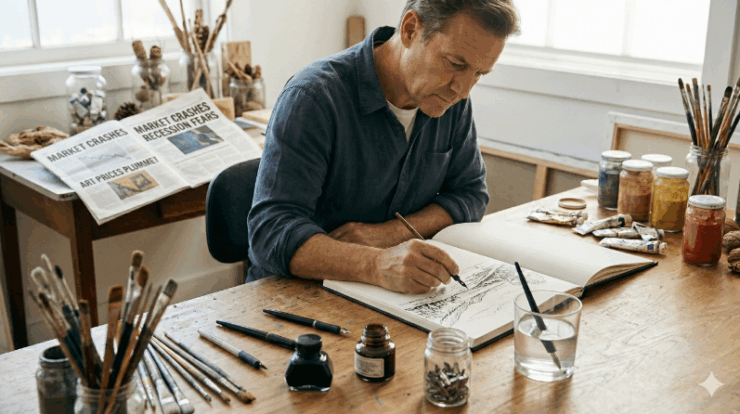
It’s been a wild few years for headlines. Markets up, markets down. Inflation fears, election cycles, global tension, interest rates, banking scares, booming months followed by surprisingly quiet ones. It’s understandable that artists look at the news and wonder what it means for sales — or whether it means anything at all.
Financial climate and art buying are connected, but not always in the way we assume.
In my experience watching collector behavior season after season, uncertainty has more immediate effect on art sales than actual economic downturn. Wealth doesn’t vanish overnight when the stock market dips. What changes is confidence — and confidence is often what drives someone to buy a painting or walk away to “think about it a little longer.”
The Real Influence Is Not the Economy — It’s the Mood Around It
When the financial news turns turbulent, many people pause before making discretionary purchases. Not because they’ve suddenly lost the ability to buy, but because they’ve lost a sense of clarity. A collector may still love a sculpture, still envision it in their home, still have the means — but hesitate when the headlines tell them the world is unstable.
This hesitation can show up as:
-
“We’ll wait and see how things look next quarter.”
-
“We’re watching our portfolio — maybe later.”
-
“We’re remodeling but want to hold off for now.”
Meanwhile nothing substantial has changed in their net worth.
Volatility sparks caution more than scarcity.
I’ve watched years where the stock market bounced dramatically — down one week, up the next — and sales reflected the mood swings more than the numbers. Buyers weren’t unable to purchase; they were uncertain whether they should.
The Danger for Artists Isn’t the Economy — It’s Overreaction
When sales slow for a few weeks, it’s tempting to attribute it to an economic headline, assume the worst, and mentally pull back. But the pattern I’ve seen repeatedly is that those who retreat during periods of uncertainty are the ones who fall behind when confidence returns.
The artists who hold steady — continuing to create, show work, reach out to collectors, and feed their marketing channels — are in position when the pause lifts.
Overreacting to the news cycle often looks like:
-
Halting production
-
Reducing visibility
-
Delaying outreach
-
Assuming buyers “aren’t spending right now”
In reality, sales often resume as soon as sentiment stabilizes — and they go first to those who stayed active.
Less News, More Work
None of us can control global markets, election cycles, or media tone. What we control is our studio practice, our presentation, our relationships with collectors, and the consistency of our activity.
I’ve noticed that artists who limit their exposure to headlines generally navigate uncertainty more productively. Not because they’re uninformed, but because they’re less emotionally reactive. They spend less time forecasting catastrophe and more time building inventory, strengthening marketing, and refining pricing and presentation.
It’s a simple equation:
The more attention you give to news, the less momentum you often maintain.
The more attention you give to your work, the more resilient your business becomes.
A Practical Approach for Artists
When the headlines look chaotic — and they will again — the healthiest response is measured, not emotional.
A few practices that make a difference:
-
Watch long-term trends, not weekly swings.
-
Maintain production even when sales slow.
-
Keep marketing consistent, especially during uncertainty.
-
Remember that hesitation ≠ inability to purchase.
Collectors don’t disappear; they wait.
When confidence returns, opportunity favors the prepared.
The Noise Will Continue — Your Work Should Too
Economic cycles rise and fall, but art buyers rarely vanish. They pause, observe, and move forward when the world feels stable again. The artists who remain present through those pauses — steady, productive, available — are the ones who benefit most when momentum returns.
Headlines create hesitation.
Consistency creates opportunity.
And the quieter you keep the noise, the clearer the path ahead becomes.

Great article, when the economy is unstable and art sales dip, it is an opportunity to continue creating and getting your name out when others may hold back.
if your in the art business long enough to view trends [both up and down] and have survived the realisation of steady gets the reward seems more real. chasing the latest news cycle [up or down] is interesting for short term plans only.
the next big thing is often not over the horizon its in your own back yard. continue the work of presenting and creating your unique art, its the only thing you can control.
Great article Jason. I agree 100%. The media is well trained to scare and create a negative outlook for people. It’s good to be cautious, but better to be aware of who we are listening to. We have to keep living our lives, moving forward, and keeping hold of our dreams, especially in the art world.
This is a resonant and necessary read. The advice to connect deeply with “why” you create feels especially vital—it’s the one constant an artist can control when external markets feel volatile. The idea of focusing on community and accessibility, rather than chasing trends or high-stakes sales, seems like a more sustainable and human-centered path forward, both financially and creatively.
My question is about the practical mindset during creation. For an artist in the studio today, does selling in uncertain times change the creative process itself? Should they consciously create smaller, more accessible pieces, or does staying true to their vision—even if that means large, ambitious, and expensive work—become an even more important act of resilience?
Yes, really crazy times for sales!
I cannot control the external influences, so I keep my head down, brush to board, and use the time to produce … while trying to pay my rent.🤔😬
When I leave a comment, the form will not accept my url … leeperrault.com
🧐
Exactly what I told myself this morning.. no news. You’re so right..turbulent times call for more focus on your work, whether it’s in the studio producing or performing administrative tasks and research. Stay focused