


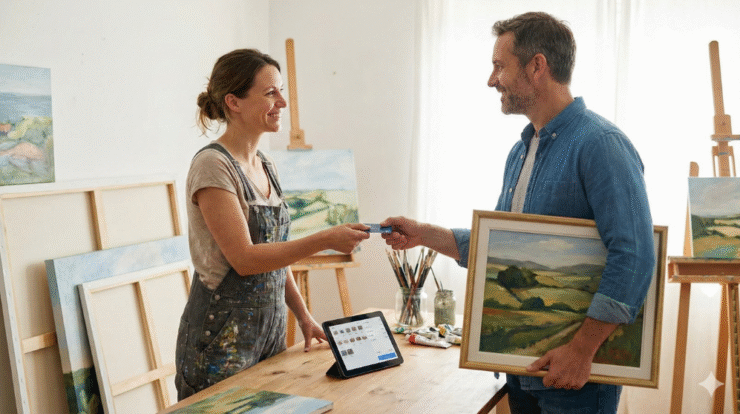
It is a scenario every artist faces eventually. You are at a gathering, or perhaps hosting an open studio, and a close friend or family member stops in front of a piece. They look at it, then look at you, and ask: “I love this. How much is it?”
For many artists, this moment triggers an immediate internal panic. A feeling of “ick” sets in. We suddenly feel like we are capitalizing on a relationship, or that charging full price to a loved one is somehow greedy.
To compensate, the artist often blurts out, “Well, it’s listed at $1,000, but for you, I can do $500.” Or worse, “Just take it, pay me for the materials.”
While this comes from a place of generosity, I want to suggest that treating your friends and family differently than your “real” collectors is actually a disservice—both to you and to them.
Respecting the Buyer
There is a misconception that “sales tactics” are manipulative tricks we use on strangers, but that we should be “authentic” with our friends.
I take the opposite view. Good salesmanship is not about manipulation; it is about service. It is about educating the viewer, sharing the story behind the work, and helping them acquire something that will bring value to their lives.
When you rush to offer a discount or shy away from the price with a friend, you are making an assumption. You are assuming they don’t value your work enough to pay for it, or that they are looking for a bargain rather than a piece of art.
My advice is to treat your friends and family with the exact same professional respect you would afford a stranger walking into a gallery. Don’t skip the “sales” part. Tell them about the inspiration. Explain the technique. And when they ask the price, state it clearly and confidently. Give them the dignity of being a true patron of the arts.
The Value of Paying Full Price
There is a psychological component to pricing that we often forget: People value what they pay for.
If you give a family member a painting for free or at a steep discount, it often ends up in a closet or hung in a spare room. But when someone pays full price—or close to it—they have made a significant investment. They have skin in the game. That artwork becomes a prized possession, not just a “favor” they did for their artist cousin.
Furthermore, your friends and family are often your biggest cheerleaders. They want you to succeed. When they offer to buy your work, they often want to support your career. By slashing the price immediately, you are denying them the opportunity to support you in the way they intended.
The “Friends and Family” Discount
Does this mean you can never offer a deal? Not necessarily. But I would urge you not to offer it preemptively. Wait to see if price is actually an objection.
If a friend loves the piece but genuinely can’t afford the sticker price, you can handle that negotiation just as you would with any other client—perhaps offering a payment plan or a modest adjustment. But do not institute a blanket “50% off for relatives” policy. It devalues your inventory and sets a precedent that can be hard to break.
I often joke with friends that my gallery has a very strict “Friends and Family Discount policy.” When they ask what it is, I tell them: “It’s $20 off.”
It always gets a laugh, especially when we are talking about paintings worth thousands of dollars. But the joke serves a purpose. It signals that this is a business, the prices are real, and while I love them, the value of the art remains the same regardless of who signs the check.
Conclusion
Don’t let the fear of awkwardness rob you of a sale or rob your loved ones of the experience of collecting. The next time a friend asks about a piece, take a deep breath, smile, and treat them like the VIP collector they are.
How do you handle this?
Do you have a set policy for sales to friends and family? Do you find it difficult to talk money with people you know personally, or do you find they are your easiest customers? Share your experiences in the comments below.

I do give CLOSE friends and MY Sister a discount. Not much but they get a discount of 10-20% on their 2nd and 3rd paintings.
I believe this is also a matter of treating your artwork with the respect it deserves. When you discount your art, you are diminishing it – not only to the people you give the work to, but also to yourself and your efforts.
I will always value my friends and family enough to offer them my work at a reasonable price. They are special and their support of my craft is invaluable.
I have a dear friend, 25 years of growing into our art together. He is a stupendous artist and as a side gig, an internationally renowned surgeon with a sterling reputation. He’s so graciously helped me through huge health issues – I simply adore him and his wife. Without ever saying a word to me about wanting a piece of mine, which frankly, I would have given to him without a second of hesitation, his wife bought him a piece of mine from Xanadu as a gift. She sent me a video of him unboxing it. Knowing I would have sent them whatever they wanted, the fact they bought it without ever saying a word to me, I can hardly describe that pride. They didn’t put me in the situation to stammer about price. They loved it, they bought it, and it’s probably my favorite sale ever.
No sale has ever made me feel more valued than when two different friends purchased paintings at two different shows without my knowledge. One invited me for dinner and included the surprise unveiling my Raven hanging in a lovely setting in their dining room. The other friend had a ladies neighborhood luncheon. Imagine my surprise when it was another “reveal” for all to share. Neither friend had asked for a discount or even hinted to me that they were purchasing the pieces.
This is a timely blog. I’m hesitant to give a discount to friends if they ask for several reasons: 1) I price my work reasonably to begin with. 2) A discount makes me feel de-valued. 3) I’m pretty sure I can sell my paintings at full price elsewhere. 4) I don’t want the word to get around that some people get discounts. 5) I don’t want to short circuit a gallery I’m working with. I took a year long workshop with an artist on the business side of art years ago. I remember she said not to offer discounts for friends and family but instead offer something else of value such as a print of your work, greeting cards with your work on them, free art installation, etc. That said, If I want to give a painting as a gift, that’s different but not on request.
I have a standard policy of offering a ‘friends and family’ discount of 15% (the equivalent of me paying the tax on a piece) up to 20% on large paintings. The exact percentage varies as I ’round’ up/down to the nearest $50. I expect I could be even more professional and just stick to 15% across the board, no rounding.
Friends and family can be a bit challenging. I had originally offered a small print as a housewarming gift.
To save a friendship, I cancelled because the friend truly could NOT afford any art but wanted
3 large pieces. I was happy to offer a discount on the first as she had just purchased a new home and had give me something of value earlier. However, as negotiations developed over 2 months! She wanted extra art for the same discount and then wanted a long payment plan while having my art all that time. It became so uncomfortable for me that I finally said: I need to cancel this order, go back to my original offer. So, I packaged up the print and put it in the mail that evening. I hope they frame it well and enjoy.
I sold a painting to a cousin in another state and did not discount the price. Instead, I gave her a small 5×7 as a Thank You and paid for half the shipping cost.
Yes- This has kept me awake at night.
Quick Story: the descendants of our first settler get together each year at a little park at the base of the hill where the homestead once stood. I had made a digital painting if the hill a few years ago. I decided on a whim to bring it so that once and for all, my cousins could see what it was i did with my time.
It attracted serious attention and questions as well as stories I had forgotten about. Many small works given as wedding gifts had valued places in homes and hearts. One cousin I had never met asked me if it was for sale.
Panic set in. Others leaned in. I said , yes. Not ready for the next question which gets to the heart of this article. Fear is a stumbling block and a lie sometimes. I feel, if I had stated a price there might have been a bidding war.
As it turns out, I have a lot of drafts of a letter.
I will finalize and send the letter this weekend.
A Gentle Reality Check:
Selling art to friends sounds simple.
It’s not.
I’ve experienced it with paintings, prints, and wedding photography. And somehow, the moment price enters the room… so does expectation.
“Do I get the friends-and-family discount?”
“Can I just have it?”
“Remember that weekend at my ski chalet?”
Ah yes. The nostalgia-based pricing model.
Now listen — I believe in generosity. I believe in reciprocity. But my work didn’t materialize out of thin air. It came from tuition payments, student loans, materials, failed canvases, late nights, and years of refining my craft.
For a long time, I would preemptively discount myself before anyone even asked. I thought I was being kind. What I was really doing was avoiding discomfort.
There are beautiful moments. Friends proudly hanging your art and saying, “That’s my friend — she’s an artist.” That part feels amazing.
But here’s the less romantic truth:
Sometimes people want access more than art.
Sometimes “support” comes with strings.
Sometimes a discount quietly becomes an entitlement.
And yes — I once had someone ask to trade in a painting she bought 25 years ago. As if art came with a lifetime exchange policy.
It doesn’t.
I’ve also noticed something interesting: the bigger the “friend discount,” the higher the expectations tend to climb. Funny how that works.
Here’s what I know now:
Discounts given from guilt create resentment.
People value what they invest in.
And clarity is kinder than awkward generosity.
Selling to friends isn’t wrong.
But art isn’t a favor.
It’s a profession.
And the friends who truly support you?
They don’t ask you to shrink your value to prove your friendship. 😉
I sell my art in a small seaside town. We have a lot of tourists. I received payment for a painting and I asked the owner who had bought the painting as locals also are my collectors & I like to thank them. She said the purchaser asked to remain anonymous. I respected that & didn’t ask further. The painting remained on the wall of the shop for quite some time and so I asked if it needed to be delivered. The shop owner then confessed ( I guess enough time had gone by!) that my son, who lives away, had purchased the painting!
I think that I price my art fairly and frankly given my cost I really dont make any money when I take supplies, classes, frames etc – yet I’m still not comfortable when friends/family ask for a discount – i like it when people want my art but not sure what to do
This article and comments help