


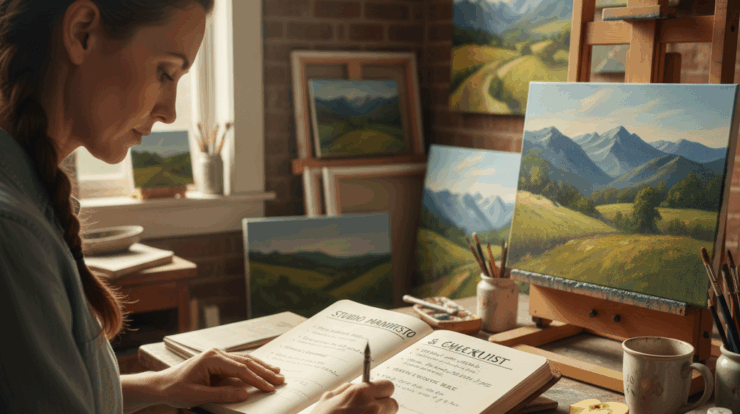
Over the years, I’ve learned that rules can be freeing. At the gallery, we have systems for nearly everything—how we photograph artwork, how files are named, how and when clients are contacted. It’s not because I love structure for its own sake. It’s because good systems make space for calm. They reduce anxiety, eliminate rework, and keep the creative energy where it belongs: on the art.
Artists can benefit from the same kind of structure in their studios. A few clear rules can take the edge off the chaos that comes with managing your own production, promotion, and communication.
The Power of a Pre-Submit Checklist
Before you send an image to a gallery, publication, or collector, pause and run through a short list:
-
Final photo taken? Make sure lighting, color, and cropping are accurate.
-
Title, size, and medium finalized? Details tend to drift during creation—lock them down before sending.
-
Varnish or finish applied? Avoid awkward surprises when a piece looks different in person.
This checklist becomes your line in the sand—proof that the piece is finished and ready to represent you.
No Edits After Send
Once you’ve shared an image, consider the piece done. This single rule saves a lot of stress for both artists and galleries.
When a piece keeps changing after it’s been submitted or photographed, keeping records straight becomes a tangle of confusion. It also drains you emotionally—you’re never “done.” Establishing your own no edits after send policy lets you release the piece and focus on what’s next.
If this idea resonates, I wrote more about it here:
https://reddotblog.com/stop-revising-your-art-after-you-share-the-photo/
Versioning and Naming
Adopt a simple naming convention for your images and documents, such as:
Lastname_Title_Year_Dimensions.jpg
orLastname_Title_YYYYMMDD_v1.jpg
When you’re sending dozens of images a year, this habit prevents mix-ups, helps galleries stay organized, and makes it easy for you to track versions when you update your portfolio or website.
A Simple Outreach Cadence
Without structure, communication can become reactive—you either overdo it or forget entirely. Set a rhythm:
-
Check in with your gallery once a month.
-
Email collectors quarterly with updates or new work.
-
Post on social media once or twice a week, then stop worrying until your next slot.
Predictable routines reduce decision fatigue. You don’t have to guess when to reach out—you already know.
Other Studio Rules to Consider
Here are some practical “rules of thumb” I’ve seen artists adopt that make their careers smoother and less stressful.
Creating and Workflow
-
Paint in consistent blocks of time, even if short, to build rhythm.
-
Photograph every piece before varnishing or framing.
-
Keep a simple studio log noting title, date, medium, and size.
-
Have a weekly cleanup and restock day—reset before the next cycle.
-
Set a rule for when a piece is finished (e.g., after signing, no further changes).
Gallery and Representation
-
Respond to gallery emails within 24 hours.
-
Never deliver or ship wet work.
-
Keep a current inventory list that matches what the gallery has.
-
Notify your gallery immediately if a work sells directly from your studio.
-
Use consistent pricing across venues—no exceptions.
Client and Collector Communication
-
Send thank-you notes (or emails) within 24 hours of a sale.
-
Follow up with new collectors a month later to check on delivery and satisfaction.
-
Maintain a collector database with notes about preferences and purchases.
-
Offer to notify clients when new work in their favorite style becomes available.
Marketing and Professionalism
-
Update your website twice a year with current inventory.
-
Keep your artist statement and bio in a single, easy-to-access document.
-
Use the same headshot and short bio everywhere for consistency.
-
Avoid posting work-in-progress photos until pieces are finished and documented.
Personal Sanity Rules
-
No studio work after a set hour—protect your rest and recharge time.
-
Step back from a finished piece for 24 hours before calling it done.
-
Treat administrative time (emails, inventory, finances) as real work—schedule it.
-
Don’t compare your studio pace to anyone else’s.
Rules That Simplify, Not Restrict
Good studio rules don’t box you in—they clear mental clutter so your creativity can breathe. Whether it’s a workflow checklist, a naming convention, or a policy that says “the painting is done when the photo is sent,” structure builds confidence.
I’d love to hear from you—what rules or systems have made your studio life smoother? Share your ideas in the comments so we can learn from each other’s best practices.

Thanks, Jason. This is really helpful.
I’m a little confused by these two points, though, that seem contradictory:
“Varnish or finish applied? Avoid awkward surprises when a piece looks different in person.”
“Photograph every piece *before* varnishing or framing.”
Do you mean take two photos, one for my own records before I varnish, and one for the gallery after?
Chris, Varnishing your painting after photos is recommended because the varnish can create glare, making it difficult to photograph.
Yeah, I understand that. It’s just that in the “pre-submit” checklist Jason had:
“Varnish or finish applied? Avoid awkward surprises when a piece looks different in person.”
That sounds like it’s saying the opposite, to varnish first to avoid delivering a piece that looks different from what you photographed.
Jason, I was always told to post work-in-progress photos. I always felt I lost control of the narrative of my work when I showed the messy, awkward phase of my painting. All I can say is thanks for your advice.
Hi Gail, you can still post WIP shots, but do it after the piece is successfully finished. This takes away all the stress of putting yourself out there without knowing the outcome. I take photos of the stages of a work in progress right up to the finished state. After I post the finished work on my web site, I can use the WIP photos to make blog posts and/or social media posts, to show people the sequential steps of how I typically work. Sometimes for an important piece I will make a video compiled of the photos of the stages (like a mini time lapse) and explain my painting strategies or how I solved a technical problem. I post these videos on my blog and send a link to the post in my monthly email updates to clients and fans. People love this ‘behind the scenes’ look at an artist’s process. Often these posts generate enough interest to sell the finished work.
I agree with photographing prior to varnish in most instances, however once framed and varnished I will take another photo, primarily if I intend to sell the work with a specific custom frame. I do try to be consistent with my naming of the photo files but different galleries and juried shows can require different naming. In this case I create a folder just with the show entries, named as they require. For my use I try to have the sku in the name since I use a spreadsheet and your Artsala to track my inventory.
This is so helpful. Yes, photograph BEFORE varnishing. I have made that mistake.
Don’t post until a painting is done. I see other artist showing themselves painting and felt that I must do the same. NO MORE. I will only be posting finished paintings. I agree, structure is good. I have inventoried my paintings for the past few years. I use google sheets. It includes a title, a short description, price, size a column for location, a column for SOLD and a column for a small photo of the work.
I have copied this post and am making a check list from it. Invaluable. Thank You.
Wow, this is amazing. Thank you so much. Been making some major errors in my practice.
Such organisational practices become more important the older one gets to ensure that work gets done in a timely manner. What used to take a month now takes 2 days by virtue of a few thousand paintings as backup experience. There is no longer the urgency of completion schedules to drive the studio time.
Remind yourself to take time away from your art to rejuvinate your vision through different activities and expressions. For myself this is accomplished through building landscapes in the summer and home interiors during the winter when its 20 below. Balance is required to have the art flow.
I like the idea of doing outside subjects in the summer and indoor subjects in the winter. (I live in Wisconsin!)
Thank you for all the great tips on staying organized! However can you please elaborate on why you recommend not posting progress photos of paintings? I always thought collectors and fellow artists would find the process of creating a painting interesting- kind of like watching a house being built from the foundation up.