


There comes a moment in every serious artist’s career where the local market simply isn’t enough. You have scoured the galleries within driving distance, and while some might be good fits, you realize they cannot provide the volume, price points, or traffic you need to sustain a full-time living.
To grow, you have to cast a wider net. You realize you need representation in art hubs that might be hundreds or even thousands of miles away.
Almost immediately, however, a new anxiety sets in. You do the math: If I have to ship my work to a gallery in another state, who pays for that? And if I pay for it, what does that do to my bottom line?
I see this mental roadblock constantly. It stops talented artists from ever reaching out to the galleries that could change the trajectory of their careers. To move past this, we need to look at three realities regarding shipping, margins, and the “paper profits” that are holding you back.
1. The Industry Standard
First, let’s address the practical question. If you are working with a gallery at a distance, who is responsible for the shipping costs?
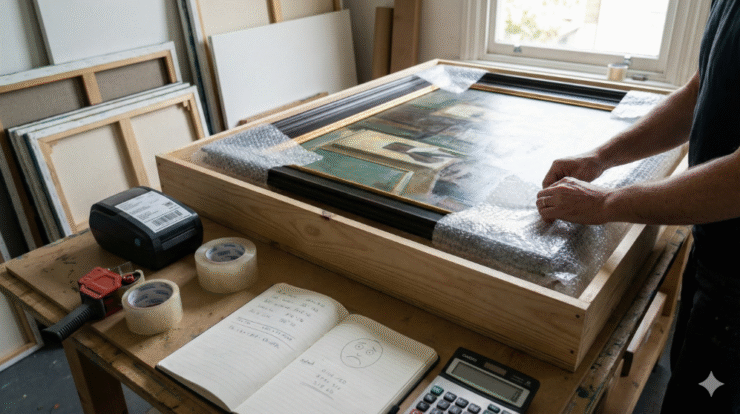
While this can vary from venue to venue, the traditional standard in the industry is that the artist is responsible for getting the work to the gallery. You pay for the packing and the shipping to get it onto their walls.
Once the work is there, the gallery typically takes responsibility. If the piece sells, the gallery (or the collector) usually covers the cost of shipping it to the new home. If the piece doesn’t sell and needs to be returned, the gallery will often cover the return shipping to you.
There are exceptions. You may find a gallery that asks you to pay both ways. While not ideal, it is not necessarily a dealbreaker if that gallery is selling your work consistently. But generally, you must accept that outbound shipping is your cost of doing business.
2. The “Paper Profit” Trap
Here is where the psychology gets tricky. When you research successful artists in your target galleries, you see a painting listed for $4,000. You immediately do the mental math: “Okay, at a 50% commission, I would get $2,000. That’s a great margin!”
In your head, you have already spent that $2,000. You have adjusted to that higher profit margin.
But then, reality intrudes. You remember you have to pay $200 for shipping. You remember the $150 spent on framing. Suddenly, that beautiful $2,000 check starts shrinking. You look at the final number and feel a sense of despair. You feel like you are losing money you were “supposed” to make.
This is a trap. You are mourning the loss of fictitious returns.
You are worrying about the profit margin on a sale that hasn’t happened yet, regarding a career you haven’t fully built yet. It is vital to remember that the artists you are researching—the ones currently hanging on those gallery walls with the $4,000 price tags—are facing the exact same expenses. They are paying for shipping; they are paying for framing; they have studio costs. And yet, they are making it work.
3. Sales First, Optimization Second
If you focus too heavily on protecting your profit margin in the beginning, you will talk yourself out of the opportunities you need to succeed.
Your goal in the early stages is not to optimize your tax bracket or buy a Porsche. Your goal is to prove that your work has a market. You need to prove that a gallery can find buyers for your work and that you can generate sales.
Is it painful to pay a 50% commission, plus shipping, plus framing? Perhaps. You might look at the final number and realize you only netted 15% or 17% profit on that specific piece.
But realize this: 17% of a sale is infinitely better than 100% of nothing.
There is a natural order to building a business. First, you must generate activity. You need to get the work out of the studio and in front of qualified buyers, even if it costs you money to get it there. Once the sales start flowing, then you shift your focus to efficiency. That is when you start looking for economies of scale, better shipping rates, or more cost-effective framing solutions.
But you cannot optimize a vacuum. You cannot streamline a sales process that doesn’t exist yet.
Are Logistics Holding You Back? I’d love to hear from you. When you think about approaching galleries outside your local area, is it the shipping costs or the logistics that stop you, or is it something else entirely? Let me know in the comments below.

No 17% of a sale isn’t better than “nothing.” When your sale price, minus gallery, minus shipping, minus framing, minus materials leaves you with just plain “minus,” then you have LESS THAN nothing.
One big piece of the logistics of distance is the ability and cost to travel to events like openings and artist talks. More and more gallerists are wanting artists to show up in person, which carries obligations and expenses.
What do artists do about shipping framed glazed work? In most cases I use UV glass to help protect the work. Some shows and galleries require plexiglass. It costs more than glass and UV plexi is even more expensive.
I ship unframed free to buyers.
Would you recommend plain plexiglass if shipping framed works? It would be lighter weight, but does it arrive intact? Thanks for sharing your knowledge.
Plexiglass is way more durable than glass which makes it great for shipping framed pieces. However, I have experienced a lot of static that attracts dust if your planning to show them at out door events.
I highly recommend Pirate Ship. They use all the standard shippers but at a steep discount, even refunding excess estimated payment you pay.
I am fine with shipping costs, but I haven’t shipped any paintings over 16×20. I’m not at all sure how to ship larger framed works.
Saatchi online has an excellent series of step by step tutorial videos showing exactly how to pack and ship large artwork..I just shippid an 18×24 canvas and the collector actually commented on the “professional shipping” So I recommend that resource!
Also DEFINITELY sign up for Pirate Shipping. It cuts the cost in half.
I prepare my work for shipping, rather than using a service. I purchase shipping boxes by the 25-50 lots from U-line. I save cardboard, bubble wrap but also have rolls on hand. I wrap my work in glassine which isn’t cheap but purchase it by the roll. I have accounts with UPS and FedEx. All in all, my shipping isn’t that bad. My work probably ships 50/50 framed/unframed. As an oil painter, I don’t need to worry about glass though my wife is a watercolorist and does. For the most part her works are smaller so far.
my most expensive shipping/preparation exercise for a single show was 250,000 which was a significant bite which was balanced off by the opportunity to exhibit to hundreds of the top oil executives on the planet. in the end it worked because of 2 clients whom i otherwise would have had 0 chance of meeting. sometimes you just have to take the chance.
50 years ago at my first local exhibit i sold exactly 0 so i took that show ,packed it into the pickup and went hunting for clients further afield. that resulted in a lifetime of mainly intl exhibits and for decades never even showing locally. your best or only markets can often be outside where you reside and that takes travelling, shipping and working with others. sitting on your hands surviving at the whims of a small pool of collectors/galleries in your local region often results in an unhappy starving artist.
Hi Richard- just want to do a quick check – $250,000??? Could the decimal be in the wrong spot on this one?
More and more, I’m learning the value of building relationships with buyers who often turn into repeat collectors. Yes, it took a lot of sacrifice, years where I took in less than I spent on my art practice while I was still working a day job. Taking chances helped me break through that barrier.
One thing that helps is that I do not rely on gallery sales alone. I also paint tiny and sell through local art group shows. I also run a monthly subscription-based snail mail print club. These two things have a much higher profit margin. They help build valuable long-term collector relationships so that once I establish a collector base through a gallery farther from home, I can work hand-in-hand with that gallery to gradually increase price. At that point, shipping and framing should be a non-issue.
Love your caution against …’mourning the loss of fictitious returns.’
I have a book full of boring horror stories and NO, I will not recount them here. Only how I sleep at night with a head full of new ideas for tomorrow.
iF the production of art images were a manufacturing issue, then the costs of delivering the product to the purchaser would be accounted for in the projections and break evens.
That’s not what we do mostly. I tried that “system” trying tto account for every nuance of production. It was an “air pudding with wind sauce” endeavor which I continued to adjust almost monthly. It was conjecture with the bottom line reflecting a hope that never materialized.
Market research was the next step in a vain attempt to eliminate the guess work. Futility because what was missing was the potential buyer.
The shocking reality was, the potential buyer connects with the image as presented. They do not see what it takes to get that image in its current state in front of them, in the same way they do not see or care about that gizmo they acquired yesterday.
Are all of the production aspects real for you? Yes! Are they important to you? Yes! Are they important to the collector? Who knows! One thing is clear, they are not funding your career, they are seeking to own this small piece of your best and highest efforts because they can’t not have it where they can spend time with it as they know it in its cirrent state. it’s the tag with numbers on it that is the key.
I was shocked at how my 50% became so much less. It felt like everyone else was getting whatr they needed at ny expense. The next morning, the realization dawned that all those extra bits of expense was aimed at getting the piece the collector had to have. If that takes 80-90% of the eventual striking price, that is better than 50-100% of the unsold price.
If, after all the calculations, you find yourself with no mpney for you, or worse, debt, the problem may be in calculating the cost of production. From experience, that has to be simple enough to calculate and universal enough that you don’t have to recalculate each new piece.
SPOILER- Everything cab be reduced to a $/sq” including what you want to see in your pocket at the end of the sale.
My former husband – who has become a moderately well-known artist – and I (who rarely paints, but sometimes) have been working with galleries and shipping art for almost 50 years. We built his career through gallery representation, and at one time had 8 representing galleries, one of which was in Europe. We have always shipped art, originals plus glassed prints. We do not assume that all works must be framed. The cost for framing, if required, and of shipping in either direction – to a client or to a gallery – is a matter for negotiation and then inclusion in either the written contract or on the invoice. I have learned that there may be “customary” ways of doing things, but it never hurts to ask, and that the answer may well depend on how much desire there is on the part of the gallery/client for your cooperation. Is it difficult to create enough work to supply galleries, especially if they sell well? Is it difficult to deal with all the non-creative aspects of an art career? Damn right it is. But that’s the price to be paid if you wish a professional career with some type of success. I think it’s important to be clear-headed about desires and about the obligations those desires entail. Good luck to everyone.
I have been selling miniatures, and some smaller works via a local gallery, but no larger ones yet. I have an appointment with a local (UK) curator soon to help me to get into consignment galleries that sell well. For this I realise that I will have to raise my prices (that were lowered by the first gallery when I approached them a few years back) to make it worthwhile them giving my work space on their walls. Time to start afresh, to break into the market for larger work. That’s the plan!