


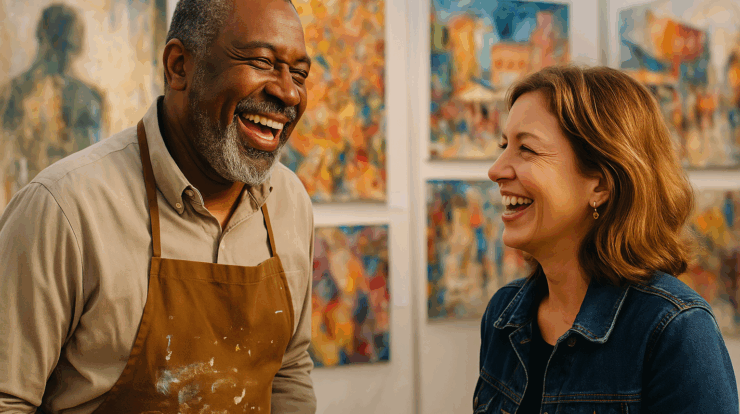
For many artists, the hardest part of selling art isn’t creating it—it’s talking about it. The studio is safe. The moment you step into a gallery or event, though, the stakes suddenly feel sky-high. You start overthinking every word: What if I sound awkward? What if I say the wrong thing?
Here’s the truth: every confident salesperson, artist, or gallerist you’ve met learned to talk about art by talking—often, badly at first. The good news is, you don’t need to practice only in formal settings. You can start in grocery lines, on airplanes, or on your morning walk. Everyday conversations are the perfect rehearsal space for learning how to connect naturally.
The Grocery Line Method
 I’ve joked before that my family hates going out in public with me because I talk to everyone. In line at the store, on a hike, waiting for a flight—it doesn’t matter. I’ll start a conversation. Sometimes it’s as simple as, “Where are you from?” or “That’s a great color on you.”
It’s not about networking or making a sale. It’s about keeping the social gears oiled. Each time you start a small conversation, you remind yourself that people are approachable, that silence doesn’t have to be heavy, and that curiosity is disarming.
Think of it as training your conversational reflexes. The more you do it, the less effort it takes when it matters—like greeting a collector at an opening or introducing yourself to a gallery owner.
Start Simple
You don’t need to say anything profound to begin. In fact, the best openers are obvious:
-
“How’s your day going?”
-
“That’s a great jacket.”
-
“Are you from around here?”
The point isn’t to deliver brilliance—it’s to engage. Once the conversation starts, the rest tends to unfold naturally. You’ll learn to read cues, listen well, and add just enough about yourself or your art without forcing it.
The Compliment Rule
One of the best tricks I’ve learned is to lead with a genuine compliment. People light up when you notice them. Compliments on names, colors, accessories, or even scents all work, as long as they’re authentic and brief. “That’s a great name—unusual and memorable.” “That shade looks fantastic on you.” “What a beautiful car!”
It’s not flattery; it’s connection. And if you happen to mention your work in passing—“I notice color a lot; I’m a painter”—you’ve just shared something about yourself without launching into a pitch.
Low Stakes, Big Gains
The goal isn’t to turn every encounter into a networking opportunity. It’s to build comfort with human interaction in general. Artists who practice casual conversation find that gallery events, openings, and studio visits stop feeling like interrogations. They become natural extensions of the same skill.
When you’ve had a dozen friendly chats with strangers in the past week, walking up to a potential collector doesn’t feel like leaping off a cliff. It’s just another conversation.
The Cumulative Effect
Over time, you’ll notice a shift. You won’t rehearse every line in your head before speaking. You’ll stop apologizing for existing in a conversation. You’ll talk about your work with ease because it feels like a continuation of the same curiosity you bring to others.
So the next time you’re waiting in line or walking a trail, take a small risk. Ask a question. Make a comment. See what happens.
You don’t need to feel brave first. Talk first. The confidence comes later.

I recently was at a three hour church art show in which I had donated six small pieces of art. It was a 50-50 split between the church and me. I had the best time standing close to the display, listening to comments, and when I felt it was appropriate, I would walk up and say I hope you don’t mind but the artist is behind you. Everyone welcomed the conversation and were full of questions and I sold four out of the six pieces. One woman even told me she had seen a piece that was displayed in a local magazine at the beach and just loved my work. She was thrilled to meet me. Very seldom do I find someone who’s not interested in talking to the artist.
I was at an art opening in a group show at a gallery that represented my work at the time.
The opening was crowded and the staff was busy with other sales. I was standing casually near my painting, a few feet behind a woman looking at it. Out of the blue, she turned to me and said, “I could look at this painting forever! I’d love to meet the artist.” I was surprised. by her comment, and just replied, “Well, I’m the artist.” “Oh, I’m so glad to meet you!” she responded. We had a nice, friendly chat and she bought the painting that evening. Artists need to show up to every opening, even if they aren’t the “star” of the exhibit. You never know when an opportunity will present itself to make a sale for you.
I’m quite confident with people but you have helped me to take it to the next level which is to talk about my art. I also say I’m an artist but the next step… I’m not there yet. Thank-you. Work to do
I came here to tell you that your use of Ai images are turning me off. They are unsettling. Creepy. It’s like a horror movie still. Something is wrong, but they’re just clowns being funny? How am I supposed to even read your blog if my heart is pounding because the Ai is freaking my mind out. Hope you’ll consider not using it in the future.
Taryn, it is probably not usual to experience such a visceral reaction to an AI image that most of us don’t even register as being anything other than a cute cartoon or image. It is likely that AI is here to stay in every domain one can think of. So while it is prudent to use caution and common sense, let’s try to make peace with it. And it might be worth talking to someone who can help you discover what is driving this reaction. People are all so different. A few weeks ago, I learned something odd from an 84 year old friend. She admittedly has a button phobia and has a similar reaction to yours, but with buttons. She speculated about where it comes from. Strange but true. Just sayin’…..
Good luck with this and hopefully RedDotBlog forum won’t lose you.
I used to be an INTROVERT. I took me until my 40;s to loosen up. Now I really enjoy when people walk up to or even near my booth. I might not sell them something, but I learn something (usually) from them and / or have a good time talking and laughing.
If you are an introvert you might give TOASTMASTERS a try for a year. It can change who you are. It helped me. Also, just say to yourself ” This is a great opportunity to meet people, learn something new. (And talk about my art. It will be fun.
If it is not fun, you are not doing it right.
One way to help overcome shyness in talking about your art is to create your art story or simply how did you happen to start your painting career.
I am part of a Cooperative Gallery and one of the obligations is to work the kiosk 1-2 times per month. I encourage people to ask questions about the Gallery and about any artist with in the gallery they seem to gravitate to. Often there are beginning artists who visit and seek advice on how I started. Stories are great to help people connect and understand many of us have similar questions about the art world and how to become a part of it.
Thank you for your insight and suggestions.
This is a great “trick”, Jason. Although I was a nationally award-winning high school and university scientist and educator for 40 years, loved every second of doing that, I kept sculpting the whole time, talking about myself and my art is still frightening. I’m OK talking with even famous artists and even with radio and TV interviewers. But maybe because although I didn’t do art for a living until I retired, I have usually felt like the untrained amateur I was in talking with gallerists and art experts. And think I come across to them that way as well. But the more I (force myself to) exercise things like talking with people in grocery lines, the better I feel, and the better I perform, when it counts.
LOVE the cartoon of your family!! 😂
Thanks, Jason. I love talking if I’m in my extroverted space. My challenge is talking when I’m not feeling it. So, practicing is especially important to have that friendliness mode accessible ,if I draw a blank. Being a Chaplain and preacher’s kid has its advantages, though! I’m a good listener, too.
I have had trouble figuring out what to say to people at a show of my work. Recently I was standing in a hallway at a Cancer Center where 15 of my paintings were being shown. People were looking silently, and to me they seemed closed off. I’m a landscape painter of local Southwestern scenes, and suddenly it occurred to me to ask someone “Do you see some place you recognize?” Immediately smiles, people turning to talk with me about what they recognized, places they loved and suggested I could paint, remarks on how the work affected them. The evening came alive and I had the most fun I’ve ever had at an art show I was in. It seems people were just waiting for an opportunity to interact. Three of my paintings sold and now I’m sold on starting the conversation. Thank you for your even lower-risk suggestions for getting the ball rolling.