


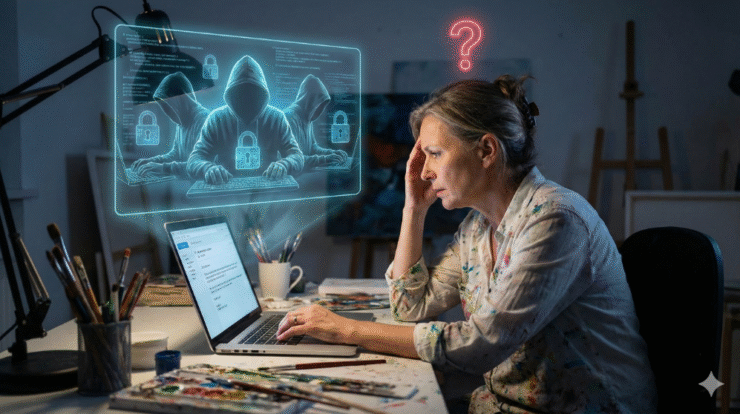
Visibility is the currency of the modern art world. We spend years building it—polishing our websites, optimizing our portfolios, and plastering our contact information across the web in the hopes of connecting with that one life-changing collector.
But there is a specific “tax” on this visibility. As your digital footprint grows, so does the target on your back.
Open your inbox on any given morning, and you are likely to find a strange mix of opportunities: a subject line promising to skyrocket your sales, a sender claiming to have “just fallen in love with your design,” or an offer to feature you in a “prestige” art book.
In the past, these messages were easy to spot. They were riddled with typos, bad grammar, and generic greetings. But the game has changed. With the rise of advanced Artificial Intelligence, scammers now have tools that can generate perfectly written, persuasive, and seemingly personalized emails in seconds. The days of obvious “Nigerian Prince” scams are fading; we are entering an era of sophisticated, AI-polished fraud that is much harder to discern.
Here is how to filter out the noise and identify the scams—even the smart ones—without wasting your mental energy.
The New Reality: Perfectly Polished Deception
For years, the easiest way to spot a scam was the language barrier. Broken English or odd phrasing were dead giveaways. Today, AI tools can draft flawless, professional-sounding emails that mimic the tone of a real collector or gallery director. They can even scrape your website to include specific details about your art, making the message feel eerily legitimate.
Because the surface-level “tells” are disappearing, we have to rely on deeper instincts and stricter protocols.
Trust the Algorithm (and Your Gut)
The first rule remains unchanged: If it went to your spam folder, leave it there. Modern email providers like Google and Microsoft are using their own AI to fight back, identifying patterns in phishing expeditions and mass marketing schemes. If a message is flagged as junk, trust the technology.
However, some will slip through. This is where your “Gut Check” becomes critical. If you find yourself pausing to ask, “Is this a scam?”, the answer is almost invariably “Yes.” Legitimate opportunities rarely trigger that specific alarm bell.
If you are ever unsure, I have previously broken down the classic structures of fraud in my article, Anatomy of an Email Art Scam. While the grammar has improved, the underlying structure of the scam—the urgency, the complicated payment requests, the over-the-top flattery—remains the same.
The Human Test: What Still Works?
So, how do you verify a “collector” who sounds perfectly real? You force them to be human.
AI and mass-marketers rely on volume and speed. They cannot afford to spend time on deep, specific engagement. To test them, ask questions that require a uniquely human, subjective response.
-
Ask for Specifics: Instead of accepting “I love your work,” reply with, “Thank you! Which specific piece moved you, and where do you envision it hanging in your home?” Bots struggle with subjective context.
-
Request a Call: If a “collector” wants to buy a $5,000 painting but refuses a brief phone call or Zoom chat, walk away. A legitimate buyer spending that kind of money will usually welcome a quick conversation.
-
Check the Payment Method: No matter how eloquent the email is, if they ask to pay via a complicated check scheme, overpayment reimbursement, or a weird third-party service, it is a scam. Legitimate commerce is simple.
Proactive vs. Reactive Business
The AI revolution in marketing means your inbox will be flooded with more “service providers” offering SEO, web design, and social media growth. These pitches will sound increasingly convincing.
However, the rule of “Proactive Hiring” still applies. Even if an email highlights a real need in your business, never hire the random person who cold-emailed you. If an AI-generated email reminds you that you need marketing help, delete the email, and then go do your own research to find a reputable human expert.
The Power of the Delete Button
The most valuable resource you have is your time. Every minute you spend decoding a confusing email or worrying about a “collector” with a strange request is a minute you aren’t painting.
Don’t be afraid to use the delete button liberally. In this new era of digital noise, your ability to ignore the clutter is a professional superpower.
Have You Seen the “New” Scams?
As technology evolves, so do the tricks. Have you received an email recently that almost fooled you because it was so well-written? Share your experiences in the comments so we can all stay one step ahead of the curve.

Not sure about the spam folder. I’ve had a lot of my subscriptions end up in spam, even a legitimate notice from my credit card holder.
Um, yes. I became a target for “paks gallery” after my last comment on your blog where I declared I wanted curators to notice me. I supplied my website address for that blog entry. (It of course lists an email address.)
Paks Gallery, (which may or may not exist) began offering me instant international exposure at renowned art fairs, even some side events such as exposure at venues for the likes of Cannes Film Festival. Each listing quoted a deadline of 6 March to pay for my registration to be involved.
I researched it on Google, read the warnings, and hit delete. When the second more sophisticated version arrived, I set up the block sender rule, so I haven’t seen anymore since.
Bottom line is this: as long as you have an iron-clad rule that you NEVER,EVER ship an artwork until the check or charge clears your bank, then you are almost entirely safe. Also, talk with your bank about what their rules are about bad charges and checks and use that as your benchmark for shipping. So the very worst you have to risk with this rule is a waste of time. Of course you always check every single online person/group as best you can, too. Google people and see what you can learn, etc. And scams these days can even come with some pretty good phone conversation in my experience, so that isn’t a reliable precaution, though it helps. I admit I have fallen for sweet-talking, so that’s why I include that as a precaution. But it’s only been once in a great many years. Good luck to you all.
This is good advice but what happens if the charge clears, you ship the work, and then it is reversed? Is there anything you can do? I’m new at this and don’t want to be scammed.
Oh no! I’ve been operating on the old assumption/screening that scammers will have excuses why they won’t make phone contact, but you say that now scammers will include conversations by phone in their playbook?
Lately I’ve noticed normal flattery introduction and the desire to buy a painting but asks for recommendations. I assume these are spam and tell them if they want to see what work I have available for sale they can see it on my sales site and I give them the URL. I never hear from them again.
I have had prior purchasers of my art buy my art through that site and I recognize their names, so the site does work and if these “provide a recommendation” emails happen to ever be real that would be great. But I’m not holding my breath.
The newest one we have seen around here consists of lavish praise for our artworks, then an offer to buy specific paintings as NFT’s and offering overly high prices. I did an internet search for some of the wording plus the term “scam” and found lots of information. It works by the collector directing the artist to an NFT processor that is not one of the reliable ones. The naive artist pays significant set-up fees that the scammer pockets. The general advice is that an artist should not have to pay money to make a sale (money that the artist will be defrauded of).
Thank you for addressing and updating the information on this subject. I have received my share of these scam letters. I respond to people with courtesy and respect even when I suspect a scam, just in case the communication is legitimate. I ask what they are interested in and direct them to the appropriate webpage for purchase. When questioned if they can purchase another way, I simply tell them my purchase policies are written in stone and are in place to protect legitimate purchasers and protect me against art scammers; and when necessary, that I do not deal in NFTs–ever. That ends the conversation. What has been interesting are those scammers who test the waters again under another pseudonym with the same storyline; or the laughably inept letter from the same scammer addressed to another artist, but sent to me. I guess thieves are the most hopeful of people.
Spot on, Sherrie! The sad part of all of this is that they wouldn’t keep trying if they didn’t sometimes hit pay dirt, usually a new artist desperate for validation. So thankful for Red Dot Blog!
99% of the scam messages I get claim to have seen my website yet ask for pricing details and steps for purchasing. All of those details are on my website on the same page as the individual art pieces. Nearly all are NFT scams.
I refer them back to the website and have a disclaimer I include in the reply. It states that I never offer any NFTs, verify all requests to eliminate the numerous scams targeting artists, and report suspected scams to authorities.
They instantly stop responding.
I follow up by blocking the sending domain.
I recently received a message from a well know auction house in NYC. I looked up the name of the person who actually sent the email. After checking her name out on Google, it seemed legit that this person does work at this auction house. But, I was still suspicious. So, I copied and pasted the entire letter into Chat GPT. Within seconds, I received a complete analysis with my suspicion being correct. From now on, I will trust AI to let me know if it’s a scam or not.
I always say “Thank you so much, I’d love to chat with you more about the piece, what’s your phone number so we can discuss this further?”
They disappear faster than a fart in the wind.