


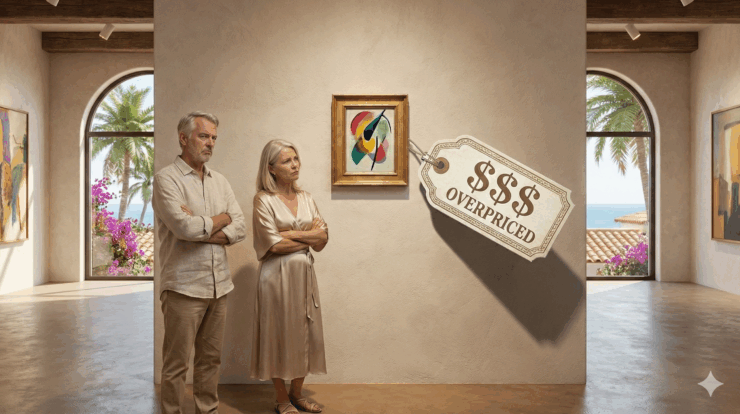
I recently received an email from an artist who discovered—much to their surprise—that a gallery had marked up their work to nearly four times the established retail price. The artist had never approved the increase, had no history of selling at that level, and immediately understood why nothing was moving.
Situations like this are fairly rare, but they do happen. Every once in a while, an artist discovers that a gallery has inflated prices far beyond what the market has demonstrated. The reasoning is usually some version of: “This city has money,” or “Our clients expect higher price points.”
But here’s the truth—this issue isn’t only an artist problem. It’s a gallery problem too.
Overpricing doesn’t elevate the work. It shuts down momentum for everyone involved.
Prices Must Match Reality—or Sales Stop
Today’s collectors are well-informed. They check websites, compare sizes, follow careers, and quickly detect when something feels off.
When a gallery suddenly lists work at a wildly inflated price, several things happen:
-
Buyers sense a disconnect.
-
Trust erodes.
-
Interest drops.
-
Sales stall.
Even high-end collectors don’t want to feel manipulated. Disconnected or inconsistent pricing sends exactly that message.
Why “Our Market Can Handle It” Doesn’t Work
Some galleries assume their location justifies a premium price. And yes—certain markets do support higher spending.
But market affluence doesn’t automatically raise the value of a specific artist’s work. Pricing still has to follow the artist’s established demand. A gallery’s confidence in its buyer base isn’t the same as proven sales momentum.
This is where well-intentioned optimism can quietly sabotage a career.
Price Increases Should Follow Demand, Not Imagination
There’s a healthy, predictable path for raising prices:
-
Consistent, repeatable sales
-
Increased demand
-
Strain on available inventory
When these pieces line up, raising prices is appropriate—and expected.
But when the increase comes out of nowhere, unsupported by actual sales, both the gallery and the artist pay the price. The work sits. The market stalls. Momentum evaporates.
Overpricing Leaves a Long Shadow
Arbitrary price jumps don’t just impact one venue:
-
Other galleries assume your prices are legitimately that high.
-
Collectors hesitate when information doesn’t match across platforms.
-
Correcting the mistake later can be awkward and credibility-damaging.
-
You lose the chance for steady, sustainable growth.
Pricing only works when it’s consistent. Consistency builds trust, and trust drives sales.
What to Do When Prices Suddenly Spike
If you’re an artist and discover inflated pricing:
-
Reach out calmly and ask for clarification.
-
Reiterate your current retail structure.
-
Request approval for any future changes.
-
If needed, pull the work.
If you’re a gallery owner, consider the long-term impact before increasing pricing:
-
Has the artist demonstrated repeatable sales at the previous level?
-
Are collectors actively asking for more of this work?
-
Is the artist’s market ready for the jump?
-
Have you discussed the change with the artist?
Healthy artist–gallery relationships are built on communication, not assumptions.
Healthy Price Growth Serves Everyone
The best price increases don’t come from location, hope, or ambition. They come from proven demand. They come from momentum.
When prices rise because the market supports it, collectors feel confident, artists grow steadily, and galleries benefit from stronger sales.
But when prices inflate without evidence, both sides lose.
Protect the foundation you’re both building. Guard your pricing. Raise it only when the market has earned it—not because someone believes “this town can handle more.”
That’s how you build a career—and a gallery program—that lasts.

Yes, I’ve had a gallery inflate my prices after an auction happened to sell a piece at a higher than usual price. Nothing moved for years and I eventually returned across the board to earlier prices and movement was restored!
I too have experienced a galleries price spiking. I was fine with that as long as the work actually moved at “the galleries price.” I immediately understood why there was an “artists asking price.” Pricing is not static, but I benefited from this experience and learned that I can flex up and down when it comes to sales. While I enjoy that sales histories act as a milestone and marker for my work, I also consider the nation and the state of our economy. I am more interested in art work moving into a collectors home than receiving exactly what I asked for in the pricing game. Sell to the right people and they will continue to have interest in your work. I met some wonderful people who didnt have walls — that you could see! Their walls were covered in paintings!!! WOW!! I felt honored to have several of my works in their collection. Thanks
The opposite argument is also true.A gallery owner told me, “I really like your work but your prices are ‘city’ prices. Even at 50% you are going to be out of my market.”
It is a local gallery and I have a couple of pieces in it for the exposure bewteen my local community and me. She is able to boast that I’m her “abstract artist”. Not totally pleased with that moniker but I’m not expecting sales. Locally I’m probably the topic of conversation about my “crazy pricing”. However, my pricing is consistent across the board.
It is important to keep an eye on who are representing you. Two years ago, I decided to do business with a gallery that I never worked with. Over the years, I have been pricing my works by square inches. As a result, my collectors know exactly my prices base on size. The gallery in question, had four paintings and without telling me raised my prices. After this one collector purchased all four paintings, at the opening, when it was time to finalize the transaction the gallery had raised the prices. And now the collector decided not to purchased them after we had celebrated the sale in front of everybody. I was managed to control the situation and sale the pieces at the original price, the gallery still wanted to get the same commission if the pieces was sold at the higher price, which I gladly pay, just to terminate our agreement.
Nothing makes a collector more angry than finding out they’ve overpaid. And collectors aren’t dumb, nor are they unaware of how to find out what the prices are in other venues. That speaks to the wisdom of keeping your prices consistent across the board.
interesting topic. I have found that galleries that jump prices do so based upon their perception of the worth of the artists works relative to the specific clientelle the gallery serves. A high end gallery cannot sell at prices to be asked by the artists or local frame shop dealers. the clients are different and expectations are different. Artists undervalue themselves and their work most of the time so the local clients/collectors use this to set a price scale of value in their minds. [outside of that set of parameters the values can change significantly according to the context the art is shown in] . DO NOT SELL YOURSELF SHORT JUST BECAUSE YOUR IDEA OF THE MARKET IS LIMITED.
An example from my 50 years in the art business. When travelling in northern california i stumbled across a painter of the most exquisite flowers. Beautiful work at jumble sale prices that would with proper presentation sell in the best galleries in the world. I bought a few pieces and then started making introductions to appropriate venues and dealers. they went from starving to prosperous overnight however the locals still wanted jumble sale prices. whining about the works being overpriced.
IF A CLIENT SAYS ITS OVERPRICED FIND A NEW MARKET AND A NEW CLIENT. TODAY WITH THE INTERNET ITS EASIER THAN EVER TO DO THAT.
Be realistic about value based upon your market not upon hopes, wishes, fantasies. after all the 100 million$ van gogh is a painting that many artists today can match but they do not have the marketing machine a century of exposure can generate.