


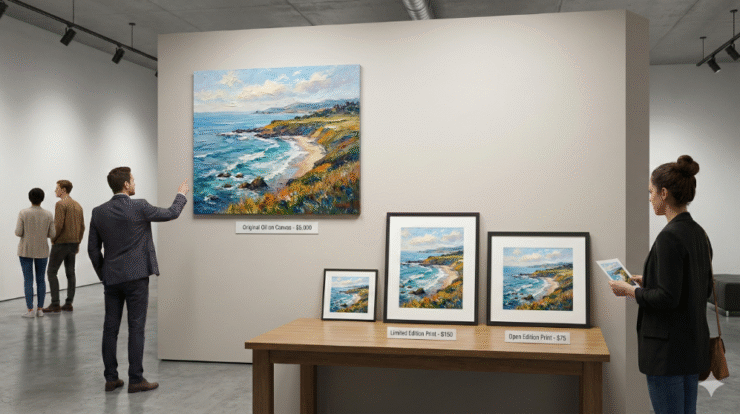
There is a pervasive fear that haunts many artists who are considering entering the print market. The logic goes like this: “If I offer an affordable open-edition print of my best painting, why would anyone ever pay thousands of dollars for the original? Won’t the cheap copy ‘cannibalize’ the sale of the masterpiece?”
To solve this imaginary problem, many artists decide to split their portfolio into two rigid lines. They designate certain images as “Print Only” and others as “Original Only,” ensuring the two never meet. They believe that by keeping their originals exclusive and unreproduced, they are protecting the value and “specialness” of the artwork for serious collectors.
While I understand the theoretical appeal of this strategy, my experience in the gallery business suggests that it is completely unnecessary. In fact, artificially separating your work into two lines might be holding back your sales potential in both categories.
Two Different Worlds
The most important thing to understand is that the person buying a $50 reproduction and the person buying a $5,000 original are usually two different customers. Or, at the very least, they are the same customer in two very different modes of buying.
Rarely does a collector walk into a gallery, fall in love with the texture, brushwork, and presence of an original oil painting, and then say, “Oh, wait, I can get a flat ink-jet print of this on Etsy for $100? I’ll take that instead.”
The collector buying the original wants the object itself. They want the scarcity, the hand of the artist, and the prestige of ownership. The existence of a reproduction does not diminish that desire. Conversely, the buyer purchasing the print usually does not have the budget for the original. By offering the print, you aren’t losing an original sale; you are gaining a customer who otherwise couldn’t afford to collect your work at all.
The Fame Factor
There is a counter-intuitive reality in the art world: Ubiquity often drives value.
Think about the most famous paintings in history—Van Gogh’s Starry Night or Da Vinci’s Mona Lisa. You can buy these images on coffee mugs, tote bags, posters, and mousepads. There are millions of reproductions in existence. Does that make the original painting less valuable? Of course not. It makes it an icon.
On a smaller scale, the same applies to working artists. If you create an image that becomes popular enough to sell hundreds of prints, you are building fame for that image. For the collector who owns the original, knowing that they possess the source material for a popular image can actually be a point of pride. It validates their taste. They own the “real thing” that everyone else admires.
Don’t Limit Your Inventory
By separating your work into “Print Lines” and “Original Lines,” you are essentially betting against yourself. You are guessing which images will sell as prints and which will sell as originals, and you might be wrong on both counts.
If you have a painting that is a “hit,” you should be able to maximize its revenue potential across all channels. There is no reason to hoard the original in a closet because you are selling prints, nor is there a reason to refuse to make prints of a sold original (provided you retained the rights, which you generally do).
The Size Question
If you are still nervous about this, there is a simple compromise that many artists use: Size Differentiation.
A common practice is to ensure that reproductions are never produced at the same scale as the original. If the original painting is a massive 30×40 inches, perhaps you only offer prints up to 16×20 inches. This creates a physical distinction between the products.
However, even this isn’t a hard-and-fast rule. I have represented artists who sold full-size canvas reproductions alongside the originals without issue. But if differentiation helps you (or your collectors) sleep better at night, changing the size is a much better solution than withholding the artwork entirely.
The Bottom Line
Don’t overcomplicate your inventory management based on a fear of a problem that rarely exists. Galleries are generally very adept at explaining the difference between an original and a reproduction to collectors.
Your job is to create the work and make it accessible. Let the market decide which version they can afford, but give them the opportunity to say “yes” to your art in whatever format fits their life.
What is your strategy?
Do you offer prints of your original work? Have you ever had a collector express concern that an image was reproduced, or have you found that prints help market your originals? Share your experience in the comments below.

Thank you very much for this article. Jason
I would very much like to sell prints
I have trouble determining, which sizes and a price to charge.
Whether to use paper only or canvas or both
Olaf
Hey Olaf, good to see you here. Paint on, Canada!
Thank you for your very helpful discussion. What do you think about providing open edition prints of an original versus limited editions?
Great article Jason.
Yes I have offered reproductions of my paintings since the early days of my art career. In 40 years, I only ever had one client who bought an original because I had not made prints of it, and that was probably in the 1990’s. Nowadays, it is very acceptable to sell an original and prints of the same image. As you say, the buyer of the original feels very proud to own the hand-painted version of such a popular image.
In the early days, I published offset lithographic editions of 100 to 250 copies of several of my popular images. This kept the unit cost low, but meant I had to invest thousands of dollars and risk of having more copies than I could reasonably sell.
Now I offer made-to-order prints of about 50 of my most popular images via Fine Art America and they ship directly to the client. FAA does a super job, pays me a small royalty for each sale, and I don’t have to invest big bucks in print inventory. The only downside is shipping costs can be high for the client.
My website features separate pages listing original work and reproductions, so I can cater to almost all budgets.
I live in an area where what people are willing to pay for an original is often less than what they’ll pay for million-copy franchise prints. There’s a persistent belief that if it’s local, it’s hobby, and should fetch hobbyist prices. Doesn’t help that most venues are volunteer-run thrift-looking affairs.
Things are different as a digital painter, where my large canvases are produced similarly to the small studio print. Not exactly but similar. My canvases are archival pigment produced for me by the licensed master printmaker for the Andy Warhol museum and I only make one unless the first owner agrees to let me produce a second. My studio prints are made on a 15 year old Epson 13×19. They’re both printed. AND they both look phenomenal. So, I show everything together in the gallery (3 Seasons Gallery, Perez Art District, Cathedral City CA) and at high end shows like La Quinta Celebration. Both kinds of buyers “cross-appreciate” the canvas and print. I even show some people the studio print next to the large canvas demonstrating color matching accuracy. It comes down to educating the collector and allowing them to decide whether they want high end big or really nice small. People are fascinated by the concept.
Hi Reese. See my comment in the next post on the thread. How do you assure the client purchasing the single run print that they will have the only one? Do you offer a certificate of some sort? I have an awesome digital artist who is producing similarly to you and I’m working hard at figuring out how to best represent her.
Yes yes. As a gallerist I manage that responsibility of differentiating between prints and originals. One of my leading artists does both quite well, and adheres (usually) to size differentiation to maintain the distinction of his larger, original works.
BUT
What happens when the digital print IS the original? I’ve encountered this for the first time this year. An artist who’s creation is exclusively digital. She wants only to work on a tablet with tools that emulate her hand tools and paints, and then produce a giclee using acrylic media as a “printed original?” I’ve had some trouble explaining this to clients who are intrigued but so far haven’t purchased. Thoughts?
Thanks Jason, your insights are always helpful. You answered a concern I had with prints vs originals, however I don’t have a resolution on the pricing question. I use the (H+W = x times a multiplier) equation for originals 30″ x 40″, but struggle with what a smaller 16″ x 20″ print is worth in comparison? any guidelines you can offer? Thanks
I do large acrylic on canvas paintings generally 36” x 48”, but also as big as 48” x 72”. My originals run $4000- $8000 depending on the size. I offer limited edition giclee prints on canvas of 100. I offer customers custom sizing of the prints if necessary to fit their unique space. My prints range from $800-$2000 depending on the size of the print. I sell plenty of originals and a ton of prints. Honestly, over time I make much more on the prints than the original. And you are right the prints customers are not generally original buyers, and that is fine. They should have nice art as well. I want my work in the hands as many of people as possible, different price points of high quality prints allows that to happen. I have an excellent printer who I trust, the quality is top notch.
Everything Jason says here about the value of prints to painters makes sense. Still, I wonder about something. I have read in several places that Dali made inexpensive replicas of his work , so high quality, so affordable, and so ubiquitous around the world that it detracted significantly from the value of his originals. Did that acrtually happen?
Whether the recognition value of small replicas of large sculptures adds to or detracts from the value of the originals is another question, and I can’t answer it. In one case, it did make it possible to place 3/4 scale bronzes in homes in which the stone original would have been too large. Now, Jason makes me wonder about the value of the Listening to the Wind form of a 1/3 or 1/4 scale series! Hmmm!
My personal experiences is that buyers of original artwork would prefer that there not be copies sold of what they are considering their property. I won’t sell prints of an artwork that has been purchased by a collector.
dali did not do mass prints publishers and scam guys did those in vast quantities in a variety of quality levels from trash to truly spectacular. i once bought full pallet loads of pieces for the stores, flea markets etc that we operated around the usa. there was the good, the bad and the ugly. many historical artists had presumably authorized print editions published before the copyright laws changed to become enforceable. These have mysteriously become valued over the ensuing decades.
The buyers of prints are distinctly different from those that purchase original works. There is some crossover when original prints such as serigraphs, etchings and stone lithos are the chosen mediums. reproduction works are completely different markets and cannot be assessed from the same market basis as originals. a work the may sell immediately as an original will often be a dud as a print. assess the market for prints as an image only marketplace and success will be much easier. this comes from 50 years of experience publishing and marketing prints globally as well as dealing in print markets. the original market cannot be assessed from original success or failure. for decades i bought/sold entire art publishing companies globally and the same rule applied in every case.
Just an additional thought – sometimes people who buy your prints love them but can’t afford an original…yet. If you treat the buyer of a print with the same respect as the buyer of an original, AND keep in touch, down the line, they may transition to becoming a buyer of your originals. Finally, as a reminder, people who buy prints often spend a greater percentage of their income than the rich buyer of an original. It’s an honor to have these customers as well.
I commissioned one of my favorite paintings because the artist offered giclees in her studio.
I walked in and was stopped dead in my tracks by a painting of a scene dear to me from childhood. Unfortunately the painting was too large for my very low ceilinged home. Looking around the studio I noticed giclee prints of a number of paintings available and inquired from the studio assistant about possibly having a print made to suit my available space.
The studio assistant was on her A game and asked me if I would like to speak with the artist about commissioning an original to fit my space. I said I would like this. The artist was summoned. After some discussion about what I liked and did not like about the large painting, why the scene was special to me, and the artist’s plein air methodology we agreed on a price and I commissioned a smaller version of the scene to fit my home.
Don’t lose a potential collector just because they ask about a print first. I wanted an original, but the original of the scene I wanted was too large and I lacked the confidence to ask if I could commission a version for myself. I am sure there are others in the same situation. It was the artist suggesting that she could paint me a version that changed the sale.
I laughed when you mentioned that it is “rare” someone who falls in love with a painting would prefer an IKEA print. A local millionaire dropped into my studio one time and said exactly that. Was she/is she a collector… I doubt it. She kept her word and has not bought any of my works. I think I dodged a bullet!