


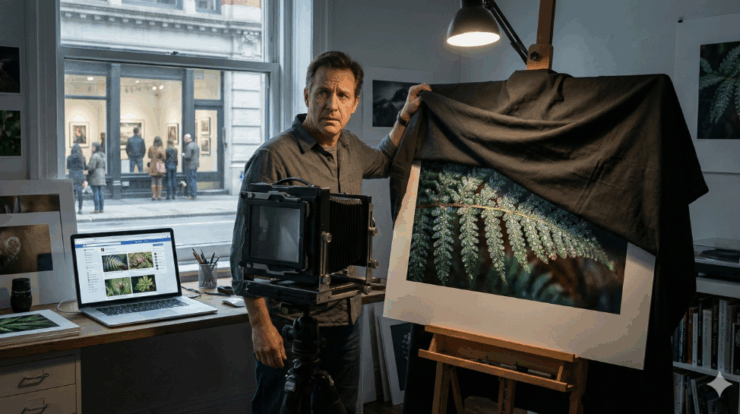
I recently had a conversation with a photographer who had developed a truly unique technique for capturing macro images of plants. The work was stunning—technically brilliant and visually distinct. He knew he had something special.
But he was paralyzed.
He was terrified to put the work online or show it in public because he was convinced that as soon as he did, other photographers would reverse-engineer his mechanical process and “steal” his style. So, he kept the work locked away in his studio, waiting for a way to guarantee its safety.
This is a fear I hear often. Whether it is a painter who has discovered a new way to layer resin or a sculptor with a unique casting method, the fear is the same: “If I show this, I will lose ownership of it.”
While this fear is valid—copycats do exist—it creates a dangerous paradox for an artist. The desire to protect the art directly contradicts the requirement to sell it.
The Hard Truth: You Can’t Sell a Secret
Here is the reality of the art market: You cannot sell what you do not show.
Safety and Exposure are mutually exclusive concepts. If you want 100% safety, you must accept 100% obscurity. If you want sales, recognition, and a career, you must accept the risk that comes with visibility.
My advice to that photographer, and to any artist holding back their best work, is simple: I would rather have your work copied because it is famous, than have it safe because it is unknown.
The biggest threat to your career is not plagiarism; it is anonymity. You cannot build a collector base, you cannot get into galleries, and you cannot generate revenue if the work is hidden.
The “Whac-A-Mole” Problem
Artists often ask if they should take legal action against copycats. While there are certainly instances where copyright infringement is clear-cut and actionable, trying to legally protect a “style” or a “technique” is incredibly difficult.
Spending your days scouring the internet for potential imitators and sending cease-and-desist letters is a game of “Whac-A-Mole.” It is exhausting, expensive, and ultimately, a distraction. Every hour you spend policing the internet is an hour you are not spending in the studio creating new work or connecting with your collectors.
Your Best Defense is Your Brand
If you release your work and someone copies the technique, have they actually stolen your career? No.
They might be able to replicate the mechanics of what you do, but they cannot replicate you. They cannot copy your personal history, the “why” behind your work, your relationships with your collectors, or your commitment to service.
Think about the most famous artists in history. You can find thousands of artists who paint in the style of Van Gogh or Picasso. You can find YouTube tutorials on how to paint exactly like them. Has that diminished the value of a real Van Gogh? On the contrary, it has solidified his status as the Originator.
When you put your work out there fearlessly, you stake your claim as the leader of that aesthetic. If copycats follow, they are merely reinforcing your position at the front of the pack.
Success Attracts Imitation
If you are doing something boring that no one wants, you are safe. No one will copy you.
If you are doing something innovative, exciting, and marketable, people will notice. Some might try to mimic it. In a strange way, having copycats is a metric of success. It means you have tapped into something that resonates.
Don’t let the fear of what might happen prevent the success that could happen. Release the work. Tell the story. Build the relationships. Let the copycats fight for second place while you move on to your next great idea.
What Are You Holding Back?
Is there a series or a style you have been hesitant to share online because you are afraid of losing control of it? I want to encourage you to take the leap. Let me know in the comments: what creates that hesitation for you, and what would it take to overcome it?

This was once a struggle i had as well. the concern was the images would be ripped off and reproduced en mass from china but it never happened. There are millions of images available all the time and with computer manipulation copyright is absolutely useless. The only deterent is to get the work out and sell it. then at least you have got the money to fight. There are really very few really unique materials or processes in the arts. anything can be copied or broken down and copied.
example; a sw usa painter i know had a unique style which for a short while no one could figure out for techniques. finally the chinese copy painters out of guangzhou figured it out and began limited production of landscape forms. he would not stand a chance fighting the process so instead contracted them to paint for him. issue solved.
i have had pieces copied out of guangzhou where once they were presented to me i could not tell they were not my own work! the guys are great technicians.
theres nothing you can do about it so just sell your work. you are one minnow in a worldwide fish bowl the likelihood of issues is remote.
I have been posting my work consistently on the internet in its many guises for many, many years. My style and subjects are pretty unusual and only once did I ever see a stolen image. I firmly believe that if you really have your own style, philosophy and way of making art, no one can really copy it anyway.
The internet is a gift. You have access to thousands of viewers that you would never have access to without it.
Just last week, I happened to see a painting that contained a unique composition of horses that were “lifted” right out of one of my paintings. I contacted the artist and “threatened” a lawsuit. He quickly removed the image from his website.
Looking over his website, I noticed that anything that was much better than his usual work was a plagiarism. I brought this to his attention, and now half his pages have been removed.
I’ve had work show up on foreign websites without my permission. I’ve been sharing my work for years through facebook, instagram and of course my website. About two years ago I decided to watermark everything. That makes no difference as watermarks are easily removed. A year ago I started uploading slightly fuzzy images of my work. Clean enough to see but they fall apart quickly when zooming in. As I tell people whose work has been scraped, stolen or copied, take it as a compliment that your work is valuable enough to tempt people.
Thank you for this!
I have to assume all those bot visits to my website must be for a reason?! But I don’t go looking for images of my work, it would just upset me, when I need my energy for selling my original work. My only defense is to upload only low resolution images.
This is good information……should we always post our images with a watermark?
To have your artistic style used by others is a compliment – you were worth being copied. Throughout art history, artists took ideas from other artists and made it their own.
We are in a time of AI and its ability to make anything in any style based on something that already exists. Only the .01% of international artists can defend themselves against AI.
I think the only real answer is to make yourself and your art known well enough that if other artwork shows up somewhere, viewers will look at that work and remark that it reminds them of YOUR work.
All great points Jason. I agree that we just gotta get our art out there and seen. Innovators are copied – like you say, chasing them is like Whack A Mole.
I painted with Richard Schmid’s Putney Painters for 16 years. While I didn’t emulate his style, the majority of the painters did. He didn’t mind at all. None of the group member’s painting sales suffered and neither did his. It’s OK to be part of a school or style of painting.
There’s a line from a 60s song, “The In Crowd”. It states, “Others try to imitate us, but the original is still the greatest”.
Thanks again for your writing – it hits where artists itch.