


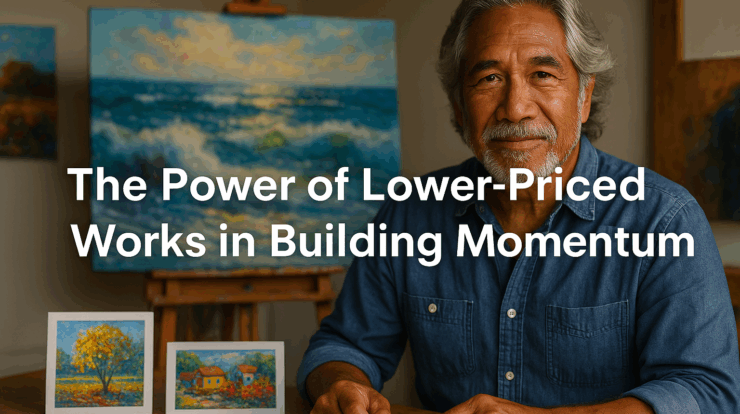
Every artist dreams of selling large, original works. Those sales bring both financial reward and the deep satisfaction of seeing a major piece find its home. But for many collectors, the first step into your world will be smaller. Offering lower-priced works—note cards, prints, and smaller originals—can create opportunities that build long-term momentum.
A Doorway for New Collectors
Small, accessible works act as entry points. A visitor who hesitates at the price of an original painting might still happily purchase a set of note cards. That transaction, while modest, gives them a tangible piece of your art to take home. The experience of living with even a small reminder of your work plants the seed for a future connection.
From Entry-Level to Lifelong Collectors
A print or a card purchase isn’t the end of the journey—it’s often the beginning. Collectors who start with a small purchase frequently return, drawn deeper by continued exposure to your work. Over time, the person who once bought a $20 card set may acquire a $2,000 painting.
Think of lower-priced works as stepping stones: they make collecting approachable, help you build relationships, and create repeat opportunities for engagement.
Balancing Accessibility with Long-Term Goals
The key is balance. Lower-priced works should complement your originals, not overshadow them. It’s important to maintain clear positioning: note cards and prints are an accessible way to enjoy your art, while your originals remain the pinnacle of your creative output.
When presented thoughtfully, small works reinforce the value of larger ones. They broaden your audience while reminding collectors that owning an original is a distinct, elevated experience.
Building Momentum
Momentum in an art career rarely comes from a single large sale. It comes from consistent activity: conversations, connections, small wins that accumulate. Lower-priced works keep that activity alive, helping you reach wider audiences, create more touchpoints, and grow a base of collectors who are primed for bigger steps down the road.
The power lies not in the size of the piece, but in the opportunity it creates.

dLove every informative article it’s great for new and old artists alike. Thank you
Recently, I had a solo show at a New Mexico gallery in an area where they truly appreciate art but don’t necessarily have the means like they do in Scottsdale or Santa Fe. The opening was well attended, my Artists Talks held attention, prompted questions and went on twice as long as anticipated.
The gallerist, whom I have a good relationship with, asked me if I would consider making some smaller more accessible pieces because he had clients in love with the work who genuinely couldn’t afford a more substantial piece. I really had to think on this request; I did not want to make lesser quality pieces, every step in my process is necessary, what could I come up with that would satisfy my need to be proud of what I’m putting my name on, yet fulfill his request?
I came up with an idea that we could both live with, The Mini Modular Collection. It’s my exact same work as in my more substantial pieces, but in a ‘Mini’ version that allows patrons to start with one or two pieces and build their collections over time. They all are the same size and mount to the wall in the same fashion, all in my signature palette making them easy to mix, match, rearrange and add to as they can. At first, being honest, I was a little bit hurt. But just having completed the first series of them, I feel like it was a great solution. It’s completely brand new, so time will tell. But I really trust your opinions, Jason, and seeing this post from you is so reassuring, that accessible pieces are a stepping stone, not selling out, makes me feel so much better. Great timing for me to read this post!
I love your idea of doing a whole collection of miniature works! That’s brilliant to market it as mix & match, too.
Thank you – now I have to wait and see if it’s a successful idea.