


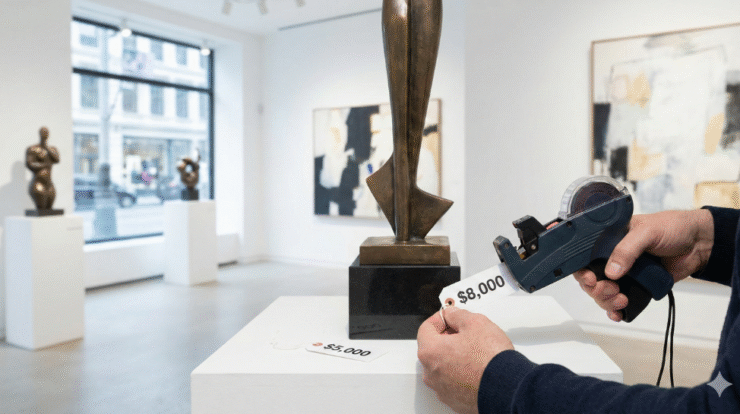
If you have been reading my advice for any length of time, you know that I have long argued that price consistency is critical to your success. I have written many articles on this blog emphasizing that a 24×30 inch painting should cost the same whether it is hanging in your studio, a gallery in Santa Fe, or a gallery in Maine.
This consistency protects the collector; nobody wants to buy a piece of art only to find out they could have purchased a similar one from the same artist for 20% less by Googling a different venue.
However, the real world is rarely ideal.
As your career grows and you expand into different markets, you may encounter a gallery owner who challenges this rule. They might look at your price list and say, “I can’t sell this for $3,000. In my neighborhood, collectors won’t take it seriously unless it’s $5,000.”
This often happens in high-rent, luxury districts—think La Jolla, Aspen, or Manhattan—where overhead is high and the clientele is accustomed to premium valuations.
So, if a gallery insists on marking up your work significantly above your standard retail price, what do you do? And more importantly, do you have to call your other galleries and tell them to raise their prices to match?
The “Don’t Poke the Bear” Strategy
The anxiety here is usually about fairness. You worry that Gallery A (the affordable one) will be furious if they find out Gallery B (the expensive one) is selling your work for more. You might feel obligated to harmonize the prices immediately to avoid conflict.
My advice? Check your contract first.
Unless your agreement with Gallery A explicitly states that you must inform them of any price variance in other markets (which is rare), you are generally not under a legal obligation to report what Gallery B is doing.
In this specific scenario, I often advise artists to let the situation play out without stirring the pot. Going to Gallery A and demanding they raise their prices because a new gallery in a wealthy zip code thinks they can get more is a recipe for annoyance. You are asking Gallery A to fix a problem that hasn’t happened yet.
The “Competitive Advantage” Perspective
Here is the secret that eases the anxiety: Your other galleries might not actually mind the discrepancy.
If a collector is shopping around (and they do), and they see your work listed for $8,000 in a luxury coastal gallery, but find similar available work for $5,000 in your Midwest gallery, the Midwest gallery suddenly looks like a brilliant investment.
The higher price point validates the work’s potential value, while the lower price point closes the sale. The “expensive” gallery is unknowingly acting as a marketing anchor for the “affordable” one.
Letting the Market Decide
Ultimately, pricing is an experiment. If the luxury gallery insists on a higher price point, view it as a market test.
-
Scenario A: They struggle to sell the work. The market has spoken; the price was too high. You can then gently suggest bringing the prices back in line with your standard.
-
Scenario B: They sell the work like hotcakes. Congratulations! You have just learned that your work is undervalued. Now you have the data you need to go back to your other galleries and justify a widespread price increase.
When to Intervene
While you don’t need to micro-manage every dollar difference, you do need to protect your brand.
-
Don’t Undercut Them Yourself: If a gallery is pushing for high prices, ensure your website doesn’t list the work for rock-bottom prices. That makes the gallery look predatory.
-
Communication: If the “expensive” gallery demands that you force everyone else to raise prices before they have proven they can sell the work, you need to hold your ground. Tell them: “Let’s see how it goes in your market first. If we see strong sales at that level, I’ll look at a global price increase next year.”
Pricing isn’t always a hard science. Sometimes, it’s about reading the room, knowing the zip code, and letting the different segments of the market do their thing.
Have You Experienced “Zip Code Pricing”?
Have you ever had a gallery tell you that your prices were too low for their clientele? How did you handle the discrepancy with your other representation? Share your experiences with pricing strategy in the comments.

This is what I struggle with. I’ve probably already posted here the story of the artist who, as an experiment, put an $80 price on a pastel in Door County, and no one respected him for it. Then he put a $5 price on it, took it to Shawano, and again brought it home, this time because no one thought it was worth that much.
I live in Shawano. People try to “wheel and deal” an 8×10 with a $50 tag that, according to a common formula, I should be wholesaling for $95 and retailing for $164.
I often wonder about that. I price my work consistently and based on my observation of the prices of artists I often show with in museums.
I have seen, however, that it seems like similar art in other parts of the country is less expensive. I really don’t know how to handle that issue as I’d like to sell my work all over — not just on the west coast areas.
Hi Jason,
I’ve been enjoying your take on the “art world” since I took your workshop many years ago in San Francisco. There is course, no monolithic “art world”.
I appreciate the idea of letting the gallery that wants to charge more try that. However, that doesn’t really answer the question of how to price ones work when selling in vastly different geographic areas with significantly different economic realities..Brick and mortar galleries have to contend with those local economic realities, but the Internet doesn’t confine search results to those same realities. And so a buyer who really loves an artist’s work is potentially still left seeing that artist’s comparably-sized work at meaningfully different price points.
As you mentioned, prices for comparable work should be fairly uniform across the board. But the reality is that pricing Artwork is not a pure science. It’s a function of math, science, and experimentation.
Perhaps artists can only do just so much to help buyers feel comfortable that the price they see is equal to the value of the artwork.
So this begs another question. I notice a lot of my favorite artists (favorite for their luminous qualities) do not list prices on their websites. Yet their work seems to sell quickly. If I want to court other galleries who are a bit of a price-step-up from my current one, should I only list prices in the portfolio I send them? Should I remove prices from my website and place an “Inquire about this artwork” link instead?