


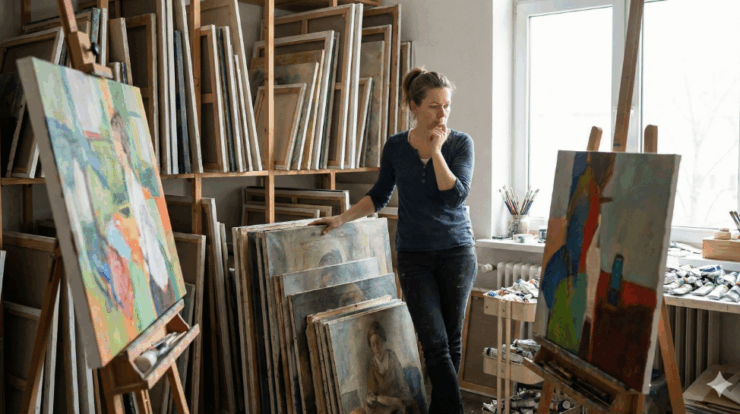
Every artist who has been working for more than a few years eventually faces the same problem: The Accumulation.
You look around your studio or storage rack and find a stack of paintings from five, ten, or even twenty years ago. Perhaps they were part of a series you moved on from. Maybe the style is completely different from what you are producing today.
The temptation is strong to clear the space—both physical and mental—by offering these pieces to your collectors at a steep discount. You might think, “I’ll just sell them for cheap to get rid of them.”
Before you send that email or post that “Studio Clean-Out Sale,” pause. While the intention is practical, the result can be damaging to your career.
The Danger of the “Fire Sale”
The primary risk of selling older work at a significant discount is the devaluation of your current work.
To you, the distinction is clear: “This is my old style, so it is worth less. This is my new style, so it is worth full price.”
To a collector, however, that distinction is often blurry. If a collector recently paid $4,000 for a current piece, and then sees you selling a similar-sized piece from ten years ago for $1,000, they don’t always see the nuance of “artistic evolution.” They simply see that your work can be bought for much less. It introduces doubt about the stability of your pricing structure.
Furthermore, if the older work is stylistically very different, introducing it to your current audience can be confusing. You want your portfolio to look cohesive. Flooding your market with work that doesn’t resemble your current brand muddies the waters.
So, if you can’t sell it at a discount to your current list, what should you do?
Strategy 1: The “Rework”
One of the most effective ways to deal with high-quality substrates (canvases or panels) that feature outdated work is to simply reclaim them.
Many successful artists take their older inventory—specifically pieces that have no hope of selling in their current form—and paint over them. You can sand them down, apply a new ground, and use them for new creations.
This has two benefits:
-
Cost Savings: You save on the expense of new materials.
-
Elevation: If you do choose to leave some of the original underpainting showing, or if you simply refresh the piece to bring it up to your current standard, you can re-title it. Instead of calling it “Old Work” (which sounds stale), you can refer to it as “Earlier Work” that has been revisited. This subtle shift in language preserves the dignity of the piece.
Strategy 2: Silent Channels
If you simply want the work gone and don’t want to invest time in reworking it, consider selling it outside of your primary ecosystem.
Avoid putting these deep discounts in your main newsletter or on your primary website where your full-price collectors will see them. Instead, utilize alternative, lower-profile venues. This could be an anonymous listing on eBay, a local “market” group, or a physical sidewalk sale where the audience is distinct from your gallery collectors.
The goal is to clear the inventory without attaching your primary brand name to a plummeting price tag.
Strategy 3: Donation and Gifting
Sometimes, the best value you can extract from an older piece is not monetary, but relational or charitable.
-
Donations: donating art to charity auctions can be a way to support a cause you care about while clearing space. (Note: Consult your tax professional, as artists can typically only deduct the cost of materials, not the market value, for their own work).
-
Gifting: Friends and family who have admired your journey often cherish these older pieces. Giving them a home where they will be loved is often more satisfying than selling them for pennies on the dollar.
Summary
Your “Studio Vault” represents your history, but it shouldn’t hold back your future. Be careful not to let the desire for a quick sale undermine the value you have worked so hard to build in your current portfolio. Treat your pricing with respect, and your collectors will too.
How do you manage your older inventory? Do you store it, paint over it, or find other creative ways to move it along? Let me know in the comments.

Excellent advice.. I often paint over older work.. the newer painting always sells I never sell at a discount..ever.. it cheapens you as an artist. Thank you
In graduate school we were told to save back 10 percent of early work for later in career. Am in my 70’s and now having retrospective exhibits at colleges wi talks and area museums. Current show will be on tour for 3 years.
This is a good way to share your history and also reignite interest in your work to a different audience.
I have been recently facing this exact issue, and your article helped me to see it from new perspectives. What are your thoughts about erasing one’s history, by painting over earlier works? Could it possibly have unwanted repercussions later? I’ve been following you for a while and appreciate your blog. Thank you.
P.S. We may have some mutual acquaintances – Mamie and Geoff Coffey. Years ago now, their daughters, Isabel and Sophia attended the Montessori elementary school in Phoenix where I was a teacher.
I have found that painting over my old work is the best solution. Not only is it economical, but certain aspects of old work can be inspiration for new work, especially if one is stuck. Disposing of old paintings and drawings can be cumbersome and time consuming. I feel that if the paintings have been sitting around for years and moved here and there, they are not going to be suddenly recognized. I like the idea of donating work to friends, family, institutions as well.
I have a small studio space. About 6 months ago, I was advised by an art collector to re-compose my older works didn’t sale. So I have been cutting out pieces from different paintings and using them as part of my mixed-media compositions. Creating new works. The process been very valuable to me in light of taking risks and pushing boundaries.
I have re-worked several of my older wood sculptures that I didn’t feel lived up to my expectations. One piece that was a large rectangular work has been cut into a crescent shape which complements several other crescent shaped pieces I’ve done recently, and it looks great. And as you mention in your blog, the material cost for this “new piece” is zero!
Last year, with a major exhibition coming up in 6 months and new work being finished every other week, I had to accept that I was running out of space to store anything new, even temporarily. So I took a closer look at old work I have in studio storage (well over 200 paintings), and considered where else it could go. Of course each painting has its own little story, and if I could connect that to someone I knew of who might be interested, I’d contact them, usually by letter with a small inkjet print of the work enclosed.
Surprisingly, I found some relatives weren’t the least bit interested in acquiring a fine portrait of a close family member (done as a sample), even at a discount. Others have jumped at the opportunity to have a legacy piece at full price for a painting they had no idea even existed. And each year I gift a number of paintings to family, friends or organizations who I know will enjoy them. Posting work in Facebook groups whose interests are the subject of my paintings is another avenue I’m exploring for possible sales. In any case, it’s always a thrill to know that one of my paintings has found a new home.
Hi Jason, thank you for your generous sharing and expertise!
Like Reginald, I also have a tiny studio space, so it doesn’t take much to be too much. Some of my hardboard canvases are ones made from scratch by me in a wood shop some years back — ripped unprepared Masonite, deep Poplar cradles, and lots of time, expense + effort. Given that, I have found a fair amount of success painting over when they no longer suit me or haven’t sold. I pick up inexpensive canvases to try new things and experiment, so I don’t feel pressure to make a masterpiece.
As a digital painter producing works as archival pigment on canvas, the “what to do” is much harder. A 42”x42” costs me in materials and pro printing my and stretching close to $600. It kinda “is” what it is from that point on.
This is all good advice, but my media is pastels. I like the idea of of cutting up for mixed media, and i have ample works to do that with. If others have ideas about reusing my pastel works on pastelmat and sanded papers, I would welcome them.
Yes, Jason, I rework my earlier pieces.
They become collage, montage, or mixed medi. I enjoy the process, it is constructive, and I come out with a better piece.
Yes, Jason, I rework my earlier pieces.
They become collage, montage, or mixed media. I enjoy the process, it is constructive, and I come out with a better piece.
I do all of the above with any unsold photography. Matted and framed works just get a new image. Archival prints mounted on cradled birch panels can take a new one on top, and after that I can remove (with some effort) all work mounted on the panel and basically start fresh. But, I also donate work annually to two organizations that raise funds for the non-medical needs of their cancer patients. It all works out.
(Note please: for some reason your form does not allow the domain I use for my email and website. It’s alllen@allenbourne.art and http://www.allenbourne.art , though the website address I’ve indicated redirects there.)
I dig them out of storage and retake a look at them. Usually I see what they need and fix them. I have also painted over them leaving some of the artwork showing. For instance, I took an abstract (which I am not good at, though I try every now and then) and painted my daughter’s portrait on it leaving yellows and oranges from underneath to highlight her hands and part of her face. It got accepted into the Pittsburgh Children’s Museum’s Faces show. Once in a while I will paint over the whole piece. Especially when I need a canvas to paint on.
I have reworked my textiles, cutting them up to reuse favorite elements in new sculptures. In fact when I first started working with textiles I made scarves to sell at juried art fairs. Although these sold well I quickly became bored after only 2 years and made the decision to cut up what I had left, after gifting to family, and began making soft sculpture. I also cannibalize prints for collage.
My old watercolors, usually sealed or fixed, don’t respond well to reworking. So I guess it’s the anonymous marketplace, family and friends, donations. Might try a coating of watercolor ground – nah, it’s paper, not worth the trouble, and the frame might be re-usable.
Coincidentally, I am in the process of looking through my old pieces. Since they are based on paper, not canvas, I don’t really have the option of resurfacing and reusing them, for the most part. I’ve decided to:
1) Throw out some of my REALLY old (and not that good) work — work that I’m positive will never sell;
2) Rework a couple of pieces; and 3) Donate 2 or 3 pieces.