


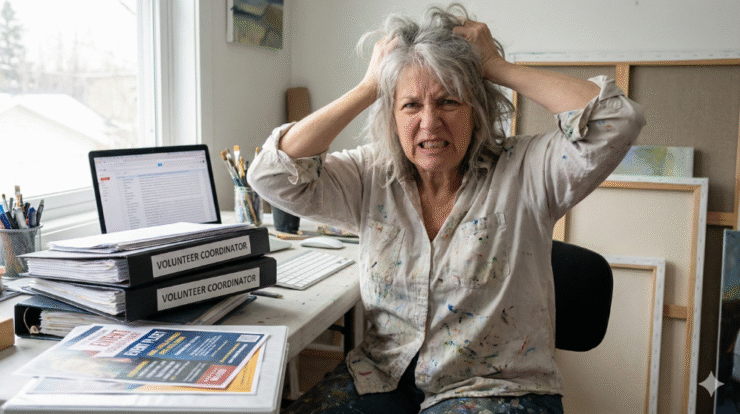
Local arts organizations form the bedrock of many communities. They provide exhibition opportunities, foster connection, and keep the cultural dialogue alive in neighborhoods and towns. These groups, almost without exception, rely on the blood, sweat, and tears of volunteers to survive.
It is a familiar scenario: An organization is experiencing a rebirth or launching an ambitious new exhibition series. They need someone dedicated, intelligent, and hardworking to pull it together. Naturally, they turn to the most reliable artists in their circle.
If you are that reliable artist, you know what happens next. You step up. You organize the hanging committees, you manage the difficult personalities, you handle the marketing, and perhaps you even teach the older members how to use the new digital submission system.
It feels good to be needed, and it is rewarding to serve your community. But there is a shadow side to this reliability. Many talented artists find themselves caught in a “volunteer trap,” where the immense effort required to uplift other artists comes at the direct expense of their own creative output and career growth.
How do you balance the desire to be a good community citizen with the necessity of prioritizing your own art business?
The “Curse” of Competence
The unfortunate reality of volunteer-led organizations is that their success often hangs squarely on the shoulders of a very small number of dynamic individuals.
If you are someone who figures things out—whether it’s updating the website or negotiating a venue contract—you quickly become indispensable. The reward for doing good work is often just more work. The feeling of responsibility can become overwhelming. You may feel trapped, convinced that if you step away, the entire organization, event, or program will collapse.
This sense of duty is noble, but it is also a heavy anchor. It ties up your bandwidth, consumes your time, and drains emotional energy that should be directed toward your own easel or sculpture stand.
Calculating the True Cost
When you are deep in the trenches of organizing, it is easy to rationalize the effort. You might tell yourself that organizing this major exhibit will provide a great platform for selling your own work included in the show. You might hope to parlay the administrative work into an income stream.
While it’s true that organizing an event gives you some control over displaying your own art, the hard truth is that volunteer arts organizations rarely have the budget to compensate their organizers fairly. Trying to replace studio income with administrative volunteer work is often a losing proposition.
The cost needs to be calculated honestly. It isn’t just the five hours you spent at the board meeting; it’s the emotional recovery time from the organizational politics. It’s the studio time lost because you were answering emails about drop-off schedules. I have known artists who realize they have dozens of finished paintings stacked up, unsold, because all their marketing energy was spent promoting other people’s work rather than their own.
Embracing Essentialism
If you find yourself in this position, it might be time to embrace a philosophy of “essentialism.” This isn’t just about getting better organized so you can cram more activities into your day. It is about the disciplined pursuit of less.
Essentialism requires looking at your life and ruthlessly simplifying, cutting out the extraneous—even things that are “good”—if they do not align with your highest long-term priorities.
For an artist dedicated to career success, the highest priority must be making and marketing your own work. If a volunteer role is actively preventing you from doing that, something has to give. Learning to say “no” to great opportunities to serve others is incredibly difficult for a person of conscience, but it is sometimes necessary for professional survival.
The Graceful Exit
Stepping back doesn’t have to mean burning bridges or abandoning your community. It is about finding sustainable balance.
-
Pacing Your Service: Consider actively participating for a defined period—say, two years—and then taking two years off to focus entirely on your practice. This rotation prevents burnout and forces the organization to develop a deeper bench of leaders.
-
The Honest Evaluation: Ask yourself periodically: Am I still getting non-monetary rewards from this (joy, relationships, learning) that outweigh the stress? If the answer becomes no, it’s time to plan an exit.
-
Letting Go of the Outcome: The hardest part is accepting that if you step away, the program might actually fail or diminish in quality. And that is okay. It is not your sole responsibility to prop up an organization that cannot sustain itself without your superhuman effort.
You can be proud of the service you have rendered without martyring your own career on the altar of community obligation. Sometimes, the best thing you can do for the art world is to step back into your studio and create your best work.
Where Do You Draw the Line?
Have you ever found yourself so deep in volunteer organizing duties that your own artwork suffered? How did you recognize the imbalance, and what steps did you take to reclaim your time without feeling guilty?
Share your experiences in the comments below so we can learn from each other’s strategies for setting boundaries.

I just stepped back from some responsibilities a couple of months ago. I gave a six-month notice and resignation date, and did everything I could to transfer important forms, paperwork, and procedures. Two weeks before my final date I asked everyone involved if they needed anything else from me before I handed over the reins. I think it went well, and remain on good terms with that organization.
There is an old and very wise saying I have tried to live by. ‘A wise man sees danger coming and hides himself from it. The foolish push ahead and are sorry for it later (my paraphrase).’
Just a few years ago the president of a small local artists’ group I belonged to was ready to step down. She called for nominations and no one stepped forward. I had served as recording secretary, so I saw truckload of duties her role entailed that only a few realized. She very politely remained silent…waiting…scanning faces. Finally, out of mercy to her more than anything, I said I would run if someone else would take on my previous role. I was hoping this would encourage a couple of others to throw their hats in the ring. It had the opposite effect.
I immediately felt my chest tighten and my stomach churned. I knew I’d ignored my instincts and I had two choices. Spend the next two years doing a job I was ill-fitted for and that would cause me to neglect my fledgling art practice or bow out. The real clincher was that I was also involved in another organization that was my #1 commitment. After a week or so agonizing over the consequences of either choice, I felt I would do the art group a disservice by taking the new role. A month before elections, I withdrew and explained with sincerity the best I could. It was one of the hardest decisions I’ve ever had to make, but very necessary. Did it damage my overall reputation as an artist? Only within that group and only for a short while, as I’ve had many other opportunities come my way since.
From that time to this, I’ve insisted on ‘sleeping on’ any volunteer roles for at least a few days before making a decision.
Oh yeah! When I foolishly made the suggestion that the California Art Club needed a Sacramento -Sierra chapter, all the famous artists said Yes! and took several firm steps back. Leaving me to organize, advertise and host the meetings, critique sessions, paintouts and retreats. My work suffered immeasurably for those 3-4 years. When I asked local members for help I got accused by some for making others do the work while I “got all the glory”. I didn’t get any glory. But I did meet some wonderful people in the Pasadena headquarters that stood up for me and appreciated my efforts. But I’ll never get that involved in any organization again.
All these “opportunities” but in art and my prior career, present potential to improve the situation and create something better. Until you are in the position and find the resources and collaboration were not as promised. I get hooked on knowing with the right resources I can make it work better. But once you say “yes”, the resources and collaboration are always less than expected. And it does take energy away from your own art and promotion.So now I keep to a time limited volunteer experience and only do those that I can justify as allowing me to experience something I know will help my career or learn something new. I am happier with this plan.
That sounds like my story. It took me longer than it should have to realize I was spinning my wheels trying to improve things and spending a lot of time and money commuting to meetings and the gallery duties.
So I just did not renew my membership and find I have a calmer mind, less frustration and more time to work on my own art pieces which bring me joy. I am now mentoring a young neighbor who is focused and enthusiastic by introducing different materials, ideas etc. to this young person which is bringing me a lot of satisfaction. Far more rewarding than dealing with adults who do not want to change the status quo.
I was involved in the leadership of a national group for about four years. The friendships and connections that I made with other professional artists are the best things I got out of it. I know my contributions were valuable to the group. It can be a very rewarding experience, but you do have to guard your time. And when it gets to be a bit too much let someone else take over.
I just let our local art guild know that I am stepping down as Secretary at the end of this one year term. I was surprised throughout the year as the President kept pilling responsibilities on my plate and getting more resentful as the days drug on. As soon as I told her I felt immediate relief so I knew I did the right thing. We have 130+ members so I feel like there ought to be another member who can step up. Thanks for this article, it helped me to confirm my own thoughts.
The need to be needed is the way I rationalized it. It eventually took a three month chunk out of my year and they were the months when I needed to be productive for me.
What happened was everything soured. I was kept on only because noone else wanted to do it. Eventually I was replaced.
It’s so much better to be in charge of you and say, “Thank you, but I just can’t take anything else on just now.” If you don’t do you, no one and nothing else will do you for you.
Hard lesson to learn sometimes.
I have different but related problem. I am confined to a bed and so many galleries are not available to me. I can’t participate in ‘meet the artist’ events, etc. Selling art when I can’t go out is difficult to say the least. And with my expenses and completely filled wall space, I really need to sell art!