


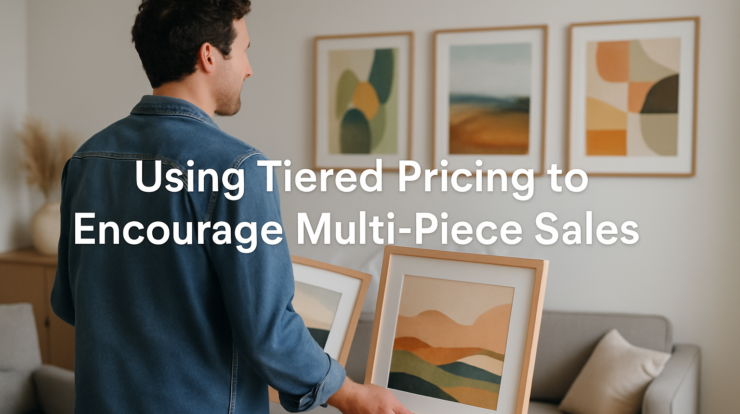
I’ve long believed that pricing art is both an art and a science. We want to be intentional about the value we place on our work—but we also want to create opportunities for buyers to collect more. One strategy that’s gaining traction, and that we’ve actively tested in the gallery, is tiered pricing for multi-piece purchases.
It’s a simple idea: buy one at full price, buy two or more and get a discount. But behind that simplicity is a powerful tool for increasing the average sale and encouraging collectors to think beyond just a single piece.
Why Tiered Pricing Works

Buyers often make decisions in the moment. They see a piece they love, and they’re weighing not just whether they want it, but whether they can justify the purchase. Now, imagine that same buyer is presented with a group of works that fit beautifully together—same size, same theme, cohesive presentation—and then learns that purchasing more than one comes with a price advantage.
At that point, the mental calculus shifts from “Should I buy this one?” to “Should I get two or three?” That’s a very different kind of conversation—and one that can lead to bigger sales.
We’ve seen this happen consistently in the gallery when the price points are accessible (generally under $2,000 per piece) and the works are presented as natural groupings—diptychs, triptychs, or just well-matched companion pieces.
A Simple Tiered Structure That Works
There’s no need to reinvent the wheel. We’ve found that the following structure strikes the right balance between maintaining value and rewarding commitment:
-
One piece: Full price (though, of course, you’re free to negotiate if appropriate)
-
Two pieces: 8–10% discount
-
Three pieces: 12–15% discount
-
Four pieces: 15–20% discount
It’s generous enough to make an impact but still protects your margins. And because this discount structure isn’t advertised as a “sale,” it feels more like a professional courtesy—a collector’s reward for deepening their engagement with your work.
When Tiered Pricing Makes the Most Sense

Like any strategy, tiered pricing isn’t one-size-fits-all. But it tends to work best when:
-
The works are similar in size and scale: It’s easier for buyers to envision multiple pieces displayed together.
-
There’s a strong visual or thematic connection: A cohesive group feels natural to collect as a set.
-
You’re working at lower to mid-range price points: The incentive carries more weight when the buyer isn’t already making a five-figure decision.
-
You’re having a direct conversation with the collector: Whether in person, by email, or over the phone, tiered pricing works best when it’s offered as part of a thoughtful dialogue.
Will Collectors Think It Devalues the Work?
Not at all—if you handle it well. This isn’t a clearance sale or a fire drill. It’s a curated, intentional offer to those who are making a bigger commitment to your work. You’re not dropping your prices across the board or undercutting your value. You’re simply rewarding volume.
And let’s not forget: most collectors understand that buying multiple pieces may open the door to some negotiation. Tiered pricing just provides a clearer framework for that possibility—without making it feel arbitrary.
Final Thoughts
If you’re building a body of work that lends itself to groupings—especially small- to mid-sized pieces—tiered pricing is a smart, professional way to nudge collectors toward deeper engagement. You’re not just selling more art; you’re helping buyers envision your work as a part of their environment in a bigger, more lasting way.
It doesn’t need to be flashy. Just quiet, confident, and consistent.
Have you tried offering multi-piece discounts? I’d love to hear how you approach it—or help you think through how to implement it effectively.

I have done this, but only offer discounts on the additional pieces – or the less expensive one(s). Are you suggesting the discount should be on every piece?
I’d like to know this, too.
Great question, Kathy. We’ve found it most effective (and cleanest) to apply the discount evenly across all pieces in the group—it feels simpler and more generous to the buyer. That said, your approach—discounting only the additional or lower-priced works—is also perfectly valid, especially if you’re trying to protect margins on a signature or higher-value piece. The key is clarity and confidence in how you present the offer.
Yes, I have successfully used the tiered pricing approach over the entire collection once the collector showed sincere interest. My art was on the smaller side, three pieces. Singularity I was asking $1800.00, but to help with their decision and hoping it secured a sale I made it clear that they could purchase all three for $1500.00 each. For a total of $4500.00.
Thanks for sharing that example, Steve. That’s a great way to reward sincere interest while still protecting the overall value of your work. Offering that kind of clarity and flexibility often tips the scale in favor of the sale—and helps build long-term relationships with collectors. Well done.
This is just what Inwould love to pursue. Here’s why.
Most of my work is built in a series concept and they are usually conceived within a consistent format as to size, framning, format. My innaugural show in what was called “to the corners” resulted in a collector buying. 3 of the 12 images. And we settled on a price for all three. the discount ended up about where you suggest.
I’m loving the concept because I’ve got “merch’ (read “art work)” that needs to move.
Thanks for sharing that, Stephen. Your series approach sounds like a perfect match for tiered pricing—it creates a natural incentive for collectors to go deeper. And you’re right, when you’ve got strong work ready to go, this strategy can help move it while still honoring its value. Sounds like you’re on the right track!
I read both this essay and your blog on mail communication. For the past client who purchased a single piece, including a commission, do you suggest the email might offer a discount on future purchases?
I have for many years offered a 15% discount to loyal customers when they purchase their third painting. This is for any future purchases. It’s worked out well for me.
Thanks for sharing that, Doris. Offering a loyalty discount on a third purchase is a smart way to encourage continued collecting. It rewards engagement without devaluing your work—and gives collectors a good reason to come back.
Thanks, Jack. Yes—offering a small, personalized incentive can be a great way to encourage a second purchase, especially if it’s framed as a thank-you for their support. Rather than positioning it as a generic discount, you might say something like:
“As a valued collector, I’d love to extend a special price if you’re ever interested in adding another piece to your collection.”
This keeps the tone warm and exclusive, without sounding like a mass promotion. It also leaves the door open for a conversation rather than committing to a set percentage.
I recently sold a collector 8 pieces of my work. What I did was rework my formula for each individual painting. I presented him with the retail price each painting would go for in the gallery and discounted price per painting due to his level of purchase. It meant the difference between a 6 or 7 painting purchase leading to the sale of the 8th. This worked out very well for both of us.
That’s a great example, Bonnie. By clearly showing the value of each piece and then offering thoughtful, scaled pricing, you honored your retail structure while also rewarding the collector’s commitment. That kind of transparency not only builds trust but can also tip the scale toward a larger sale—as it did in your case. Well done.
I love this idea and have offered this to returning collectors on new works as well as those aquiring multiple pieces at the same time. However, I only offer the discount on works purchased after the first piece. Also, a variation of your approach was effective in a hospital ultimately aquiring 22 large, fine art photographs for their Women’s Center. The original requst was for seven pieces. I proposed to them the regular fee with the offer to reduce the fee by 10 percent for any additional works. Then they were interested in doubling their order to 14 and they again increased their order for a final aquisition of 22 pieces. For every piece they purchased in addition to the original seven works I offered a 10 percent discount. The entire ordering process took some two months. Each time they were interested in additional works they requested a proposal with a visual layout of the pieces for displaying in their space.
CONGRATULATIONS!—-both on your sale and on your wisdom! Beautifully Done! Win/Win!
Rhona, appreciate your reply. Continued success to you too!
That’s a fantastic example of how a well-structured tiered discount can turn a modest request into a major acquisition. Your approach was smart: offer value incrementally while maintaining perceived quality. And providing visual layouts shows a level of professionalism that probably made the decision easier for them. Thanks for sharing—this is exactly the kind of thinking that helps artists grow bigger opportunities from initial interest.
Jason, appreciate your comment. I learned this approach early on from a successful painter friend. She guided me to not get “excited” and “give it away” so to speak. She also reminded me that I was acting as the artist and agent / gallery owner / artist’s representative and should approach the process from this place. I totally trusted her recommendation knowing that mulitple pieces of her works have been acquired by over 100 corporations and hospitals across America which were sold through an agent.
Phoenix, that’s such a valuable perspective—and wise advice from your friend. I love the reminder to approach the transaction wearing all the hats: artist, agent, and representative. When we do, we can stay grounded in the value of the work while still building strong relationships with collectors. Your friend’s success speaks volumes.
This post is very applicable to the kind of pieces I do. I have my jellyfish lamps prices at $1800 each or a set of three for $4500, which has been successful at least twice. I recently started offering trio discounts on the bugs too on my website but haven’t sent out a newsletter for it yet.
I also do paintings that I sell in getting card format and this tier works like a charm.
individual card = $5
set of five = $20 (most popular option)
set of ten = $30
Mason, that’s a perfect real-world application of tiered pricing at multiple price levels. Offering both high-end (your jellyfish lamps) and low-end (cards) examples shows just how flexible and effective this strategy can be. Highlighting the trio discount in your next newsletter sounds like a smart next step—it gives collectors a reason to act now and deepens engagement with your work.