


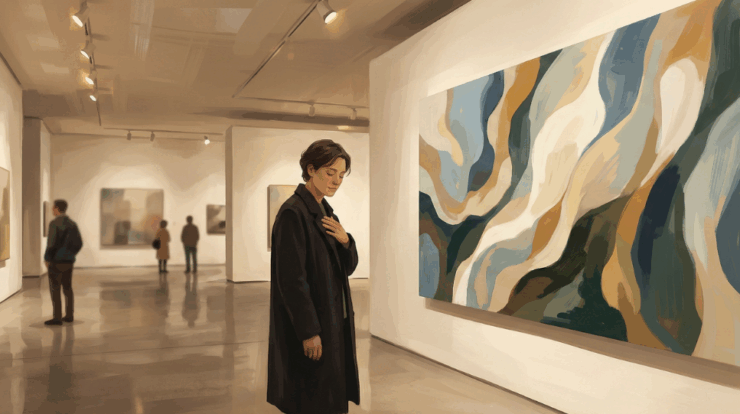
Every so often, an artist witnesses something remarkable: a viewer stands before a piece and is visibly affected. Sometimes it shows up as tears, but just as often it’s a long pause, a shift in posture, a softened expression, or the unmistakable sense that something deep has stirred. These moments transcend technique or trend — they reveal the true power of connection.
In my last article, I wrote about how the real measure of art isn’t objective quality but the connection it makes with the viewer. That connection sometimes arrives quietly, and other times it hits with emotional force. When it does, artists often wonder what to do with it. Do you engage? Do you give the person space? And how should you interpret that reaction?
Below are some thoughts on understanding and navigating these moments with care.
Why Strong Emotional Reactions Matter
When someone has a powerful response to your work, it means the piece reached a place beyond the surface — a memory, a loss, a joy, a longing, a question they’ve been carrying. These reactions are rare. They’re also among the highest compliments an artist can receive.
Long before a viewer becomes a collector, they become a participant in the emotional space your art creates. That’s a profound exchange. It means what you’ve produced isn’t just visually appealing — it’s meaningful.
This is why, even if no sale happens in the moment, the experience itself has value. It’s a reminder that your work carries impact you may never fully see.
How to Respond in the Moment
When someone is deeply moved by your work, the instinct might be to jump in, offer explanations, or even shift into sales mode. But strong emotion is delicate. A thoughtful response makes all the difference.
Here’s a simple rhythm to follow:
Pause and honor the moment.
You don’t need to fill the silence. Let the viewer process. Whether the reaction shows up as tears, stillness, or quiet reflection, their experience is valid.
Offer presence, not pressure.
A gentle acknowledgment — “Take your time” or “This piece means a lot to many viewers” — can be enough. They may choose to open up; they may not.
Let the viewer lead the interaction.
Some will want to share what they’re feeling. Others will step back and need space. Either response is perfectly fine.
Avoid shifting into sales mode.
As tempting as it is, emotional moments are not closing moments. Trying to sell too quickly risks flattening what just happened. There will be time later — and in many cases, a deeper connection leads to a more meaningful sale down the road.
Your role is to support, not steer.
Why Emotional Resonance Reaffirms Your Purpose
Artists often question whether their work is reaching anyone. Strong reactions offer an unmistakable answer: yes. They reaffirm that the hours spent refining technique, chasing ideas, and pushing through doubt are worthwhile.
When a viewer is visibly moved, it demonstrates that what you’re creating is more than decoration — it’s a bridge. These moments remind you that your work carries the capacity to comfort, challenge, inspire, or heal. That’s the deeper purpose many artists are ultimately chasing, whether consciously or not.
The Long Tail of Emotional Impact
One of the surprising things about emotional responses is how often they outlast the moment. A viewer may not buy a piece immediately, but they remember how it felt. They may return days or weeks later. They may commission something. They may become a long-term follower of your work.
Emotional connection creates memory — and memory creates momentum.
If your art has moved someone strongly once, it will likely continue to do so.
Connection Is the Heart of the Work
In the earlier article, I emphasized that “good” is not an objective measure — connection is. Strong emotional responses are simply connection at its fullest intensity. They reveal the real exchange happening between you and your audience.
Not every viewer will feel something powerful. They’re not supposed to. But when a viewer does, it’s a reminder that your art is doing exactly what art at its best has always done: touching the human experience in ways that words often can’t.
What about you?
Have you ever seen someone respond strongly — emotionally or otherwise — to your work? How did you handle the moment, and what did you take from it? I’d love to hear your experiences in the comments.

I appreciate your sensitivity to this topic. Sales are great, but you are so right, it’s the connection that matters in the end. As an artist, it’s the best feedback. I recently had a friend text me after he had seen one of my paintings in a local gallery that it really touched him. I rarely hear from him so to receive a text to tell me how the painting touched him was very special. I thanked him for sharing that with me, told him it was one of my favorite paintings, and asked him how it touched him. He said it is difficult to explain how it affected him and then wrote a couple short sentences. He though it was the dark color with bits of light and the title helped him see it in a particular way. Artwork comes from a nonverbal place inside the artist. And it can affect the viewer in a nonverbal way so it makes sense that it’s hard to explain how the work affects one. He didn’t buy the piece but it sold a week after he saw it. I’m happy he had that experience.
Yes, I created a multimedium piece of art called Losing sight of the light of Humanity. It is a powerful piece. One lady stood with her Husband a long time and eventually she turned to me and asked if I was indeed the artist and I said yes, she then asked me with tears streaming down her face if she could give me a hug and thank me for creating such a meaningful piece. I did have more similar reactions but none as profound a hers. If I never again create another such piece, that one was worth every minute.
I do a lot of landscapes based on our Texas Hill Country region. I did one of our iconic Enchanted Rock and a young woman and her husband came by and were viewing it. Later, the woman came back and wanted to purchase it for her husband’s birthday because it reminded him of all the times he and his father hiked up the Rock when he was a kid. It always gives me such pleasure to have people connect with one of my pieces like this, even if they don’t buy it. This is why I paint.
As you say, sometimes there are tears. Sometimes an animated viewer suddenly goes quiet. I have even seen times when they suddenly suck in their breath or their shoulders drop and their eyes dilate. Each experience is slightly different according to the person and the piece. Usually I let them initiate any words when they are ready for words, but always thank them for such a great compliment. They can tell by the look on my face that I know the work has touched them profoundly and we now share a connection that wasn’t there before. Sales can happen but it is never about the sale. One of my favorite experiences was a little boy who looked at me with stars in his eyes and asked me, “How do you make them “alive”? I treasure that reaction to this day.
I create woodturned-art in a unique vein. I accentuate natural edges, surfaces, and perfect imperfections — characteristics — with the express intent of carrying the story of the original tree forward. I contrast those natural features against finely finished surfaces within the same piece. I regularly witness patrons and patrons-to-be experiencing strong emotional connections to my work, specifically every day that I show, which is roughly 60-70 days per year.
While I like to have as many pieces as possible find appreciative, loving homes, my real payoff as an artist is seeing a person’s eyes light up at first sight with unmistakable connection. That’s where my heart lies. Being a highly emotional person myself, these moments often result in strong personal — often emotional — connections that carry forward. It’s the best of life.
At a recent Art Fair a woman described my work as ‘ Making the world lovely again’. What I am doing by observing the world by bicycle, is reminding people to pause and see that the world is indeed lovely.
I have done many portraits of horses and dogs over the years. I have always tried to connect with both the subject and the pet owner whenever possible. It is not only the likeness of the animal that is needed, but also some aspect of the pet’s behavior or a shared incident that endears the animals to their owners. Once I can put my finger on what that is and deliver that in the painting, emotional connection is always achieved with the final portrait. The most difficult of my recent commissions was for a posthumous portrait of a dog commissioned by the dog owner’s best friend as a surprise gift. I had only a few photos of the dog given secretly by the dog owner’s daughter, which included one with all of the family. Long story short, I studied that family photo and was able to decipher what the people really wanted from the dog in the way they were holding him and the various reactions of the family members. This led me to do the portrait differently from how my patron initially expressed he wanted it done. When the painting was done and shipped the dog owners were thrilled with it and my patron said it was the best gift he had ever given to anyone. The emotional connection was successfully made. I think, ultimately, the emotional connection is everything.
I love this blog you wrote. I have often seen viewers connect to my work deeply, expressing verbally what they felt. I have seen them stand in front of my work and stare at it. And my first reaction is to go on a sale mode! Oftentimes it never works. It has flattened the moment 🙁
I like what you said— the work has done and reaffirmed its purpose…the emotional connection that we would love our viewers to experience!