


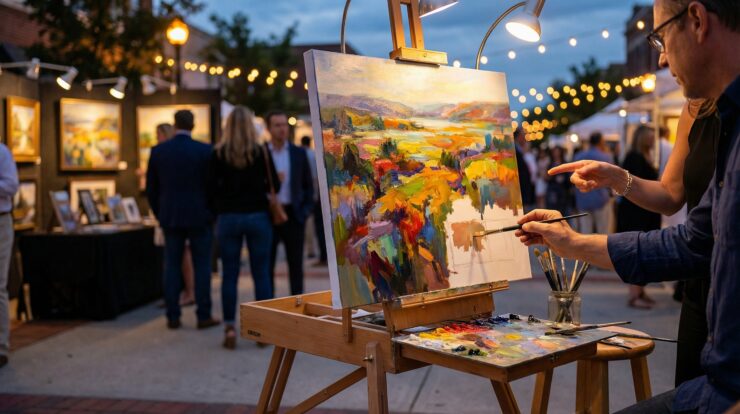
A couple of years ago, during a Thursday night art walk in Scottsdale, our gallery hosted a live painting demonstration. The space was buzzing with energy, casual foot traffic, and potential buyers out looking for a touch of culture. My father, a seasoned artist, set up his easel right in the center of the room.
But he didn’t bring a blank canvas. He brought a piece that was already three-quarters finished.
If you treat live demonstrations simply as studio time relocated to a public venue, you are leaving money on the table. To maximize live event sales, you must treat your demonstration as a strategic lead-generation tool by bringing a 75% complete canvas, actively pulling attendees into the process, and using that engagement to book lucrative home viewings.
1. The Psychology of the Three-Quarters Canvas
When you start with a blank canvas at a two-hour event, you demand too much imagination from the passing crowd. A casual buyer walking into a busy gallery doesn’t have the time or the vision to watch you block in underpainting.
Bringing a piece that is 75% complete changes the entire dynamic of the room. You are presenting a recognizable, highly professional image while still offering the romance of the live creative process.
- Instant Visual Impact: A nearly finished piece commands respect from the moment the doors open. Buyers immediately recognize the value and skill involved.
- Focused Action: You only have a couple of hours. Starting late in the process allows you to focus on the flashy, interesting detail work—adding highlights, refining edges, and making the painting pop.
- Managing Expectations: The goal of a live demo is never to actually complete a painting. It is simply an opportunity for buyers to witness the magic of paint hitting the canvas.
2. Hand Over the Brush
As my father worked on his piece, he did something that completely shattered the traditional gallery barrier. He pulled a couple from the crowd, handed them a brush, and invited them to paint a few strokes with him.
The traditional gallery environment quietly screams, “Do not touch.” By breaking that rule and physically handing the tool to a prospect, you create an unforgettable, tactile memory. It builds an immediate emotional bridge between the buyer, the artwork, and the artist.
When that couple walked away, they weren’t just thinking, “We saw a nice painting.” They were thinking, “We helped paint that piece.” That psychological ownership is incredibly powerful.
3. Strike When Serendipity Occurs
That interactive energy sparked a deeper conversation. The couple, visiting from Ohio, mentioned they were building a new home in North Scottsdale. As we talked, a massive coincidence emerged: they had recently seen another one of my father’s large paintings in the lobby of the hotel where they were staying.
That hotel painting had literally sparked their internal conversation about what they wanted for their new home. Now, here they were, holding his brush.
As a gallery owner, when I hear this kind of serendipity, my internal alarm bells go off. Everything is perfectly aligned for a major sale. You cannot let these moments end with a polite, “Thanks for stopping by.” You must pivot immediately to the logistics of a home viewing, gathering their contact information, timeline, and spatial requirements.
4. Proactive Follow-Up Secures the Sale
The morning after the art walk, I sent an email thanking them for the visit, attaching an image of a specific piece they admired in the gallery, and proposing a timeline to bring the artwork to their new home.
The client replied with a polite, “Thanks Jason, I’ll get back to you with some options.”
Many artists will read a response like that and simply wait. Do not do this. Every day that passes without a solid action plan decreases your likelihood of closing the sale. I responded immediately, offering specific availability for the following week. When I didn’t hear back for a few days, I followed up again with an update that the demonstration piece was now finished, proposing a low-pressure, 30-minute home visit.
- Set Daily Reminders: Never trust your memory. Put the prospect in your task manager to ensure you follow up relentlessly.
- Always Offer Value: Use your follow-up to provide new information, like a photo of the completed demo piece or a digital mockup of the art in their space.
- Be Unambiguous: Suggest specific times and days. Make it as easy as possible for the client to say yes to an appointment.
That persistent follow-up resulted in a home viewing, a negotiation phase, and ultimately, a $7,700 sale—with the door left wide open for future commissions.
One Final Takeaway
Your goal during a live event is not to showcase your technical speed or to finish a masterpiece under pressure. Your only objective is to spark meaningful conversations that result in actionable contact information and concrete appointments.
What’s Your Event Strategy?
Have you ever handed your brush to a potential buyer during a live demonstration, or do you prefer to keep a strict boundary while you work? Let me know about your most successful live event tactics in the comments below.

This sounds like an incredible opportunity. One that I wish I had seen earlier….
These are genius ideas.
Thank you, Jason, for sharing your ideas. If I find myself in such a situation I will definitely bring a painting in a 3/4’s finished state. It’s a very good idea.
I also appreciate the information on following up. It teaches me not to be reticent.
Jason, I do a lot of this type of live painting for all of th reasons you mention but have never handed my brush to someone and I LOVE 💕 that idea!!
Jason, could you tell us more about what to do to make a home visit successful?
Jason, the three-quarters canvas insight is one of those ideas that seems obvious in retrospect and yet almost nobody does it. You’re not asking the viewer to imagine — you’re inviting them to witness. Completely different ask.
And the brush handoff is genius-level sales tactics. The moment a collector makes a physical mark on a piece, psychological ownership is real.
In response to your question about live event tactics — I once produced an event where a jazz quartet accompanied an abstract painter working in real time, the painter responding directly to what the band was playing as it unfolded. Within thirty minutes customers were out of their seats, surrounding the artist, watching a painting emerge from sound. Nobody experienced it as a gallery visit. They experienced something that had never happened to them before — and the gallery walked away owning that memory.
The principle underneath it all is the same: manufacture the moment of genuine connection rather than leaving it to chance. The three-quarters canvas does it. The brush handoff does it. Live music paired with live painting does it. You’re collapsing the distance between the collector and the work by making them a participant in something unfolding in real time.
Curious whether others have experimented with layering sensory elements around live painting and whether that changes the sales conversation afterward.
Nicole Graham, Nicart Art Agency, Oregon Coast
Thank you Jason! Once again your blog posts tackle most artists’ burning questions.
During art walks I always make sure I have a work in process at my studio. Not finished but half way there. Visitors love to see artists in action. One Saturday art stroll a couple with their two kids dropped by my studio and shared how much they enjoyed my work. I struck a conversation with one of the kids (8 years old) who showed great interest in my demo painting. I gave him my brush and invited him to paint. He loved it and of course the parents enjoyed to watch his experience.
The painting didn’t get sold but led to a nice commission ($4,000) for their newly renovated home!
Yes you are so right, interaction and involvement in a studio visit can help build relationships and trust.
The Waterworks art museum in Miles City does something like this at the Bucking Horse sale. the JC’s have a parade down main street and after the parade there are events in one of the parks, which the Art Museum, has what they titled the Quick Draw Art Auction, where artists bring 3/4 or more completed works or some even do complete from start to finish works. Then there is an auctioneer who auctions off the works. This benefits both the Museum and the artists. And it gives the collectors a chance to see what artists do to make their art.
I used to work in the convention and trade show business, and several times our clients would hire a performance artist – not a singer or dancer but a performance PAINTER. He would be on a small riser stage, music would be playing and he would be slinging paint wildly onto a large canvas. As the music came to the end, he would triumphantly stop and flip the canvas 180-degrees and Voila! It was a portrait of Jimi Hendrix! The crowd erupts… He had several portraits in his repitroire; he was amazing.
Jason,
I am involved with plein air painting. This does draw a crowd. I am trying to get them to come to my studio space. When I set things up correctly, I have a studio tour to invite them too. They often come to see the finished work. See other pieces……..
Great connection builder for certain!
Jason, Thanks for this article. I have done many demos at shows. Although I choose something that I know I can do quickly, it is sometimes difficult to get people stay till it is a recognizable painting, the 3/4 painting is a good idea for reasons you stated above. I will try that next time. Yes I have invited selected people from the audience who look anxious to participate – even the kids. However lately I have bringing extra substrate and handing them out to paint on rather than painting on my painting,
Thanks,
Jason.
Hi, Jason, these are fantastic ideas and ones that I haven’t heard of before such as handing a brush to a person and allowing them to paint on a canvas. I have never done a live painting event and I’m just getting into local juried shows. Thank you for sharing these excellent business necessities.
This strategy makes so much sense to me. I have done live demos starting with a blank canvas and at the beginning there is nothing to see; nothing to pull the viewer in. It also puts a lot of pressure on the artist.
Thanks for sharing, Jason!
Thank you Jason for sharing this wonderful marketing tip that your Father used. It is such an outstanding way to create an emotional connection between the art, the artist, and the potential collector. When doing commissions for clients I have often invited my clients to be a part of the experience. Whether it is coming out with me to photograph a landscape that I am painting for them, or a short hike to locate the view and composition they want me to capture in their painting. These wonderful experiences have also lead to lifelong friendships with many of my patrons which I cherish dearly.
So happy I stumbled on this particular blog in my inbox. I am giving an Artist Talk and Demo in a gallery next weekend. I now understand the importance of showing up with a 75% finished artwork. Brilliant! Thank you so much.
Brilliant and your post has so much depth of information. Very clever engagement strategy that could be fun to boot!