


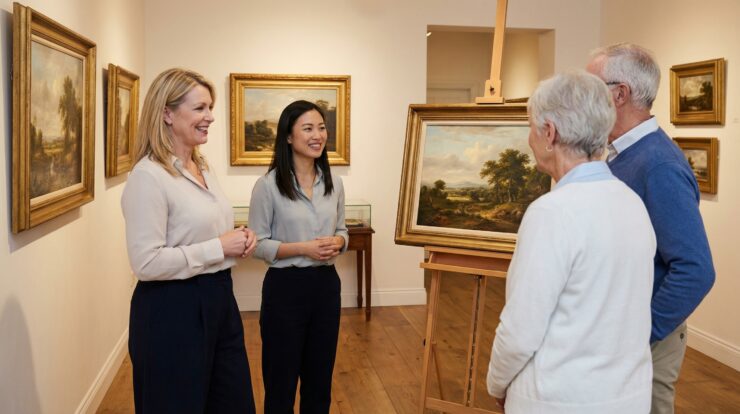
Today, I want to write a slightly different article to give you some insight into how Xanadu Gallery works and how we differ from many other galleries and traditional sales environments. When my wife Carrie and I started the business, we set it up this way to encourage a cooperative environment. The gallery I started working for in the 1990s had a similar structure, so I was fortunate to see how the concept worked firsthand before we started our own gallery.
1. The Cutthroat Reality of Individual Commissions
Traditional commission-based sales often foster a harsh, competitive environment. Staff members can end up competing against one another to make a sale happen because their take-home pay depends entirely on their personal conversion rate.
If a co-worker pulls a customer in and makes the sale, they get the commission instead of you. We wanted to avoid the intense workplace tension we had heard about in other spaces—associates guarding the door or fighting over “who owns this client.”
This internal friction bleeds directly onto the sales floor. The collector feels the desperation. They sense the hovering energy and their internal monologue kicks in: “I need to get out of here before I’m pressured into buying something.”
2. The Psychology of the Shared Commission Pool
When I first started in the business working for a large gallery in Scottsdale, they utilized a unique approach that I eventually echoed at Xanadu Gallery. They used a shared commission structure.
Instead of receiving a payout solely on direct individual sales, staff earned a percentage of the total sales generated by the entire gallery. The sales simply went into a collective pot and were divided among the team.
This inherently fosters a cooperative environment. Here is why this model has worked so well for us:
- Coverage flexibility: It no longer matters if an associate starts working with a customer but happens to be off the day they return to buy.
- Team support: A co-worker can gladly step in, answer questions, and complete the sale because everyone benefits equally.
- Collector comfort: The pressure evaporates. Multiple staff members can warmly interact with a buyer without territorial weirdness.
3. Benchmarking the Compensation Framework
Transparency into how galleries actually operate helps demystify the business side of our industry. At Xanadu Gallery, our staff compensation is structured in two distinct tiers to provide security while heavily incentivizing volume.
First, we pay a reliable base rate. Because our gallery is very seasonal, it’s important to establish a baseline for our staff throughout the year, including our slow summer season.
Second, we pay a shared commission based solely on net sales. Here are the rules we follow for that structure:
- Calculate the net: The commission is calculated only after the artist’s 50% cut is paid out.
- Deduct hard transaction costs: We also remove shipping expenses and any collector discounts before determining the commissionable amount.
- Apply the team percentage: We dedicate a healthy percentage of that final net amount to our staff pool.
While standard corporate retail might pay staff around 5% of total retail, our model carves out a much larger piece of the gallery’s margin. Because the team is highly motivated to sell, total sales volume increases, benefiting the gallery, the staff, and the artists we represent.
4. Aligning Incentives with Artist Success
We believe our team is our most important asset, second only to the artists whose work hangs on our walls and sits on our pedestals. The work our staff does—interacting with customers, following up, and building long-term relationships—is the core engine of our business.
By using a shared commission, we have found that everyone’s priorities are perfectly aligned. Our staff isn’t just trying to move the piece that yields the highest individual payout; they are trying to match the right collector with the right artist to build lifelong client loyalty.
I don’t mean to imply that there is no sense of ownership for customers or that there can’t be some territorialism that comes into play, but it is at a much lower level and greatly diffused by the commission structure we’ve set up.
When our gallery operates cooperatively, the rising tide lifts every single boat. The staff takes home a solid paycheck, the gallery stays profitable, and artwork finds its way into collections without aggressive sales tactics.
Question for Readers
Have you ever noticed a palpable difference in the atmosphere of galleries that use aggressive individual sales tactics versus those with a relaxed, team-oriented approach? How does it affect your perception of the space as an artist?

Thank you for this, Jason.
I’ve been represented by a gallery here in BC for over 15 years, and unfortunately the owner isn’t open to considering a philosophy like yours—even though I believe it would be in the gallery’s best interest. I’ve spoken with staff members on several occasions, and they seem to feel the same way.
As an artist, I understand that I can’t control the owner’s perspective, but I do agree as I’m sure many artists agree with your reasoning.
Different business but I used this same philosophy at a cafe I owned. We were small and I needed people to be willing to help in all areas and not be upset about “losing the big tips” when helping in kitchen or doing dishes. I paid a higher hourly rate and tips were split equally. It worked—most of the time.
I’ve definitely noticed a difference, and it has a real impact on whether I even want to step inside. So many galleries feel… aloof. There’s this unspoken tension, like you’re being evaluated the moment you walk in. In some cases, it honestly feels like being watched by an eagle, head on a swivel and eyes locked in, just waiting to see if you’re a “serious buyer” or someone who wandered in off the street. It creates this quiet pressure that makes me want to tiptoe right back out.
On the other hand, the few galleries that feel relaxed and team-oriented are completely different. There’s an openness, a sense that you’re actually welcome to be there; to explore, to take your time, maybe even breathe a little without feeling like you’re about to be upsold into a life decision.
As an artist, that kind of environment feels far more aligned with the spirit of creativity. It invites curiosity instead of interrogation… and oddly enough, it makes me want to stay longer, which is kind of the point.
To me, the attitude of the gallery staff not only shapes the atmosphere and visitor’s experience— it defines it.