


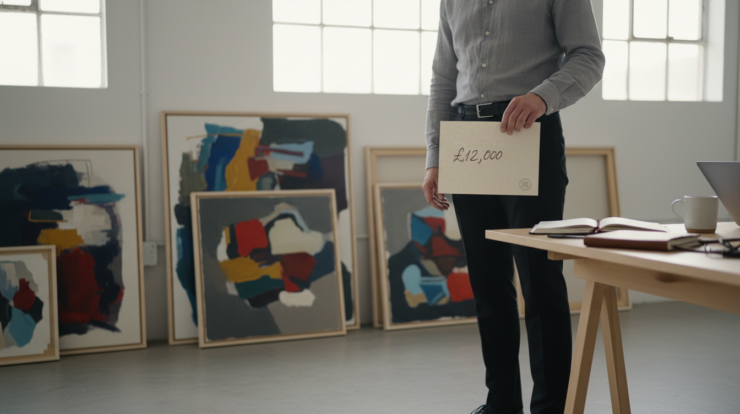
One of the most complex challenges you will face as your career expands is managing your relationship with multiple galleries. You might have one local venue charging a 17% commission, while a high-end gallery in a major city takes the industry-standard 50%. It is tempting to adjust your retail prices based on these margins, but doing so is a recipe for brand confusion and lost sales.
The Golden Rule of Consistent Pricing
To a collector, your work has a specific market value. They do not care about your overhead, your shipping costs, or the commission split you negotiated with a gallery owner. If a buyer sees a large landscape for $4,800 on your website but finds the same size piece for $4,200 in a local shop, you have created a trust problem. They will wonder why the price is lower and if something is wrong with the less expensive piece.
Always set your retail price based on your highest commission tier. If you are represented by a gallery that takes 50%, your website and every other venue must reflect that price. This ensures that no matter where a sale occurs, your brand remains professional and your relationships with all gallery partners stay intact.
Managing the Profit Margin Shift
When you maintain a singular retail price across various venues, your take-home pay will fluctuate. This is normal and should be viewed as a strategic trade-off. A gallery taking a higher commission is theoretically providing more value through high-traffic locations, active marketing, and access to wealthier clientele.
- Calculate your base retail price using your highest commission rate (typically 50%).
- Apply this price to your own website and studio sales.
- Ship work to lower-commission venues at the same retail price.
- Monitor the volume of sales at each venue over a six-to-twelve-month period.
- Reallocate your best inventory to the venues that generate the highest total revenue, regardless of the individual commission percentage.
Avoiding the Race to the Bottom
Many artists mistakenly believe that lowering prices will automatically increase sales volume. In the art market, this is rarely true. Price is often a signal of quality. If you are ready to move up-market, you must be disciplined enough to raise your prices across the board.
- Don’t leave old, lower prices on older work while raising prices on new pieces of the same size.
- Don’t offer ‘studio discounts’ that undercut your gallery partners.
- Don’t ignore your website; it must be the anchor for your current market value.
- Do realize that a higher commission gallery that sells three pieces a month is better for your business than a low-commission gallery that sells nothing.
The Inventory Strategy
If a gallery is taking a 50% commission but isn’t moving work, while your 17% venue is selling everything you send them, your inventory should reflect that reality. You aren’t ‘losing’ money by giving the 50% gallery a chance; you are testing a market. If the test fails, move the work to the venue where it prospers. By keeping the retail price the same, you can shuffle inventory between these locations without ever having to re-tag or explain a price change to a collector.
Question for Readers
Have you ever struggled with the urge to lower your prices for a direct sale, and how did that decision affect your relationship with your galleries?

Thank you for great advice
Thanks Jason, another insightful post! Re. old, lower prices artwork, do you suggest we raise the price of these older works to match our higher prices or retire them? Thanks much!
When I made the decision to focus on producing my art work (after a successful arts eductaor career), I saw the vision of glorious sales. And then the “art buisness” reality set in.
Crickets.
“Starving to Successful” (eventually after more crickets)
Art Business Academy
1. The Business of Art is hard for a person living in the world of making images on a whim which is where I was as an artist-teacher. (Model what you want to see- was my “mantra”)
2. Consistency is primary and I found it liberating productively and administratively. It was and is not quite cemented in administratively.
3. Pricing was at issue and I have probably a dozen lousy spreadsheets to feed the crickets.
4. Here’s where I am today. Production, Idea and execution, Personal gratification, Modulus, Total, Size, Per square inch, My price, Commission 50%, Asking price. Shipping separate.Everything is automated and I input production cost and size. The modulus allows for minor adjustments where needed and governs price inncreases once the crickets have stopped singing.
5. The biggest take-away for me has been, viewers and collectors fall in love with the “piece” they are viewing. They never see what it takes, how you do what you do, where you are doing it, and how you are handling your day to day. As relationships develop, the narrative emerges or not. the work is not diminished.
6. If you start to second guess your market, the ultimate extension is pricing that you think matches each and every pocketbook and that is a guess based on “air pudding with wind sauce” which is the crickets’ food of choice I’m thinking.
I agree with having one consistent price across all gallery venues and my website. My question is how should I handle sales and discounts off of the retail price? For example a gallery owner may offer a lower price to close a sale or I may offer a discount via an email or social media post in an effort to entice a potential buyer to visit my website for a look around and maybe purchase. A gallery owner’s discount offer may be more subtle as it’s one on one discussion, while a sale or discount on my website is more prominent, but in the end, they are the same thing. What do gallery owners and collectors feel about this?
I have a pricing formula that has worked for me/my former husband as my primary artist for almost 5 decades. I happily share it with my clients, who have always found it reasonable. He creates his art in about 13 different sizes ranging from 10×12 to 48×60 (many of them have kind of “happened” in the studio over the years). Each of those sizes is assigned a range of price that is 20-25%. Each artwork is placed into the range based on quality. The price ranges are evaluated once a year and adjusted upward (once or twice kept the same) depending on sales results and on the market. Galleries are given artworks with the retail prices of each specified. The commission rate charged depends on the individual contract with the gallery. There is also a clause in the contract regarding price changes. Galleries are allowed to discount no more than 15%; and cannot increase more than 15% than the price I have furnished to them. However, I am always paid on the percentage of the price furnished. This gives the gallery a great deal of latitude yet also gives me stability. And since both galleries and buyers know prices are evaluated annually, no one feels “stuck”. I wish you all well and good fortune in your art efforts.
Not sure I’ve ever seen an artist works that were all the same quality, even the Masters. I’m not disputing what you said about a collector being upset when they see different prices on 2 paintings the same size, same artist. I feel that if 2 of my paintings are the same size and one is not as strong but still above my standards, shouldn’t the strongest be priced higher?