


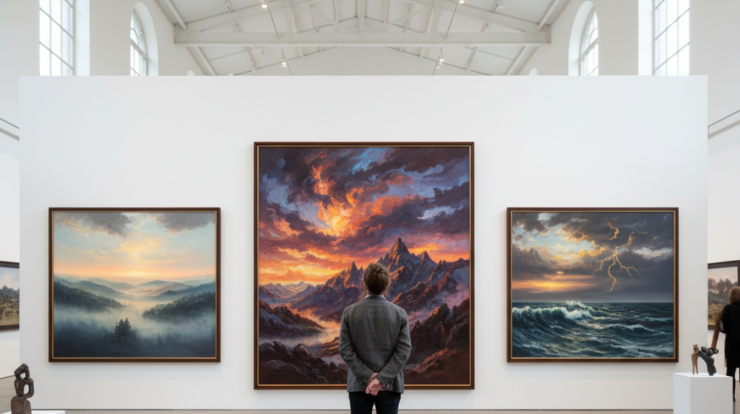
Many artists hit a plateau because they are subconsciously afraid of their own materials. They worry about the cost of a large canvas or the amount of ‘wasted’ paint if a big piece doesn’t work out. This hesitation keeps your work small, safe, and often harder to sell for a premium.
Scaling up is one of the most effective ways to command attention in a gallery setting. A statement piece doesn’t just fill a wall; it creates an atmosphere that smaller works simply cannot replicate. When you move past the fear of the format, you open your business to a new tier of collectors.
The Psychology of Scale
If you find yourself intimidated by a large blank surface, remember that it is just paint and fabric. The technical hurdles of a 48-inch canvas are largely the same as a 12-inch canvas, but the impact is exponentially greater. Fear often stems from a retail mindset where we count the cost of the tubes of paint rather than the value of the finished vision.
You have to be fearless with your strokes. Large-scale work requires you to use your entire body, moving from the shoulder rather than just the wrist. This physical shift often leads to more dynamic, energetic compositions that collectors find irresistible.
A Framework for Scaling Your Work
Transitioning to larger formats shouldn’t be done haphazardly. Use this process to ensure your quality stays consistent as your dimensions grow:
- Study the Atmosphere: Start with small studies or reference photos to nail down the lighting and mood before touching the big canvas.
- Establish the Horizon: On a large surface, composition errors are magnified. Lock in your major structural lines first.
- Use Transparent Layers: Start with thin, transparent washes to establish values. This allows the luminosity of the white canvas to bounce through the paint, preventing the piece from feeling heavy or ‘muddy.’
- Work Wet-on-Wet: To maintain a cohesive feel across a large area, try to work while the paint is still pliable. This helps blend those massive skies or landscapes without creating harsh, unintentional breaks.
Navigating the Large-Work Market
It is a common misconception that large paintings are harder to sell. While the pool of buyers with the wall space and budget might be smaller, their level of commitment is often higher. A large painting is frequently a ‘destination’ purchase—the centerpiece of a room.
However, you must be prepared for a different sales tempo. Smaller works often move quickly because they are impulse buys or gifts. Large pieces are investments that require more ‘curing’ time on the gallery wall before the right collector walks through the door. Do not lower your price just because a large piece hasn’t sold in its first month.
Common Pitfalls in the Upscaling Process
Avoid these frequent mistakes when moving into larger formats:
- Inconsistent Pricing: Ensure your per-square-inch rate remains logical. While it is common for the rate to dip slightly as size increases, avoid dramatic price gaps between pieces of the same size, as this causes collector confusion.
- Over-Framing: A massive, heavy frame can make a large piece feel dated. Consider simple floater frames to keep the focus on the art and make the piece feel more contemporary.
- Shrinking the Subject: Don’t just paint a small idea in the middle of a big canvas. Use the space to create drama and immersion.
- Ignoring the Venue: Large work needs room to breathe. Ensure you are showing in spaces with high ceilings and long walls that allow viewers to step back and take in the whole composition.
One Final Takeaway
Your willingness to go big signals to collectors and galleries that you are confident in your vision and professional in your approach.
Question for Readers
What is the largest piece you have ever completed, and what was the biggest technical or mental hurdle you faced while creating it?

This was my New Year’s resolution…go bigger! One bigger work, though modest in size compared to a 48 x72, sold in a day…maybe a fluke but one never knows. I did do a 48 x 60 painting 18 mos ago… it hangs in my home; that said I learned a ton going bigger even though it felt like a mural and yes, I have another big canvas waiting for the right subject. Thanks for great advice on this topic!
48”x60” is the largest size I’ve painted. It was a commissioned painting and I was extremely pleased with the final piece as was the client.
The amount of paint needed was, at first, troubling. It takes such a large amount of paint for the surface to be ready for the layers and glazing to work the way I’m used to on my smaller pieces.
I did start with sketches on paper and with thin washes of paint on the canvas to lay out the composition. This also gave me the freedom to make adjustments to the composition as I proceeded. Great topic, thanks!
I used to paint large scale works when I was working in acrylics. I painted on large wooden panels, usually 4’ x 4’ or 4’ x 6’. I absolutely love doing big work but I took an 8 year hiatus due to my health and also due to the fact that I no longer enjoyed painting. I came back two years ago but now I work with water media. I attempted acrylics again about 7 months ago but the minute I put paint onto board, I got the most aweful feeling and I never want to feel that again when it comes to my art. I love the joy I feel when I sit down with my watercolors, acrylic inks and begin a new work. I want to paint large scale works but paper has a limitation when it comes to sizes. The largest I can get is 55” x 33’. Any recommendations on an appropriate size to begin with would be greatly appreciated. 36” to start.. say 36” x 48”?
The largest single canvas is 84 x 96. I have a few in that format. The largest I completed this pat year, a tryptic of 3 48″ inch squares, a total of 48 x 144 of the book of Revelation. It actually took a year to research and complete. The mental hurdle for it was organizing the massive amount of imagery from the Biblical text in a way that was true to the writing and still made sense visually.
The largest single canvas is 84 x 96. I have a few in that format. The largest I completed this past year, a tryptic of 3 48″ inch squares, a total of 48 x 144 of the book of Revelation. It actually took a year to research and complete. The mental hurdle for it was organizing the massive amount of imagery from the Biblical text in a way that was true to the writing and still made sense visually.
Great insight! It seems to me, going from large to very small, is also similar.
My largest paintings are 36 x 48 inches. The challenge is moving them around because I can only fit two at a time in my car. I’d love to go bigger but don’t think I can fit a bigger canvas i my car.
Exactly. I have gone to triptyches for some. I am not sure I can get a 48 in my car. I bought a bigger one to accommodate 40×60″. My favourite size is 40x40in.
A comment I received from an observer of one of my larger paintings was “it feels like I could just walk into this scene”. I took that as a great compliment. I plan to do more larger paintings. Thanks Jason!
I love doing large paintings. As my eyes age, getting the detail I want is easier on a large surface. My largest piece was a 36″ x 72″ painting designed to go above the headboard of a bed. Transportation can be a pain, but with a Subaru Outback it fit. The larger paintings sell well with higher end buyers for two reasons: 1. They have larger houses that have bigger walls to fill. 2. They have more disposable income for the larger pieces.
The biggest ones I made were 48 X 60 and 60 X 60. They were commissioned by a church. Yes it took a lot of paint for all those layers and texturing. I would do it again. Takes a long time but it is worth it. One painting was of worshippers rejoicing at the cross. The other was an abstract of Shadrack, Mesach, and Abed nego in the fiery furnace. I am finding that as I get older the wherewithal to accomplish it is getting weaker so lately I haven’t been going bigger than 36 or40 inches. Perhaps again. Blessings.
The largest piece that I have on a gallery wall is 48×70 fine art photograph on metal. It does require a considerable amount of time to proof it & double check the processing.
Hi Jason,
Thanks very much for your blog and consistent great info.
My largest painting has been 8′ x 6′. It was an intuitive piece on unstretched canvas and a joy to paint. The only problem was consistently going up and down my 8′ ladder! I enjoy painting large and have intentions to explore going larger with placing the canvas on the floor of my studio. I can’t wait to see what develops!
Take them initially as fun exploration projects. working the image concepts up in 4 stages/sizes. if your worried about costs of numerous substrates work out the process on brown craft paper or a big piece of plastic. use a projector to test the image for size/compositional viability. because it looks good small does not mean it will carry through. buy one stretcher initially and paint on loose canvas.
cost of paints is not relevant as production costs are only a small portion of a paintings expense.
be prepared to wait for it to sell. better yet use the large work to sell the smaller ones.
they are a bother to haul around stretched so do that once the work reaches the exhibition venue.
This should read better than the previous reply.
When I taught art history I differentiated size and scale. Size is real estate- square fottage. Scale is more visceral like a sense. I made the analogy to the postage stamp (remember those?) of Niagara Falls.
My last paintings before the accident were three 48″ x 48″, a triptych which was 3 20″x30″ so 60″ w x 30 h and 2 32″ h x 50″w. Geometric Abstracts and Landscapes. Never completed. (I’m OK with that for now). the image scale just didn’t work smaller.
I’ve been upping the sizes of my digital work and expect that there will be a hybrid digital-tactile direction. My largest digital print on metal plate is planned out to be 30″x30″. My printer will print canvas up to 48″x96″ whiich I can see myself doing.
This post is fortuitous because I got an artist call from an organization that will print chosen images on billboards to be up for 2 weeks I think across a few months. Kind of large 10’x22′. (Have to reside in the area which I do.) There will definitely be a maquette version.
Do you see this applying to photography as well, Jason? Thanks. Appreciate your posts and knowledge!
The largest I’ve painted is 36″x 48″ in acrylic. I enjoy doing big blooms.
The largest piece I’ve done, Girlchild Reflected in Her Mother’s Eye, is carved into one ton of basalt, and has a bronze insert. (That ton of basalt is only 38″ high.) It was a commission from an acquaintance who had lost an adult child in a skiing accident and she wanted something to remind her of motherhood. Since Jason’s article is about both size and price, I must say that the budget was very low for the size, the time commitment, and the significance of the sculpture, I think $5,000, but it gave me the opportunity to take a giant leap in my willingness and ability to take giant leaps in my work. Later, she donated the sculpture to the University of British Columbia, where it is part of its permanent collection. I am very happy with all I received from the commission, and happy with what I contributed.
From the other comments, I think the sizes I naturally gravitate toward are medium-large, around 36×36 to 36×48. These sizes have a wonderful presence when they’re finished. If they didn’t take so much time, I would probably paint them all the time.
After working on a couple of pieces that size back to back, I actually find it harder to shift into something smaller. Even when a smaller piece turns out beautifully, the visual impact just doesn’t feel quite the same to me as a larger painting.
That said, there’s also something very enjoyable about completing a smaller piece in a few days or a couple of weeks rather than spending a few months on a large piece. Producing more work in a shorter time gives a sense of momentum, and for me that’s a good way to keep things balanced.
I’m an art quilter. The largest art piece I’ve made is 50”H x 105”W. I submitted it to an exhibition for large pieces, but it was declined with an email explaining that they have limited space. That turned out ok because I submitted it to another exhibition where it was accepted. It’s hanging now in a larger venue with long walls and high ceilings. It is in an art district in a higher population area so it gets viewed regularly. Since then I’ve made another piece that is smaller—definitely narrower—and am working on another one that is even smaller. So new I haven’t measured it yet. I loved working large. Easier to work without small, fussy pieces. This piece rolls/folds, so transport is not that big of a deal. It changed how people in my circle consider my work and that it really is art. It also gave me confidence. A mentor called it monumental. The smaller pieces go together faster and now I’m more patient with small details in those. I am a bit surprised at how quickly they come together after spending so much time on the largest. I’m also thinking about making more life-size animal pieces. And … the price per square inch is consistent across sizes. We’ll see Where it goes.
My largest oil painting was 18×24. I don’t have a large space to paint in, but I oughta try something a little larger just to see if I can do it. Thanks for the advice Jason. I was out to an opening in Tucson on Saturday and the large works had 2 inch wide frames. They looked great!
Another great article, Jason. Keep them coming! I think the medium makes a difference when analyzing relative sizes, and you are referring to works on canvas.
I work on 300-lb Arches watercolour paper that is then bonded to an archival wood panel and varnished. The largest paper I have found fits on a 28 x 40 inch custom panel.
Working this large in watercolour is very challenging for me with a wet-on-wet technique (such as skies) because I put a lot of detail in my realistic landscape or still life work and it can be a lengthy process. Also, the watercolour paper dries just as fast no matter the size (meaning I have to lay down a lot of paint more quickly on a large work), and buckling or warping of the paper is magnified at scale.
Since I need to produce enough pieces to keep four galleries stocked, and large works take much longer, I can produce only one of these large pieces each year. So far I have done three, and they each took 2 to 3 months to finish. I experienced a loss of momentum with each one, and an amplified emotional roller coaster in the early stages of the work in progress.
Now I produce smaller works concurrent with the large pieces to keep the feeling of momentum going in my studio practice. Although I produce works as small as 8 x 8 inches, I think my sweet spot is around 16 x 20 inches, which retails for $2,000.
Hello, I have been painting 36 x 48″ canvases recently and LOVE it so much that I just bought two 48 x 60″ canvases and a 48x 48″ canvas to go even bigger. I canNOT wait to paint on this larger scale… my question is how to store them. I live in a small townhouse and I am running out of room to store them. Should I rent a storage unit is what I am pondering …. Thanks for the great advice!
65″ x 85″ Is my largest piece of textile art. Large for me is easier and more fun and I have found sells better for some strange reason? Perhaps my collectors need large work for big walls to make big statements and textiles definitely fit the bill.
My largest painting was 24″ x 36″. Due to space restriction, my largest painting is limited to
22″ x 28″. I use acrylics as my medium.
Perhaps 8′ or 10′ in dimension..or even 12′ is the larger end of what I do.
I love to paint large–the wide motions with the brush, using the full arm, seem to come from within. Or, canvas/panel on floor, a brush on the end of a long stick works, as well as dripping and spattering, very wet. Any small painting feels like a study for a larger one. I use acrylic paint and sometimes a lot of water.
I often make it a diptych or triptych, for interest, but also to be able to move the piece easier (several canvases in my car rather than renting a big van for a larger one.) I see a lot of artist painting in sections these days–is that an attractive option?? When I ship it, I include some hardware and screws for the back, so they can make it one solid plane before hanging.
The largest I’ve painted was 48″ H x 84″ W, oil on wooden panel. I feel cramped under 48″ x 36″. I really feel energetic with a large space to work on. You are so right about larger works bringing a premium as a statement piece.
This article makes me chuckle a little. Since I began selling art in Boca Raton, FL, the only demand was for really, really large art. So my husband and I both began with making paintings that were at least 40×60, and often larger, or made of series’ of hollow core doors, each 36x80x1 inch, so the completed work might be 8 panels in length, or 24 ft x80 inches x 1 in. This was not unusual at all. Small paintings for us were 24×18. The key was, of course, large and authoritative gesture. The paints were acrylics atop many layers of white gesso, sanded for tooth and used for its reflective qualities. There was also thin oil glazing and oil pastel detail. They sold very well. And today, the heirs who do not want to keep them are giving them to me for resale. The circle keeps turning. I believe there is a smaller market for these very large works today because Millennials have smaller homes and have inherited many art works. It is always, however, a good way to advertise an artist’s abilities. Good luck to you all.
Such a timely post Jason. I just completed my biggest ever painting that was 108 in by 60 so 9 ft by 5 ft. I live in a single wide mobile home and I had half a foot on either side of it. I actually laid on the floor and quietly sobbed before I started painting. But here’s what I learned! It took me approximately the same amount of time as it does to do a normal large painting for me which is 48×48 and this was a commission piece which I shared on social media and could have immediately sold it to a new collector. So guess what I’m doing? I’m having another 108 by 60 ft canvas built to take to Stampede with me. Everything that you said is so true and it opens up a whole new awareness as an artist and is incredibly satisfying to see it completed. It is dynamic!
My studio space is small, so I haven’t done any really large pieces. My largest, aside from a wall mural, was 20″×40.” I really enjoyed it and hope to do more at that size.
The largest I have painted is 36 x 48 inches. I find it very exciting to paint larger pieces but the slower sales on these larger works is a bit frustrating. It affects how many I do of the larger sizes. Most of my sales are in the 16 x 20 and 18 x 24 inch sizes.
The largest piece I’ve painted is 30″ x 40″ x 1.5″. I ofen paint large, as I enjoy doing big paintings. I still haven’t found a market for most of them, though. It is funny that after doing a large painting I find the smaller ones are so quick to do. Smaller paintings do sell better for me.