


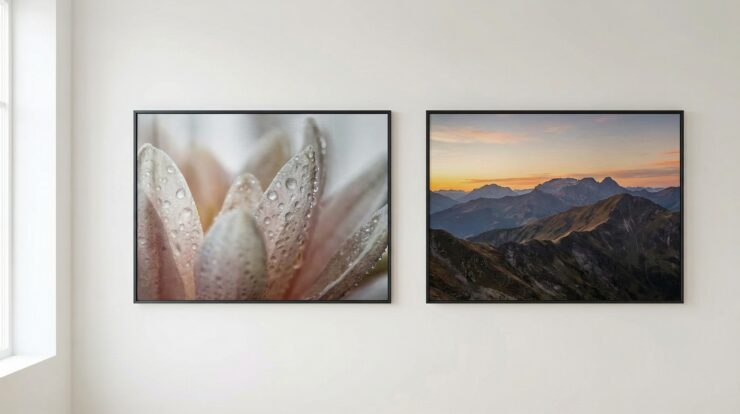
You are standing in your studio looking at three completely distinct bodies of work.
Let’s say you have a series of traditional landscapes, a collection of macro floral photography, and a highly conceptual group of 3D object scans. You feel that creeping anxiety. “If I show this to a gallery director, they are going to think I am completely unfocused.”
As a gallery owner, I review portfolios like this every single week. Before we go any further, to be clear, there are certainly instances where work is too far afield to fit into your body of work. It is possible to have work that is too disparate to put together in a portfolio or show together in a gallery. No amount of presentation or formatting will help that. I’ve written other articles on how to determine how consistent your work is in your larger body of work, which can help you decide what truly belongs.
However, presentation and format can help tie the work together that is loosely cohesive and just needs something to help bridge the gap. What looks like scattered chaos to you often looks like a mature, multipassionate artist to me—provided it is packaged correctly.
The golden rule of portfolio curation is that cohesion does not require perfectly uniform subject matter. You can tie loosely cohesive series together through strict, unwavering consistency in your presentation and formatting.
1. Standardize Your Presentation Format
When a gallery director evaluates your portfolio, we are looking for a singular aesthetic sensibility. If your subjects vary, you must artificially enforce that consistency through the physical presentation of the work.
-
Material Consistency: If you choose to print your macro photography on metal, print your traditional landscapes on metal as well. The uniform finish bridges the gap between disparate subjects.
-
Proportional Discipline: Enforce strict size proportions across all series. Seeing an eclectic mix of imagery presented in identical uniform dimensions forces the viewer’s brain to categorize them as a cohesive body of work.
2. Draw Hard Lines Around the Medium
You have a surprising amount of latitude with subject matter as long as your medium remains rock solid. An artist can shoot both highly abstracted macro forms and expansive landscapes without confusing the buyer.
The cohesion fractures the moment you introduce a completely different medium into the same portfolio. “I love photography, but I also included three oil paintings and a digital rendering.”
Suddenly, the narrative falls apart, and the work becomes far too disparate. The buyer loses confidence. Keep your medium consistent, and the viewer will follow you across surprisingly diverse thematic leaps.
3. Eliminate the “Orphan” Series
If you are going to present multiple distinct series, you must commit to them equally. Balance is critical for professional presentation.
If you show me ten abstract pieces, ten macro florals, but only two landscapes, those landscapes instantly feel like orphans. “Did they get bored? Are they just starting this? Do they know what they are doing?”
To avoid this, either build the smaller series up to a comparable volume—typically 8 to 10 strong examples—or pull it from the primary portfolio entirely until it matures.
4. Lead the Viewer with Sequencing and Story
Never underestimate the power of curation order and context. You can carefully build a bridge between loosely cohesive series by controlling how the gallery navigates your portfolio.
-
Visual Transitions: Use stylistic bridges, like placing a black-and-white macro image at the end of your floral section to smoothly transition into a series of black-and-white landscapes.
-
Unified Introductions: Include a brief, compelling introduction page that explains your core creative motivation. When collectors understand the why behind your art, the varying subjects naturally lock together.
One Final Takeaway
While you must be honest about work that is fundamentally completely disconnected, you do not need to suppress your creative curiosity or abandon distinct series to succeed in the fine art market. By enforcing strict presentation rules, standardizing your materials, and curating your layout strategically, you can help bridge the gap and present a loosely cohesive portfolio that screams professional consistency.
How Do You Tie It All Together?
Have you struggled with bringing multiple distinct series into a single cohesive portfolio? What specific presentation rules or formatting choices have you used to make your loosely connected subjects look like they belong together?

Great advice. Thank you!
I feel that the distance between my landscape and abstract photography is so vast that I handle them as separate entities. With my landscapes I create them as framed canvases to complement the organic feel. And my abstract photography (primarily compositions from aged, scratched surfaces) I print as large acrylic pieces.
I really struggle with this. My oils are large colorful palette knife paintings of landscapes and wildlife while my watercolors are realistic landscapes and portraits—largely indigenous people. I’m starting to to paint the watercolors square like the oils, but they’re still so different and framing them baffles me.
This was so incredibly useful. After 20 years of oil and watercolor teaching and painting, I am that artist with a varied portfolio!
I’m thinking a periodic “portfolio review” is perhaps a strategy to consider.
I am a artist with reasonable confidence in materials and in ideas. I see my work as evolving and what I’m doing now is a bit different from what I did earlier to the point that I’m revisiting those earlier pieces from the current perspectives. The basic premises seem to be holding.
I like the thought of finding and fixing orphans.
Yes—and I’m still in the middle of figuring this out.🙃
I used to believe showing a wide range of work proved I was skilled and experienced. But I’m realizing it can actually create confusion instead of clarity. Right now, my own portfolio reflects that. I’ve got landscapes, portraiture, and dream/myth work all living side by side, and it feels a bit all over the place.
What I understand now, more than ever, is that cohesion matters more than range… at least in how the work is presented.
My next step is to separate my work into clear series and be more intentional about what I show together, instead of trying to say everything at once.
Still refining, but this thread has been a great reminder that clarity is part of the art.
I make it connecting on the level of my intuitive technique: my individual “handwritting” that corresponds to my heart. “Each person writes as she/he breathes.”
I’ve decided that there is NO cohesion between bronze sculptures, recycled, found object sculptures, and oil paintings!! I do a separate series of each depending on the the gallery’s overall art and artists.