


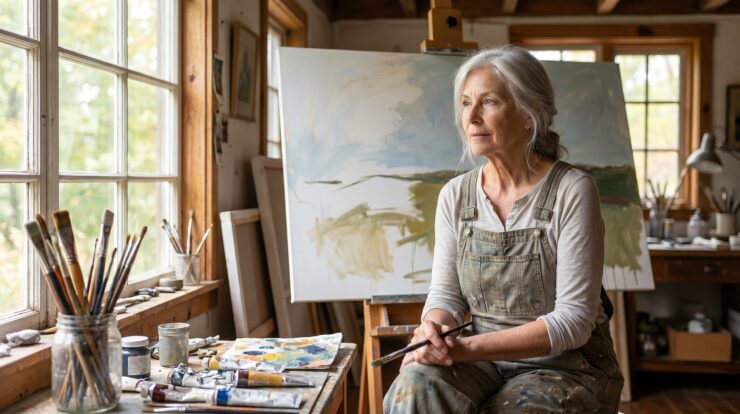
You have spent months refining your portfolio and finally compiled your list of target galleries. But as the moment to send your submissions approaches, a new anxiety suddenly freezes you in your tracks: “Am I too old to secure gallery representation?”
When the rubber meets the road and real risk is involved, our brains start scanning for potential weaknesses to protect us from rejection. We start looking for a way to pre-excuse any failure we might experience.
The Psychology of the Escape Hatch
As you start putting yourself on the line, your validity as a professional comes into question. The fear of criticism triggers an evolutionary response to mitigate risk by front-loading potential escape hatches.
If you face rejection, it is much easier to blame an unchangeable factor than to critique your own work. “They only want young artists,” becomes a convenient shield against the reality of a competitive market.
While you can actively improve the consistency and quality of your work, there is not a single thing you can do about your age. You simply have to push through the anxiety and focus on what you can control.
The Myth of the Age Handicap
I have extended offers of representation to artists at almost every stage of life. The youngest artist I ever signed was 14 years old, and the oldest was 89 when I became his first gallery.
Age is not a fatal handicap to representation. Your primary asset is your artwork, followed closely by your efforts at strict professionalism.
The Hidden Advantages of the Mature Artist
Gallery owners are acutely aware of the emotional toll that comes with representing volatile creators. In many ways, a mature artist is likely to be a significantly better partner to a gallery.
Early in my career, I watched an early-20s artist receive mild, constructive feedback on the quality of a specific piece. His response was to turn bright red, pick up the framed canvas, and smash his knee straight through it.
This shocking display of emotion was a stark reminder of the risks associated with a lack of emotional development. Older artists tend to sail at a much more even keel, making them reliable and steady business partners.
Overriding the Gallery’s Calculations
Do some gallery owners calculate the potential time horizon of their investment when taking on an older artist? Yes. However, a primal connection to the work will absolutely overpower those logistical concerns.
To ensure your work speaks louder than any demographic detail, follow these pragmatic rules:
-
Focus on presentation: Ensure your work is framed, finished, and ready to hang to remove any merchandising friction for the gallery.
-
Highlight your reliability: Leverage your years of life experience to demonstrate you are a steady, low-drama partner.
-
Produce consistently: Show that you have a deep, ongoing commitment to your studio practice and are ready to meet market demand.
One Final Takeaway
Younger artists may have higher levels of raw energy, but they lack the seasoned perspective you have cultivated. If you are not ready to retire, you have no alternative but to put your work out there and roll with whatever agism you might perceive along the way.
Question for Readers
Have you ever felt like your age was a hurdle in getting your artwork out there? Share your experiences and how you pushed past the self-doubt in the comments below.

I believe that art is one of the few passions/businesses that your age and experience works for you. Don’t listen to your head trash talk. Create and show your work. Find your collectors. They are waiting.
I’m a late 40s artist, but only came to painting about 3-4 years ago. I see other artists my age and feel that I should be so much further along in my career than I am. Sometimes it feels like I’m still at that raw, painful stage when I should be at the mature ’seasoned perspective’ stage. I don’t know whether age alone determines how well you deal with acceptance or rejection. Maybe we just get better at hiding it?
I have had more difficulty with gender than age over the years. possibly because I could not get gallery representation early in my career, I simply stopped trying until I was making work that was “acceptable’ to gallery owners…and ,the arena changed over time…..there were many more galleries for women. I am now 86, still making art, and ,compared to my early years, am relatively fearless…..They say no, and I don’t question it…for the same reason that I make the decisions about what I create..good, bad, or indifferent, all of which I have made! Age, I have always ignored…as they say – the alternative is lousy!
Sixty-eight and going strong!! Not letting my silver hair stop me! Just finished my first solo show in another city and just got offered a partner show at the gallery that represents me now.
I appreciate this post a great deal. I have often wondered if my age would get in the way of securing gallery representation. I am currently part of a co-op gallery in my city but would like to have representation outside of my area. I am 77 years old and I paint more than I ever have before because I don’t have other life demands intruding on my studio time. You’ve given me encouragement to go ahead and start looking.
Thanks, Jason!
I am gradually leaving my business profession, completing the Milan Mastery program, and planning to become a professional artist in 2027. Although I have been painting over 30 years, I struggle to determine what galleries are looking for. It is great to see that my age will be a plus. Thanks Jason.
I started painting in my twenties. Like many artists, I had to work to support myself and painted whenever I could find the time. For more than thirty years, I experimented relentlessly—exploring materials, techniques, textures, and ideas—searching for a visual language that felt truly my own.
During those years, I was not thinking about age. I was thinking about the work. I was focused on creating something unique, something authentic that reflected my experiences, questions, and vision. The journey was long, filled with uncertainty, failures, and discoveries, but eventually I found my own signature voice.
Today, when people see the finished work, they see the result of decades of experimentation, persistence, and commitment. What matters most is not how old I am, but that I continue to create, evolve, and contribute something distinctive to the conversation of contemporary art.