


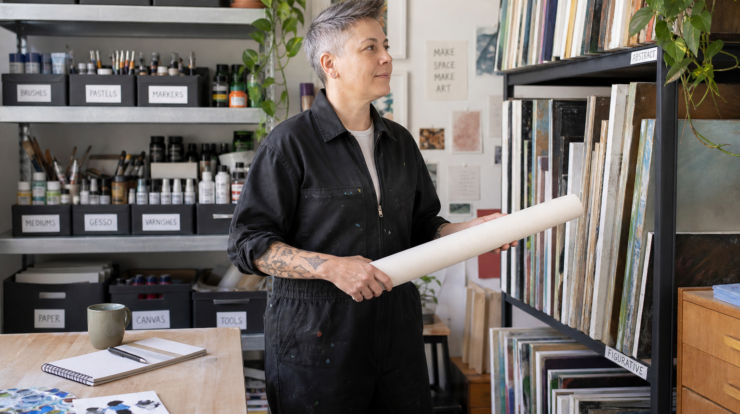
Every artist’s studio—no matter how well-intentioned the owner—is a magnet for clutter. Over the course of a year, paintings pile up, frames drift to odd corners, and materials accumulate in layers. Left unchecked, this slow build-up quietly sabotages efficiency and, more importantly, undermines your professional presence with collectors, galleries, and clients.
Yet, many artists wait until the chaos becomes overwhelming before considering a deep clean. In my experience working with hundreds of artists, the most organized professionals share a single habit: an annual, scheduled, top-to-bottom studio reset. This goes beyond the quick tidy-up. It’s a thorough, intentional process that reclaims space, surfaces neglected inventory, and puts you back in control of your art business. Here’s a straightforward framework to help you get started—and stay consistent every year.
Annual Studio Reset Checklist
1. Remove Everything—and I Mean Everything
Empty all racks, shelves, bins, and worktables. Temporarily clear art, materials, and storage containers from the room so you start with a blank canvas (pun intended). This step is crucial for spotting dust, damage, or lingering supplies you forgot you owned.
2. Clean Surfaces and Air
Wipe down every surface—tables, racks, tools, and floors. Pay extra attention to corners where dust and debris like to settle. Open a window or run a HEPA air filter to clear out accumulated aerosols from paints or solvents.
3. Review Inventory
As you handle each artwork or material, review its relevance:
- Is this piece ready to go to a gallery or collector?
- Is it outdated, unsellable, or inconsistent with your current work?
- Have you overlooked opportunities for promotion or exhibition? Document inventory as you go. A simple spreadsheet or inventory app is invaluable.
4. Protect and Store Efficiently
Invest in solutions that fit your space and practice:
- Use racks or vertical shelving to maximize available cubic footage rather than just floor space.
- Place protective barriers (cardboard, bubble wrap, or glassine) between artworks, especially frames.
- Label bins, crates, or sleeves clearly—consider digital lists for easy tracking.
- Where possible, standardize canvas or frame sizes to simplify shelving and packing.
- Avoid stacking work in ways that risk damage or make it hard to retrieve pieces at the back of a pile.
5. Streamline Tools and Materials
Cull old or dried supplies, and return unused materials to a designated area. A good rule: if you haven’t touched it in a year, question whether you still need it.
6. Create a Display Rotation
Use your refreshed space for a professional display—on open shelves or walls where you (and visiting clients) can actually see your work. Visibility not only keeps your inventory top of mind for sales, but also maintains your pride and motivation.
7. Set Your Next Reset Date
Before you dive back into creating, schedule your next annual (or biannual) reset. Add it to your calendar as a non-negotiable date—your future self (and your business) will thank you.
Takeaway
An annual cleanup isn’t wasted studio time—it’s a fundamental part of a healthy art business. Beyond keeping your workspace functional and safe, the habit prevents costly inventory mistakes, sets the stage for new growth, and signals professionalism to everyone who visits your studio.
Question for artists: What’s the number one obstacle that stops you from reorganizing your studio annually, and what’s worked (or failed) for you when you’ve tried a deep clean? Share your insights below—your ideas may be just what another artist needs to get started.

I just did this last night and it feels amazing. Emptied out two rooms that were filled up with canvases, framing stuff, giclee packaging stuff, etc. Vacuumed, mopped and wiped down all the surfaces. It was so dirty, and it feels so good to come into my studio now. Next step is to go through all the drawers and files and throw stuff away. Also have to clean up the garage, since everything went into the garage when I was cleaning out my space, so now the garage is full of stuff. But at least it’s out of my creative space now.
Photographer here. So what does one do with pieces that are outdated or not what I shoot anymore? I don’t want to sell it but do I toss it or send to a thrift store. Some old small pieces I wouldn’t mind giving them away but I don’t want others to think, “Is that is all she can do?”
Does that make sense?
i’d be interested in what people do with pieces that are not good enough to show. Do you trash them, paint over or store them hoping for inspiration?
Hi Katherine,
I find the stack of unfinished/unsold artworks a bit depressing, and have about 15 in my studio.
So to clear the space and free my mind I have just:
Destroyed some (and dismantled the wooden frames which have been sent to the recycling skip bin).
Painted over some of the canvases with new (successful) paintings which have since sold.
Sanded the top varnish off some oil painting artworks on boards, so that I can do a new painting on top.
Painted over my name and details on the backs of a couple of artworks, and sent them to the tip shop for someone to enjoy, without knowing who did them !
And then kept a couple which I have new enthusiasm to finish soon.
It is very satisfying for sure.
Good luck 😍
I may be forced to do this shortly. In the meantime a deep clean is necessary. It has been about ten years. I have started with the materials I no longer use. Some of the older work I keep for showing in businesses. The small pieces are removed from supports, rolled and stored then I re-canvas the stretchers. I really do not know what to do with the paintings I can no longer fit into my car for transportation. Cars are smaller these days. 48×48 or larger just don’t fit. Sigh.
I’m in the middle of this now. I do a deep clean two or three times a year because I have a small studio space. I do my best to keep it organized but.. life happens. I’m in the middle of a shift in my art, switching more to mixed media works and a landscape genre of sorts.. thank you for your daily blogs, I really enjoy them