


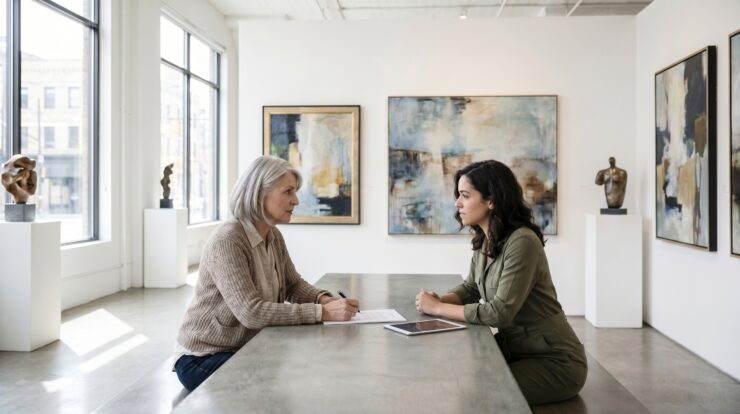
I spoke with an artist recently who was working with a new gallery owner who was trying to pull her in to help with gallery marketing and business operations. It was flattering, but a big commitment.
After a few phone calls, a sinking realization had set in. The gallery owner knew considerably less about art marketing than she did. Suddenly, she found herself fielding texts about social media strategy, email newsletters, and collector acquisition. Were they expecting her to run their business for them?
It is a fantastic problem to have, but it is still a problem. Like this artist, you can leverage a new gallery’s energy and ambition. However, you must fiercely protect your studio time by setting strict boundaries on how much free consulting you provide.
1. Understand the Startup Gallery Dynamic
When I opened my gallery at age 26, I was ambitious but wildly inexperienced. The artists who agreed to show with us took a significant risk.
We made painful missteps early on. We relied heavily on the patience and the established followings of the artists who took a chance on us. It is entirely normal for new galleries to lean on their roster for direction.
Early in your career, you accept this dynamic in exchange for broad exposure. But as your collector base grows and your studio time becomes scarce, your threshold for risk must change. You cannot afford to become an unpaid marketing director for someone else’s commercial space.
2. Establish Hard Boundaries on Your Time
Your primary responsibility is the production of compelling artwork. Every hour you spend teaching a novice gallery owner how to write a press release is an hour stolen from the easel.
When an inexperienced gallery asks for your strategic input – just as my artist friend experienced – implement these operational boundaries:
-
The Two-Hour Rule: Commit to a strict cap. Tell the gallery, ‘I am happy to give you two hours a month to brainstorm marketing strategy, but I have to aggressively protect my creative time.’
-
The Supply Chain Defense: Use your other commitments as a shield. Remind them that you are heavily bogged down supplying inventory to other galleries.
-
The Asynchronous Response: Do not answer strategic texts immediately. Train the gallery to send you an agenda via email, which you will address on your own schedule.
3. Exchange Expertise for Premium Real Estate
If you possess a deep understanding of art marketing, that knowledge is a highly valuable business asset. You do not own a stake in this new gallery, so your strategic contributions must be compensated.
I told my friend she did not need to invoice them for consulting fees. Instead, she could leverage her expertise to negotiate better terms – and you can do the same.
-
Demand Prime Wall Space: If you are feeding them marketing plays, require that your work be hung in the front window or the primary viewing room.
-
Negotiate Featured Shows: Trade your strategic insights for dedicated solo exhibitions or prominent placement in their upcoming marketing materials.
-
Ask for Favorable Terms: Request a temporary adjustment to your commission split until the gallery’s sales volume matures.
One Final Takeaway
Working with a new gallery can be highly rewarding, and some of those young businesses will eventually grow into powerhouse venues. However, you must manage the relationship like a seasoned professional.
Offer your encouragement, supply them with brilliant inventory, and share your wisdom sparingly. Keep your focus exactly where it belongs: inside your studio.
How Do You Handle New Galleries?
Have you ever found yourself doing the heavy lifting for an inexperienced gallery owner? How did you protect your time without damaging the relationship?

As usual, great information!
Thank you 😊
Anne Gaffey
Great tips! I have had galleries winnow away my time this way. It’s just not worth it, but I always want to help. Two hours a month seems reasonable. Right now I am entering into another gallery that is not brand new, but I have concerns about the level of marketing consideration I will receive. Already the gallery owner is talking about press releases using my birth name instead of my artist name that I’ve been using for 3 decades. He says he hopes I don’t “make a big deal out of this.” His gallery has a lot of traffic and I want to get in the door, but I do have concerns since my artist name is my brand. If anyone has advise on this, I’m here to listen.
That sounds weird. I would take this as a red flag. It is a big deal, for me that would be a point of no return. What do others think?
The gallery owner should respect your wishes, why use a name no one knows you by? It would be to his advantage to use your brand name. I think it is a big deal.
I have very little experience working with galleries myself, but it does seem odd this gallery wants to use a name you are not known by professionally. Perhaps they want to promote you as if you are a new artist? What would be the advantage for them in that? I’m curious, have you asked them why they want to use your birth name?
The popup gallery I have been involved in setting up, has proved exactly this. After the first month or so, I have done an evaluation. No one else has done this or wanted to do so. There aren’t enough members so I ended up being there 4 days a week, which of course has reduced my studio creating time, to no benefit, so I have drawn back, and the gallery is now closed some days, I hope this is making it clear that they need to get on with attracting more members! I’ve set this in motion, but I’m not going to do any more carrying of the group. I am not a group person, I work best alone, and this is proving that I prefer it. At the moment I am maintaining a small presence, I think it’s a good idea, but it’s not the type of venue I was hoping for.