


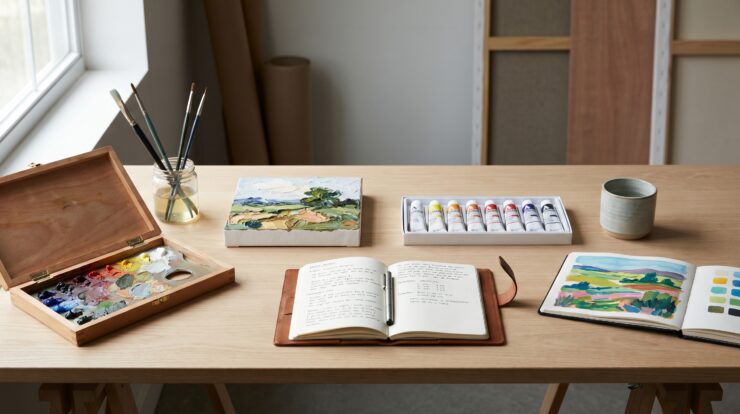
I was recently reviewing a portfolio submission from a talented artist who works in two wildly different mediums: large, deeply layered oil paintings and intimate, immediate gouache studies. The work was undeniably cohesive in style and vision. But when we started discussing her pricing structure, a familiar anxiety surfaced.
She had built two entirely different pricing models per square inch, driven by a deep-seated fear. “Oils take weeks to dry and varnish, but gouache is practically immediate. Won’t a collector refuse to pay a premium for works on paper? Don’t oil paintings just command higher prices?”
If you work across multiple mediums, you have probably wrestled with this exact same calculus. You look at the broader art market and see an invisible hierarchy dictating that oils sit at the top, while watercolors, gouache, and graphite are relegated to the bargain bin.
Here is the reality of the gallery business: You are not selling the average, and you shouldn’t price in the average. Your pricing structure shouldn’t be dictated by an arbitrary market hierarchy, but by the specific narrative of your own body of work.
1. The Myth of the Medium Hierarchy
There is a pervasive belief among artists that collectors carry a mental price sheet based strictly on the materials used. “It’s just watercolor, so it must be cheaper.”
If you take an aggregate average of all art sales globally, you might spot a statistical trend where canvas outpaces paper. But statistics do not buy artwork. Individual collectors buy artwork.
I know watercolor and gouache artists commanding tens of thousands of dollars for their pieces. Conversely, I see plenty of heavily layered oil paintings that fail to sell for a few hundred dollars. The medium itself is not the ultimate arbiter of value.
2. Focus on Your Internal Ecosystem
When a collector walks into my gallery and falls in love with your work, they are not comparing your gouache to an oil painting by a dead master. They are comparing your gouache to your other available pieces.
Instead of worrying about global market averages, focus on building a rational pricing structure within the corpus of your own work. The relationship between your prices just needs to make sense to your specific collectors.
Use a clear narrative to explain the value differences across your mediums.
-
The Studio vs. Field Narrative: Frame the immediate medium (like gouache or pastel) as your plein air field studies, while the slower medium (oils) represents your major studio works.
-
The Scale Narrative: Use the faster medium strictly for smaller, accessible entry-point pieces, preserving your complex medium for massive statement works.
-
The Process Narrative: If both mediums take an equal creative toll, price them equally. The collector is paying for your distinct vision, not the drying time of your paint.
3. Stop Punishing Your Efficiency
It is true that oil requires a tedious process of layering, waiting, and varnishing. Gouache, as the artist in my example noted, has a consistency like toothpaste—you put it down, and it’s done.
But do not penalize your mastery. If you can achieve a brilliant, emotionally resonant composition in gouache in a fraction of the time it takes to produce an oil painting, that immediacy is a feature of your talent, not a defect in your value.
Collectors are paying for the final aesthetic and emotional impact. They are not buying a timesheet.
Final Takeaway
Establish a pricing structure that you can explain with confidence. If you divide your portfolio into primary and secondary mediums, give the collector a logical reason for the price gap that elevates both. Tell them the story of your process, and let that narrative drive the perceived value.
What’s Your Pricing Narrative?
Do you work in multiple mediums, and if so, how do you handle pricing differences between them? Share your strategy or your struggles in the comments below!

I have always simply ignored the idea that works on paper should be priced lower than works on canvas. I used the same pricing structure, regardless of medium I always have, and I have never encountered any difficulty because of this. I have never received a single question or negative comment about this practice from any collector or gallerist.
thank you for the information
Well, I needed to hear this-I have been pricing my drawings a full $1/sq in. less than paintings because I am faster at it, and I feel that clients/collectors look at the medium as “less” impact than a painting. In reality my drawings are are my strong point….so I have been selling myself short I guess. Thank you for this information!
I plead guilty!!!! I have done watercolors for over 40 yrs, and paint lots of smaller works at home at night, by day doing oil painting or plein air. I have charged less than half for the watercolors, my way faster medium, and have downplayed the cost. My sister, also an artist was challenging me to quit undercharging on the watercolor, just last week. Even when they are winning awards I short them on their prices. So the timing of this article post, was serendipitous, to say the least.
Pricing has been such a rollercoaster ride for me, and charging for commission work as well. Constantly swinging on ideas of pricing…so keep it coming, thanks!
My work is done in black ink on white paper, I have given pictures to my friends and family. I do not sell them but would love to. Send me a email address and I will send you one and you can tell me if I can sell them . Thanks CEMICHAELS Art