


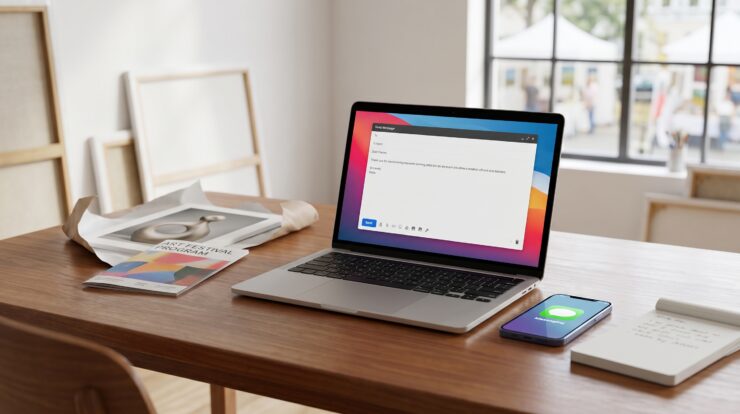
You wrap up an exhausting but exhilarating weekend at an outdoor art festival. A collector spent twenty minutes in your booth, pointed at three major pieces, and asked for a bundled price. They took your card and promised to finalize the details on Monday.
Monday comes and goes. Then Tuesday. By Friday, you are staring at an empty inbox, and the self-doubt begins to creep in.
Did I offend them with the price? Was the gallery lighting fooling them? They were probably just being polite.
Stop right there. As a gallery owner, I can tell you that a collector’s silence is almost never a personal rejection. It is simply a byproduct of a busy life. If you abandon the conversation the moment a buyer goes quiet, you are actively sabotaging your own art business and leaving real money on the table.
1. The Psychology of the Silent Buyer
When a collector ghosts you, your immediate instinct is to take it personally. You assume your follow-up email is a nuisance and that their silence is a polite way of saying no.
In reality, your buyer simply went back to their chaotic life. They had to catch up on work, pay bills, and deal with family emergencies. Buying fine art is a luxury experience, but it rarely takes precedence over the immediate demands of a Tuesday afternoon.
Your job is not to interpret their silence as rejection. Your job is to gently bring their attention back to the artwork they fell in love with.
2. A $7,500 Masterclass in Persistence
Let’s look at a recent success story. I recently had a conversation with an artist who exhibited at an outdoor festival and had a collector express serious interest in a trio of paintings totaling around $15,000.
The artist offered a bundled discount, but after the event, the buyers went completely dark. Frustrated by the lack of response, their instinct was to throw their hands up and say, “Well, I tried. They must not want them.”
I advised them to push through the discomfort and continue their outreach. They sent another polite, professional follow-up.
That single email broke the logjam. The buyers finally replied, apologizing for the delay and confirming they wanted to move forward with two of the three pieces.
3. Holding Your Ground in Negotiations
The sale was back on, but the buyers immediately tested the waters. Since they were now only buying two pieces, they asked the artist to extend the original 25% bulk discount they had offered for the trio.
This is where many artists panic and devalue their work just to close a fragile deal. This artist did not.
Instead, they politely declined the 25% discount for a two-piece purchase. They countered by offering a smaller 21% discount and throwing in white-glove delivery and installation. The buyers declined the installation because they wanted to handle the framing themselves, but they agreed to the price.
The artist touched up the edges of the canvases, provided excellent customer service, and picked up a check for $7,500. Had they surrendered to their own ego when the buyers first ghosted them, their bank account would be considerably lighter today.
4. A Framework for Professional Follow-Up
You do not need to feel desperate to be persistent. You simply need a system. Here is how you maintain contact with a stalled lead:
-
Check your ego: Never send a message laced with frustration. Keep your tone light, helpful, and completely devoid of guilt.
-
Provide an easy out: Give the collector permission to delay. Try saying, “I know how busy things get after a weekend event. No rush on my end, I just wanted to keep these pieces on your radar.”
-
Offer new information: Don’t just check in. Send a photo of the piece in different lighting, or mention that you are about to varnish it. Value-added outreach keeps the conversation moving forward organically.
The Final Takeaway
You must give one hundred percent effort to every single follow-up, even knowing that a good percentage of them will not convert. We push hard on the follow-up because we never know which specific email will be the one to finally tip the scales. Consistent persistence is what separates a hobbyist from a profitable professional.
What Is Your Follow-Up Timeline?
How many times do you typically reach out to a silent lead before you categorize it as a dead end? Share your current process and any success stories you’ve had in the comments below.

Great information. Thank you!
Such great perspective… so true that everyone, even very interested buyers, get caught up in their busy lives. Even as busy artists we can relate!
Thanks for the post.
Great advice for a touchy situation! I had a situation where a customer was interested enough in a painting I exhibited at an art fair that they came back several times to look at it again. I offered to bring it to their home so they could see it in the spot they were thinking of hanging it, but I failed to get contact information. Lesson learned, for sure!
Thanks for another informative post, Jason.
I definitely took this advice from your book. I follow up at least three times with every lead.
A recent client met me at an art festival three years ago, but only responded to my check-ins a few months ago. Turns out that they had renovated their home and saved two large walls for my work! It ended up being a $18,000 commission. You really never know.