


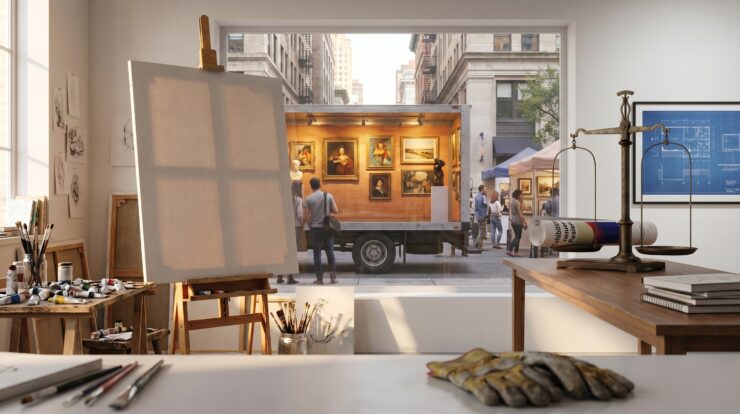
I recently had an artist tell me about a brilliant concept she’s launching: a “Box Truck Gallery” pilot designed to roll directly into downtown art walks. Another artist in our community successfully curated an eight-artist exhibition at a local museum center, handling everything from the digital floor plans to the diverse personalities of her peers.
These grassroots, artist-led initiatives are incredibly inspiring. They generate immediate buzz, elevate your standing in the local market, and force the art world to pay attention on your terms.
But there is a dark side to playing gallery director. The adrenaline of an opening reception masks a brutal reality that hits you the morning after.
The golden rule: If you step into the role of curator or event organizer, you must ruthlessly calculate the massive logistical toll it demands and weigh that opportunity cost against your personal studio production.
1. The Invisible Drain of Logistics
When you pitch a pop-up show, you are picturing the opening night. You see the well-lit walls, the clinking glasses, and the red dots. You are not picturing the endless email chains.
Curating your own exhibition means you are no longer just making art. You are managing logistics, marketing, venue negotiations, and—perhaps most exhaustingly—other people’s feelings. Coordinating a group show requires managing multiple artist egos.
“Why is my piece in the corner?” or “I forgot my hanging hardware, can you fix it?” suddenly becomes your problem. This administrative friction burns through your creative fuel at an astonishing rate.
2. The True Opportunity Cost
As a gallery owner, I know firsthand what it takes to mount a successful exhibition. I also know that artists consistently underestimate the mental energy required to pull it off.
Every hour you spend updating floor plans or negotiating temporary lighting is an hour you are not at your easel. We often think of ROI purely in terms of financial profit.
But the true metric is your physical and emotional energy. The exhaustion that follows a self-produced event can keep you out of the studio for weeks. You must ask yourself if the community exposure is worth a sudden, screeching halt to your actual inventory production.
3. When to Say Yes to Organizing
I am not telling you to avoid curating entirely. In the early phases of your career, your default should absolutely lean toward creating your own opportunities to build a bank of experiences.
But to protect your art business, you need a strict framework.
-
Set a hard boundary: Cap the amount of administrative time you will dedicate to the project per week so it doesn’t cannibalize your studio hours.
-
Leverage the momentum: If you are organizing a box truck gallery or local pop-up, guarantee that you are capturing emails and tracking every visitor. Do not do the heavy lifting just to let leads walk out the door.
-
Accept the one-time lesson: Sometimes the most important takeaway from curating an exhausting show is learning that you never want to do it again. Treat that realization as a valuable business asset.
One Final Takeaway
There are few things more powerful than an artist who refuses to wait for permission and builds their own platform. It shows incredible initiative, and collectors are drawn to that social proof.
Just ensure that the massive energy required to build the stage doesn’t leave you with nothing to display when the curtain finally opens.
What’s Your Ratio?
Have you ever curated your own exhibition or organized a pop-up event, and did the exposure outweigh the lost studio time? Share your experiences and how you balance event logistics with actual creation in the comments below.

About 20 years ago when I had more energy and I owned 4 acres of land and a former church,I organized a sculpture exhibition with 8 other sculptors from the area called “9/9” nine sculptors, 9 days. We wanted it long enough to make it worthwhile, but didn’t have time or money to go longer. And that was the problem- none of us had the money to advertise as we should. We attracted a small audience, a well-known sculptor in the area came and liked what we did, and that was that, It was a good experience for all of us, and being outdoors, 7 miles from Woodstock, NY, it did show the work well. We all were proud of what we did, but publicity is essential.And the time to do it . But if I hadn’t tried it, I think I always would have felt that I missed something essential to my learning about sculpture and how to present it.
I was lucky to discover very early that others who have a little knowledge and experience are so much better at organizing and curating my shows than I would ever be . Since then I’ve sought out opportunities in places where others are in charge of this work. And yes it leaves more time for my painting. Prepping a quantity of professional work properly for a solo show is already stressful enough!
I am in that place now: a group popup gallery in a local shopping centre, that is offering us a lot of exposure. I went into it knowing that I would want to be there every day if possible at least a part of the time, and that my children are no longer a call on me as they are now grown up. Other members are so over-stretched that they are leaving the gallery closed because they cannot be there enough. What’s the point?
Last year I tried all sorts of events further from home, and as you rightly say, I learned that the expense in all senses does not warrant the effort.
Funny thing! In my previous budding (and foundering) career I curated a couple of solo shows and a group show. I had completely forgotten about this. Obviously not memorable.
Looking back, there were lots of moving parts that seemed to have a life of their own. You gave all seen the “list”,
As Jason mentioned, the group show added egos and a variety of work that had to be balanced and arranged cohesively.
There was no studio time as I’m recollecting.
I made no notes but which I heartily reccommend everyone do- in a binder that becomes a road map including the potholes. Permanent. Accessible.
I have never have repeated these experiences exactly except to curate an annual invitational show for an arts organization for about 5 years.
My thinking often goes into those areas and I feel like I;ve been here before.
One hard and fast rule I have is “make sure there is studio time”.
Great advice, Jason.
Quick question: At any event or show, what method do you recommend for collecting emails & tracking visitors? A signup? Is there something better? Thanks!