


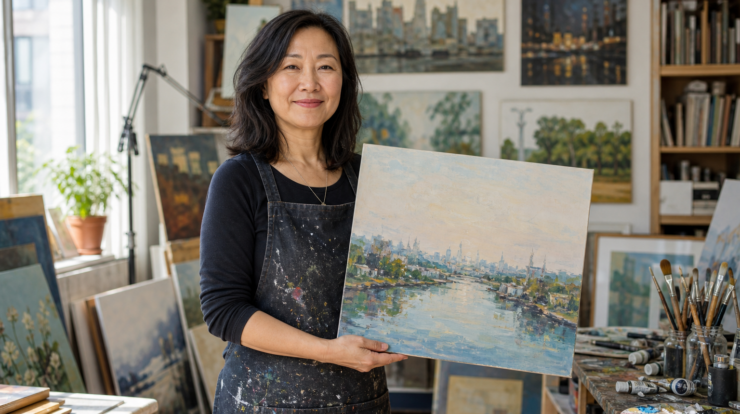
As a gallery owner, I have the privilege of working with artists in all stages of their careers. Over the years, a pattern has emerged among those who find success: they are consistently producing new work, building up their inventory, and ready when opportunity knocks.
I often hear doubts from artists during slow sales periods: “Why produce if nothing is moving?” or “Shouldn’t I wait until I have somewhere to show?” It’s understandable—creating work for its own sake, when nothing seems to be selling, can feel futile. But I’ve found that in almost every case, artists who remain focused on production are best positioned to seize new opportunities.
Here’s why:
Inventory Multiplies Your Chances
Opportunities are often unpredictable—a new gallery contacts you, a client needs several pieces for a space, or a show invites submissions. When these chances arise, artists with a backlog of finished, high-quality work can respond immediately. Without inventory, you risk missing out or feeling rushed to produce last-minute work that isn’t your best.
Regular Production Overcomes Market Swings
It’s tempting to tailor your output to what’s currently selling or trending, but that can result in an erratic creative process. Instead, artists who keep producing—regardless of what’s moving in any given month—are able to ride out fluctuations, and when demand returns, their consistency pays off.
I’ve watched artists go through slow seasons that left them questioning whether to shift direction. Yet when they doubled down on their core strengths, increased output, and sought new venues—even in unexpected places—their patience and effort were often rewarded. Recently, an artist I represent found his long-standing inventory to be a game-changer: an under-the-radar gallery in a nontraditional market was able to mount a major show quickly, leading to career-best sales.
Inventory Enables Strategic Flexibility
Trying new galleries, sending out portfolios, or participating in events all require finished pieces on hand. If your artwork is always tied up in venues that aren’t producing results, consider rotating it to fresh markets—or holding back a portion to quickly supply new opportunities. Your inventory is power: the more you have, the more options you control.
Simple Steps to Build—and Manage—Inventory
- Set a Production Goal: Aim for a steady pace, whether that’s one piece per week or whatever fits your medium and life. Consistency compounds over time.
- Diversify Venues: Don’t rely on a single gallery or market—rotate inventory and explore new sales channels.
- Regular Review: Every few months, assess where your work is and whether it’s in the right place. Pull pieces from slow venues and try new outlets.
-
Track Carefully: Maintain simple records of where your work is placed and what’s available. This saves time when opportunity arrives.
Persistence can sometimes feel unrewarded in the moment, but the artists who build and maintain a robust body of available work are the ones I see making the most of their chances. Inventory isn’t just a byproduct of slow sales—it’s a vital asset.
Takeaway: Focus on consistent creation and view your inventory as a bank of potential—ready to be drawn on when opportunity appears.
What’s your approach to production, and have you seen your inventory create unexpected chances for you? Share your experience in the comments.

I am building my inventory and
I am having a blast! I am looking forward to new opportunities and broadening a collector base. My work is personal, focused and intentional. Thank you very much for your help and I take your directions seriously. Thank you for taking your time to help me!
Jason,
While many of your artists and followers have been painting for many years, I am just now reaching 10. Since my art is influenced by travel and seeing new places and things, my art has an eclectic feel. I use “adventure” branding and series approaches. Currently, I am going deeply into our new home town of San Angelo, creating plein air paintings and sketches of historic buildings, homes and architecture. Even the water lily gardens will capture a set. Currently, western art, cowgirls, and rodeo events. We have a few local ropers making headlines in the PRCA.
By this time next year, I hope to have my third book compiled “Meander San Angelo.” I have the honor of being “Artist of the Quarter – Q4 of 2027 at our local Visitor Center through the Chamber of Commerce. So, sets of paintings has long been my approach. They continue to be my saving grace in an ecclectic attention span. Plein Air, Studio work, travel, something new regularly.