


With the rise of art contests and open calls, every artist has encountered the barrage of emails, social posts, and ads promising exposure, awards, and recognition. The opportunities seem endless—but so are the entry fees and the demands on your limited time.
How do you decide which art contests are truly worth pursuing? As a gallery owner, I've observed the full range of impacts from contest participation. Some artists build resumes and make valuable connections; for others, the rewards are negligible.
Here's a practical framework to help you approach art contests with clear eyes and purposeful strategy.
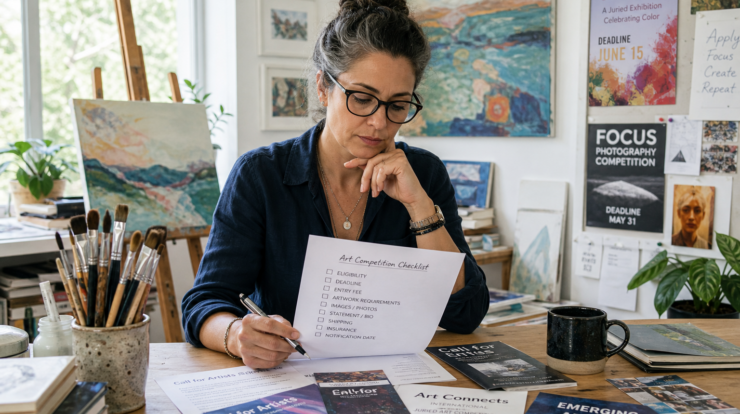
The Art Contest Decision Checklist
1. Start With Your Goals
- Is your primary goal recognition and accolades, sales, or artistic growth?
- Contests are best suited for building credentials and visibility, not for generating direct sales.
2. Research Past Results
- Who juries the contest? Are they reputable in the field?
- What happened to past winners—did the award actually lead to new opportunities, gallery connections, or collector interest?
3. Assess the Entry Fee and Hidden Costs
- Does the cost make sense for your budget, compared to the likely benefits?
- Are additional costs (shipping, insurance, travel) required for finalists?
4. Review the Contest’s Reach
- Will your work be exposed to a broad audience of collectors, gallerists, or just other artists?
- Is the contest widely recognized or a small local event?
5. Consider the Resume Value
- One or two reputable awards can bolster your bio—but diminishing returns set in quickly.
- Quantity of awards rarely impresses more than quality. Choose those that help tell your story.
6. Protect Your Rights
- Read the fine print. Make sure you retain copyright and control over your images.
- Some contests ask for extensive usage rights—avoid those that overreach.
7. Prioritize Your Time and Energy
- Every submission is time that could go toward developing your portfolio, marketing, or gallery outreach.
- Balance contest participation with core career-building activities.
Gallery Perspective: Awards and Sales
From a gallery perspective, contest recognition rarely leads directly to sales. Collectors want great art and an authentic connection—they rarely buy based on ribbons or plaques. However, a handful of well-chosen accolades can open doors, lend credibility on your website or CV, and sometimes help with juried shows or grants.
That said, making contest entries the centerpiece of your marketing is a weak strategy. Aim for a selective, intentional approach.
Takeaway
Don’t let the contest circuit distract from your long-term goals. Choose opportunities with care: pick those that match your focus, offer tangible visibility or value, and fit your budget. Use wins selectively to boost your professional presentation, but keep your real energy directed at the work that builds an art career—creating, connecting, and consistent outreach to collectors and galleries.
Reader Question:
How have contests and calls for entries helped (or hurt) your progress as an artist? What criteria do you use to decide which opportunities are worth pursuing? Share your experiences in the comments below.

Jason, your comments are spot on. Years ago, I began entering shows with the hopes that this would boost my credibility and CV. Given the sheer volume of shows, it took a lot of time, and I spent a lot of money on entry fees. And I became concerned that this approach wasn’t really bolstering my CV despite all of the time, money and effort that was going in. Over time, I became more selective, and only entered juried shows. But I still wasn’t being selective enough. So I began to target specific shows for specific reasons. I won 2nd place at an exhibition judged by a gallery owner I respected greatly. As a result of her selecting my work, I soon approached her for gallery representation, and she asked to visit my studio. She offered to represent me on the spot – and I gladly accepted.
I would like to add: the prestigious big shows, OPA, NOAPS, AIS, etc., attract a vast number of entrants.
Your work may be excellent and perfect for that organization’s style, but: if only those who think their work have a chance to get in do apply, there will still be a field of 1,200-1,500 entrants. Every time.
Classically, the show may have space to hang only 150 or less. So somewhere around 10%…
Is it worth the time and expense? I haven’t heard of massive sales beyond that. The numbers get crazy quickly.
I know many of the smaller shows struggle, especially in the current financial climate. Gallery shows, receptions? Probably depends on the gallery, their “style” and their all-important mailing list. Plein air shows are everywhere, and the work is often awesome. What is their percentage of sales? Would like to learn more. I did see a famous artist comment that there is little carryover between them and the art world in general.
I have had similar experience as described by Bob Card and am starting to be more selective, as you and he suggest. I know that entering a call for art with a prestigious group in an area of art that I pursue led to signature status for me in that group. I also know that publicity about that (on social media by me and that group) caught the eye of a successful local gallery owner who started following my social media posts. I am working to finish some pieces, stay focused to create more, and then I plan to reach out to her. I’m also thinking more about posting only my best images on social media.
As for other entries in contests, the results from those (some honorable mentions, a second in an international contest, and other awards that seemed mostly small-ish) contributed to my receiving signature status in the organization that I mentioned above.
My current plan is to avoid the ones that appear to be mere moneymakers for the contest owners and enter the ones that actually create some prestige for those who are successful-even if you’re not the winner. Just placing in a category matters to those who are making decisions.
I do enter contests for artistic growth because it keeps me making. It makes me think more carefully about my art and the basics, such as placement of the elements, color, etc. When I know that the contests that interest me more and have awarded me are approaching, I work to make more thoughtfully created pieces and push myself to mature in my art.
Thanks for helping me to focus about art contests and how they can help me more.
After fifteen years of entering the big national shows, I’ll say that developing a pretty thick skin is a perk of the numerous rejections, haha. But even getting accepted to at least a few shows a year, I can say that in all that time they have only generated one single sale for me. The payoff of these shows, in my opinion, is not in sales, but in invaluable connections made – with other artists, gallery directors, organization heads, art magazine publishers, etc. It’s certainly harder to quantify these advantages. For example: a few years ago one of my pieces was featured in a prestigious art magazine. Would that have happened if I hadn’t met the owner of the magazine at the show’s reception and had cocktails with them after? Who knows? But I do know that all of these people talk to each other, and to collectors, helping to build familiarity of an artist’s name and work.
I totally agree… connections are indeed made at these shows. I’ve made some artist friends by attending. That said, sometimes I attended the shows if they were close to me even if I didn’t have any work in the show.
When was younger, I belonged to several well-known art organizations. It became just another way for me to spend money. I only traveled to the shows when I could drive there within a few hours… even if I wasn’t in the show because I enjoyed meeting other artists and reconnecting with artist friends.
Now, I just put my time toward creating work so that I have a chance to get a new body of work done for gallery shows and representation. Trying them up for shows where It costs me money to enter doesn’t seem to make sense anymore.
For those who enjoy having work physically in juried competitions/shows and traveling to them… they can be a lot of fun.
Thank you, Jason, and the comment contributing artists for sharing your perspectives on this subject. I have been looking at the costs of entering shows and re-considering which organizations I should be a member of to promote my work. I had the assumption that artists were selling well out of the shows. The fact that it isn’t necessarily so, makes me want to re-think my sales strategy.
I would like to add another aspect to consider when applying to art contests. Often, contest websites publish high-resolution images, especially for winners and shortlisted entries. This may not be desirable for those of us who do not want our hi-res images shared or potentially stolen online.
There are so many art exhibitions here in Switzerland where artists can apply to exhibit. However, the exhibition fees are often very high, and on top of that, organizers usually charge a commission on every sale.
I’ve become increasingly selective about where I apply because, in many cases, it feels like the organizers are the ones who benefit the most, while the artists take on most of the financial risk.
I’m actually applying every year to the gallery that gives me many shows, publicity and sales. They’re non-profit serving older artists and take no commission on the sales in jury shows. They’re non-profit serving older artists and the money they get from submissions benefit all the artists with the gallery. It’s important for me to help the ones who help me.