


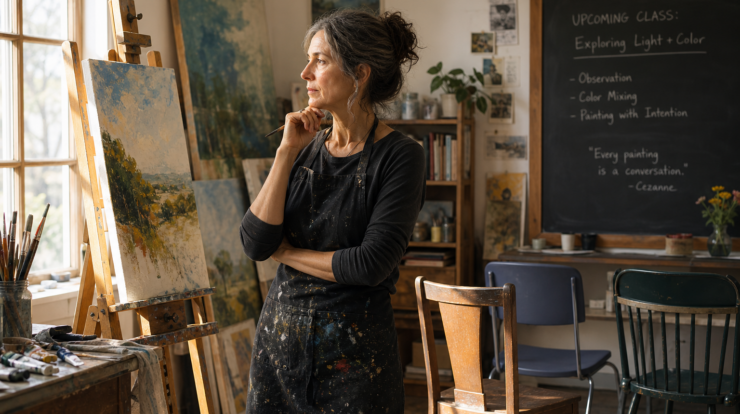
One of the most persistent dilemmas in an artist’s professional journey is whether—and how much—to teach. For many, teaching seems like a natural extension of the creative process, a way to share knowledge and connect with aspiring artists. Others, however, hesitate, worrying that time spent in the classroom is time lost at the easel.
As a gallery owner, I regularly work with artists grappling with this very question. Should you accept that offer from your local art center or launch a private class? Let’s break down the key trade-offs to help you make a clear-eyed decision.
The Benefits of Teaching
- Supplemental Income: Few artists will deny the steady income that teaching can provide—especially in leaner months for sales. Artist-instructors I know have used teaching as a financial cushion that eases pressure to sell.
- Resume and Reputation: Listing yourself as a teacher can strengthen your professional credentials. A teaching role signals to galleries, students, and collectors that you have confidence and command of your craft. Sometimes, students become collectors themselves after experiencing an artist’s teaching firsthand.
- Community Engagement: Teaching can deepen your network. Beyond potential new collectors, you’ll build relationships with other artists and professionals in your community. These connections often lead to future opportunities.
- Discovering New Insights: Many artists are surprised at how teaching pressures them to articulate and reflect on their techniques, often sparking fresh ideas for their own studio practice.
The Trade-Off: Studio Time and Focus
The main cost, of course, is time. Preparing lessons, managing classes, and working with students require energy and focus—often more than expected. For artists building momentum with galleries or aiming for a major solo show, these hours can be especially dear.
It’s common for artists to teach more early in their careers, when income is less predictable and networking feels urgent. As careers progress, and as sales or gallery opportunities require deeper studio commitments, many artists scale back or phase out teaching roles.
Key Questions to Ask Yourself
- Is your primary need right now income, visibility, or maximizing your own body of work?
- Will the commitment to teaching be short-term—a workshop, a semester—or an ongoing obligation?
- Are you energized by engaging with students, or does the thought drain you?
- Can you concretely measure the loss of studio hours, or are teaching and studio work able to coexist in your schedule?
- Does the venue (school, art center, private studio) offer opportunities to connect to new collectors or build your network?
A Framework for Deciding
- Give It a Try: When in doubt, a limited-term teaching commitment allows you to test the waters. A single season or workshop is enough to gauge personal fit and outcomes.
- Evaluate Afterward: After a teaching stint, honestly assess whether the benefits (financial, professional, or personal) were worth the sacrifice in studio time.
- Adjust as Needed: Don’t feel locked in. Careers are long, and it’s common for your balance to shift over time—as your needs, opportunities, and energy change.
Bottom Line
Teaching isn’t an all-or-nothing proposition. Many successful artists cycle in and out of teaching as their priorities and career stage change. Some find community, inspiration, or new patrons; others find it takes too much from time at the easel. The most important step is defining the role you want teaching to play in your own career trajectory.
Takeaway: Consider your current goals carefully and don’t be afraid to experiment. Teaching can provide more than just income—but studio time is always a resource worth protecting.
Question for Readers:
Have you balanced teaching with your studio practice? What did you gain—or give up—in the process? Share your experience in the comments.

Hi there,
I have been teaching for well over 30 years. When I started teaching through our local art center my sales increased significantly. After a short time I then was able to teach through my studio because my email list grew significantly also. I have taught through colleges, my studio, various neighboring town art centers, privately, on zoom, and in-person, etc.
Although I would rather just be in the studio doing my own work by myself, teaching is #1 very profitable for me, #2 therapeutic in a big way (everyone loves what you do and wants to be there) #3 a way to have connections to the art community (not just in my town).
I highly recommend trying it out for a year or so and see how it goes. If you don’t have a big email list, submit a proposal to an art center near you. It doesn’t take long to get the hang of it.
Good Luck!
Oh! I forgot to add how much I learn from my students! And like Wayne Thiebaud said, get some of my best ideas for my own work from students!
Something not mentioned here is the fact that teaching art theory and skills reinforces that for the teacher in their own work. I taught art in high school (9-12) for over 25 years. I found it also necessary to offer private art classes to my students as several couldn’t fit Art into their class schedule. I’m very proud of one of my private students who chose to take private classes for two years, majored with art in college and is now an art teacher in a private school for a few years. I have already predicted she will be having a career in professional art as an artist and possibly a full time art teacher as well. Yes, she is that good!
Much admiration for those who can teach and make it work. The benefits can be immeasurable for the students. Thank God for teachers! I’m sure the benefits are also great for the instructor, but like Jason said, it’s important to carefully consider it since it’s a highly personal decision. I tried it and found that it did not work for me. Few of the students took me or the course seriously and would not pay the very reasonable fee. It quickly became a sporadically attended babysitting service. After all the preparation I had put into it and the poor response received and the perpetual anxiety I experienced through the duration of the course, I realized that teaching doesn’t seem to work for me.
Curiosity drives me and sharing that discovery is, for me, very rewarding. I learn more than my students as a result of having to dig a little deeper and communicate so they understand the concepts. Their, sometimes naive questions make me revisit my own conclusions and look at things with a fresh perspective. I’ve been teaching for many decades, first to supplement my income, then because I found I like to share and pay it forward I’m a much better artist and person. There’s always something new to discover and share!
Jason,
I don’t teach on a regular basis. I do not want to be someone’s “weekly entertainment.” If on the other hand, someone is really interested in learning something – occasionally I have taught. One at a time. 90 minutes is all I think anyone can tolerate or absorb anything. Recently I had a 17 year old reach out and want lessons. I requested that she come with Mom and we will meet and see what we all think. A great young lady with romantic – dreamy aspirations of studying in Florence. While I believe she has a gift, she has no art background. She doesn’t know basic terminology or is able to describe it. So, Working on some foundational stuff. Recommended a couple books for her to begin studying. Loomis – on perspective for one. I hope to get some basics and solid foundation for her to continue on with. We will see if she is back for lesson 2.
Debra