


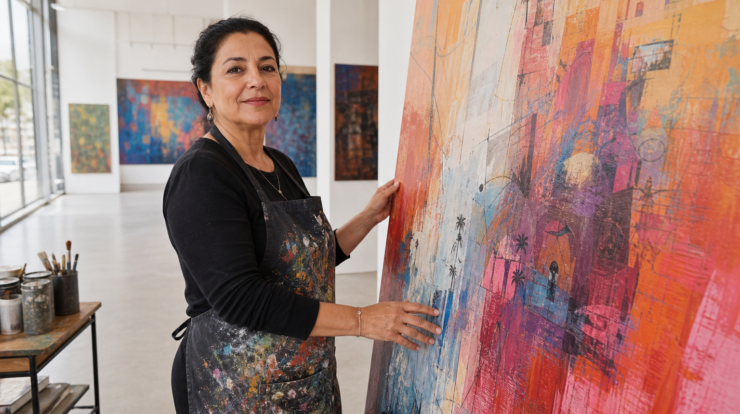
When it comes to making a living as an artist, most advice is centered around volume and price point. But over years of working with artists and managing a gallery, I've seen something interesting: occasionally, creating a monumental piece can have outsized benefits—if you approach it with strategy and clear expectations.
Why Go Big?
There's no ignoring the practical challenges of large artwork: more expensive to produce, harder to store, and the audience is narrower. The higher the price, the more limited the pool of potential buyers. Yet, every year, I witness the remarkable impact that a bold, large-scale painting or sculpture can have—not just on sales, but an artist's career trajectory and reputation.
The Psychological Effect
Big works have presence and command attention. As a focal point in a gallery or an exhibition booth, they set the tone for your creative vision and can elevate the perceived value of your entire body of work. Even if your “flagship” piece takes longer to sell, it can boost sales of your mid-sized works by showing collectors what you’re capable of.
Flagship Pieces and Sales Cycles
While large paintings are slower to move—as much an investment for the buyer as for you—they tend to bring in larger returns per sale. More importantly, their display can create interest and inquiry across your portfolio. I’ve seen collectors drawn in by a monumental work, only to fall in love with and purchase a more accessible painting. Flagship pieces also become talking points: they get photographed, shared, and remembered.
Pricing Large Works
Pricing at scale isn’t as simple as multiplying your per-square-inch rate. While the materials and hours increase, so does the risk and the investment required. You’ll need to consider:
- Will your typical collector base support the higher price?
- Are you pricing competitively in your market (especially compared to other large works at that level)?
-
Is the quality, finish, and impact of your largest works truly a step above your smaller pieces?
Some artists offer a slight discount per square inch as size increases, but don’t be quick to undervalue the time, effort, and creative capital that goes into your biggest works.
Display and Logistics
Showcasing large paintings requires forethought. In a gallery setting, they can drive foot traffic and serve as the anchor of an exhibition, but they also consume wall space. If you don’t have gallery representation, high-quality photography is essential for online marketing—scale shots with people (done tastefully) can help communicate impact. Be ready to assist buyers with shipping logistics and installation advice. Sometimes, offering professional delivery (at a premium) can be the final nudge for a hesitant collector.
When Big Pays Off
I recall an instance where an artist's large figurative work sat for several months before suddenly being snapped up, not just by a single collector, but by a pair of buyers who had long followed the artist’s work. The sale was a major win, both for the income and for the artist’s profile—the buyer sent friends, posted images online, and even returned for additional purchases at lower price points. The flagship painting was a catalyst.
Remember: the sales cycle is longer, but the ripple effect can be significant.
Is It Right For You?
Large-scale work isn’t practical (or desirable) for every artist or market. But I encourage artists to at least consider producing the occasional statement piece. Even one impressive work can reshape how you and others see your potential.
Takeaway: Big pieces bring big risks—but, with focused strategy, can bring bigger rewards. Be thoughtful about scale, price, and display, and use monumental works to anchor your brand and attract both attention and collectors.
Question for Readers: Have you created or sold a large-scale piece? What impact did it have on your sales or reputation? Share your story below.

🇺🇸 From a 5×7” original to a 30×40” commission!
I created a small American flag on a 5×7” canvas, and after it sold, the buyer was inspired to commission a much larger version for his home.
What started as a little flag became a special, one-of-a-kind piece filled with color, texture, splatters, stars, glitter, and meaningful personal details. ❤️
I love how one small painting can lead to something so much bigger!
The largest I’ve sold is 5×4’ and it was a piece that was about Ukraine 🇺🇦 and I donated the entire purchase price of $5000 to World Central Kitchen! Today I match dollar for dollar when responding to global crises.
Part of my 2027 goals are working bigger and growing my marketing strategy. And I am going to be doing IG reels about my response to Global Crises beginning this Monday.
That is outstanding.
Thank you, Anne!!!!
This year the bigger paintings in my studio sold more than more modest ones! Since I am an Open Expressionist using vibrant colors, gold leaf, and bold paintings, people are attracted to a full studio (and I keep it full on purpose). This surprised me, and I am working big.
I love painting large and have painted up to 64×68 inches. Smaller pieces are much more likely to sell, and the largest piece I have sold to date is 48×48 inches. Not going to stop painting large pieces, even if it costs me money.
Great info Jason, agree 100%. I do not work any smaller than 36″x 36″ and sometimes as large as 48″x 72″, as well as every basic size in between. I have no interest in working small, and my work is certainly considered realistic. I have found that my customer base has large wall space to fill and my work hits that spot, as well as my limited edition prints which can be custom sized to the inch to fit clients unique spaces. I have found to be a huge advantage for my print sales. If customers are interested in smaller versions of my work, I have smaller print options for them as well. I try to hit a wide variety of price points for different profile customers and it has proved very successful for me.
I work in watercolor and mixed media (w.c.,, charcoal, white gauche.) I often work on multiple full-sized watercolor papers. My original inspiration to work this way was an exhibit of Japanese screens, conveying a landscape. over multiple panels. I work from small sketches made on sight. Back in my studio I enlarge the drawing to fit over multiple sheets of watercolor paper (usually 30″ tall by 22′ wide.) My largest panoramic watercolor landscape used nine full sheets, creating a landscape painting that was 30″ tall by 198″ wide. The challenge for a collector is how to frame a piece this large. I have been fortunate to be able to refer buyers to a framer near the gallery that carries my work. He is a master framer. Sometimes the frame costs more than the painting, and is custom made to fit the buyer’s home. I do not frame my work because it would not be finacially feasible, but being able to show potential buyers examples of how others have displayed this work has helped with the sale. The gallery that carries my work is an old barn and the gallery owner pins my work to the wooden walls of the barn or sometimes just lays the work out on the barn floor. The old wood of the barn shows off my paintings to advantage.
I use very large brushes to apply the paint in multiple layers and have really enjoyed working large. It takes time to develop each painting, weeks or even months–not the usual way with watercolor. My sketches are more traditional, quick and loose, with very little detail, which encourages me to push for somewhat abstracted panoramic landscapes. They become about how the paint sits on the paper more than the actual scene. And my larger, panoramic landscapes sell faster than my more traditionally sized paintings. The real challenge is finding studio space big enough to accommodate the work while it is in process.
I do what I call Trance Art. Designs with very intricate details and contrasting color combinations. I feel the pieces are best-suited over a large-scale area thus i aspire to ultimately producing murals. So far I’ve put together the biggest stretchers available and my pieces will be around 60” if not larger as I really like throwing a design across several canvases which is pretty fun
I keep dreaming of painting big. Recently I saw a demonstration by a master painter at Oil Painters of America. He created his own painting panels by using archival glue to adhere linen to flat surfaces. After reading your article, I am wondering, if I adhered linen to a big sheet of gator foam board (which I read is archival), gessoed it and painted on that, would a skilled framer be able to frame it?
It is as easy as any panel to frame, probably easier as it is light to work with. Just ensure the glue is archival, no acid etc and will adhere properly to gator foam.
I used to paint a lot of 4’x8’ textured abstracts because I had huge walls at the hospital Where I worked in the outpatient department. I sold a lot of work there and when I retired I really missed having that connection. I also moved to a remote island where, the people living here don’t have huge houses and big walls so I downsized my art. I also don’t have the same vehicle to move big canvases. I miss working large sometimes and I miss having the space to display my art like I did.
“Hi Jason,
I’ve always loved creating large-scale artwork. My largest painting is 63 × 71 inches, and another is 63 × 51 inches. I’m continuing to create large pieces because I love the impact they make and the freedom I feel when working on a bigger canvas.
However, despite having my artwork listed on five different online platforms and making many efforts to attract attention, I haven’t been able to make a sale.
I’m wondering whether the size of my paintings might be limiting my potential buyers, or if there are other things I should be doing differently.
I would really appreciate your professional advice on how I can better market and sell my large-scale artwork.
Thank you for sharing your knowledge and experience with artists!
Maria Karlosak
I’ve been considering doing some larger paintings in acrylic to avoid the cost of framing such a large watercolor piece (my usual medium). This article is just the inspiration I needed!
Thanks!